China, India sustain thawing momentum as senior officials meet; improving ties align with multipolar trend, underpin Asian peace, devt: expert
By Published: Jun 23, 2026 11:17 PM

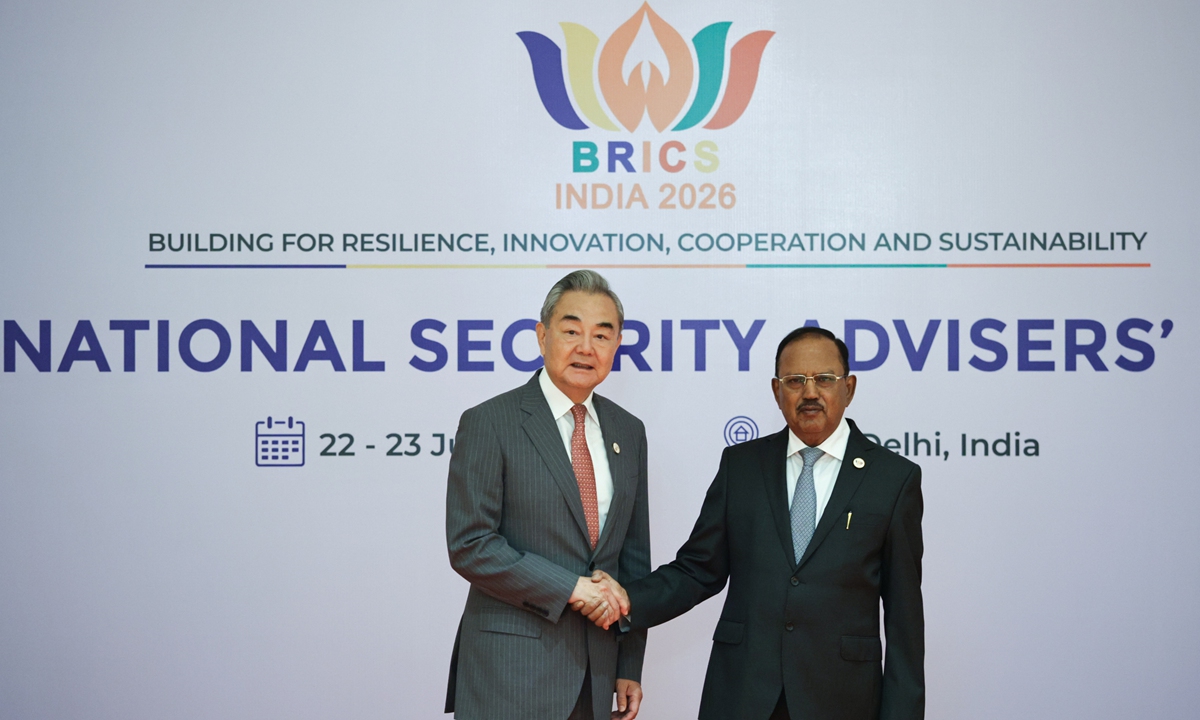
Chinese Foreign Minister Wang Yi shakes hands with Indian National Security Advisor Ajit Doval during a welcome ceremony as part of the 16th Meeting of BRICS National Security Advisors and High Representatives on National Security in New Delhi, India, on June 23, 2026. Photo: VCG
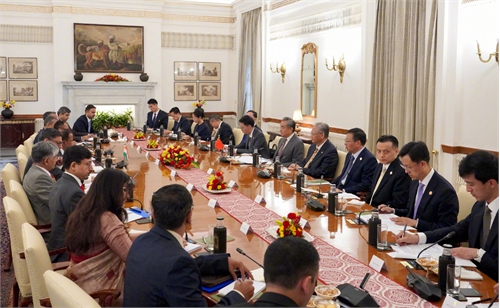
With Chinese Foreign Minister Wang Yi holding talks with India's National Security Advisor Ajit Doval on Monday and exchanging views on bilateral ties plus international and regional issues, the two major Asian powers have conducted a new round of high-level exchanges amid recent warming bilateral relations.
This latest high-level meeting took place on the sidelines of the 16th Meeting of BRICS National Security Advisors and High Representatives on National Security held in New Delhi from Monday to Tuesday, as India holds the 2026 rotating chair of the bloc.
Analysts said the latest high-level meeting will help sustain the thawing momentum in China-India ties, though further progress demands more concrete pragmatic moves. Amid a complex international landscape, Beijing and New Delhi have extensive room for coordination within multilateral mechanisms, and jointly act as a backbone for peace and stability across Asia.
During the meeting with Doval, Wang, also a member of the Political Bureau of the Communist Party of China Central Committee and director of the Office of the Central Commission for Foreign Affairs, said India is an important neighbor of China, and bilateral relations have returned to the track of recovery and improvement, per a release from Xinhua News Agency.
He noted that the leaders of the two countries agreed that China and India are partners instead of rivals, thus forming the most important strategic consensus between the two sides, providing an important impetus and strategic guarantee for the healthy and stable development of China-India relations, Xinhua reported.
Wang also underlined the need to advance the restoration of dialogue mechanisms and promote exchanges in various fields, such as trade, finance, law enforcement and media.
In terms of the border issues, Wang said that the border region has remained generally peaceful, which are hard-won achievements that deserve to be cherished all the more.
Doval, on his part, said India is willing to continue to view its relations with China from a strategic perspective, and work together to implement the consensus reached by the leaders of the two countries, view and accelerate the development process of bilateral relations with a forward-looking attitude, properly handle differences, and work towards a win-win situation, according to Xinhua.
Doval also reiterated that India, as one of the first countries to recognize the People's Republic of China, remains consistent in its position regarding the Taiwan question.
In a post on X, Randhir Jaiswal, the spokesperson of the India's Ministry of External Affairs, called the senior officials' talks as "constructive and forward-looking."
Indian media Wion described the meeting as "part of a pragmatic thaw" between the two sides that started in 2024, with both sides noting progress toward the "gradual normalization" of ties.
"China-India ties have registered steady improvement over the past two years, with overall situation largely under control," said Hu Zhiyong, a professor from Zhejiang International Studies University and also research fellow at the Institute of International Relations at the Shanghai Academy of Social Sciences.
Hu noted that China and India have extensive room for cooperation both in bilateral and multilateral spheres. Their capacity to deepen relations hinges chiefly on how India strategically perceives China.
According to Hu, progress in bilateral ties demands concerted efforts from both sides, with India in particular expected to roll out more tangible, practical moves.
Aside from bilateral issues, officials of China and India, two weighty regional powers and key stalwarts of the Global South, further emphasized the vital role of multilateral cooperation in global affairs at the meeting.
According to Chinese Foreign Ministry, Wang Yi noted that as the two economies with the largest populations, China and India should not only view bilateral relations from a long-term perspective, but also promote cooperation between the two countries from a global perspective.
He noted that currently, the Global South, including China and India, is seeing collective development, adding that China supports India in fulfilling its responsibilities as the rotating chair of the BRICS, and is willing to join hands with India in promoting the development and growth of the BRICS mechanism.
He added that both sides should take concrete actions to promote their respective development and revitalization through cooperation, and accelerate the modernization process of the Global South.
Doval expressed Indian side's willingness to support each other's core concerns with China, jointly safeguard multilateralism, and protect the legitimate rights and interests of developing countries, according to Xinhua.
Lin Minwang, Deputy Director of the Center for South Asian Studies at Fudan University, told the Global Times on Tuesday that advancing global multipolarity and upholding the legitimate rights and interests of developing countries have long been a shared stance of China and India. This common aspiration underpinned the establishment of the BRICS mechanism in the first place.
"Sustained progress in China-India ties serves the core shared interests of the two nations and aligns with the wider global trend of evolving international dynamics and multipolar development," Hu said. "Beijing and New Delhi ought to stand together as a pivotal force sustaining peace and stability throughout Asia."
RELATED ARTICLES