IN-DEPTH / IN-DEPTH
Practitioners’ Insights: Protecting Nyang River in Xizang, a practice in building a Beautiful China on snowy plateau
By and Yang Ruijia in Nyingchi Published: Jun 24, 2026 12:12 AM

Editor's Note:
The year 2026 marks the start of the 15th Five-Year Plan period (2026-30). The outline of the 15th Five-Year Plan dedicates a chapter to "accelerating the green transition across the board and building a Beautiful China."
From the guiding philosophy that "lucid waters and lush mountains are invaluable assets," to the strategic guidance of China's "dual carbon" goals, and further to the systematic arrangements for comprehensive green transition, China has, under the guidance of Xi Jinping Thought on Ecological Civilization, accelerated its green and low-carbon transition and continued to improve the quality of its ecological environment.
The book series Xi Jinping: The Governance of China includes a number of President Xi's important ideas on ecological conservation. These ideas profoundly reflect the inheritance, enrichment and development of the theoretical framework for ecological civilization construction, as well as the continuity, elevation and focus of its goals and tasks.
Volume V of the book series includes "The Beautiful China Initiative" as a dedicated topic, systematically expounding the thinking and arrangements for building a Beautiful China.
In the 25th installment of the special series "Decoding the Book Xi Jinping: The Governance of China," the Global Times, along with the People's Daily Overseas Edition, continues to invite Chinese and foreign scholars, translators of Xi's works, practitioners with firsthand experience, and international readers to focus on the theme of "accelerating the green transition across the board and building a Beautiful China." Together, they explore the vivid practices through which China, under the guidance of Xi Jinping Thought on Ecological Civilization, applies the concept of green development throughout the process of economic and social development, and discuss its major practical significance and contemporary value.
This is the 23rd installment of "Practitioners' Insights." We visited the banks of the Nyang River in Nyingchi, Southwest China's Xizang Autonomous Region, to interview grassroots wetland rangers and officials from the local departments of ecology and environment, forestry, and grassland. The Nyang River is an important ecological corridor in Nyingchi, and also a window for observing the construction of ecological civilization in Xizang. The protection practices carried out along this river record local grassroots explorations in safeguarding the plateau's pure land and maintaining the national ecological security barrier.
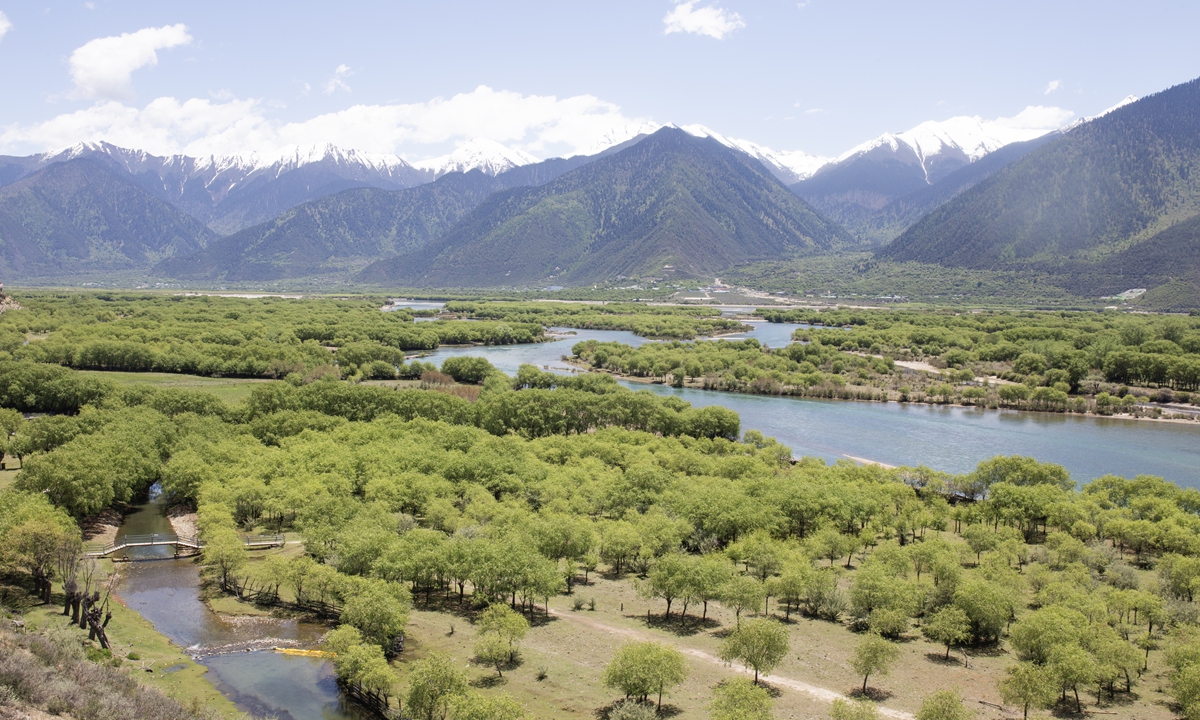
In May, the sunlight in Nyingchi is bright and strong. Looking out from the viewing platform of the Yani national wetland park, the valley ahead is open and flat, with the Nyang River winding through vast stretches of willow forest into the distance. Mountains rise layer upon layer in the distance, their peaks still capped with snow. The blue sky, snowy mountains, river, woodland and villages all appear within the same field of vision, forming a distinctive plateau ecological landscape along the Nyang River.
This quiet, open valley is a scenic landscape for tourists, but it is also part of everyday life for people living along the river. In recent years, as wetland protection, river management and public participation have continued to advance, the water has become clearer, the trees denser, and the birds more numerous.
In July 2021, Chinese President Xi Jinping arrived at the Nyingchi Mainling Airport and went to the Nyang River Bridge, where he learned about the ecological preservation of the Yarlung Zangbo River and its tributary Nyang, as well as the construction of nature reserves. He underscored the importance of protecting and restoring the ecology of major river basins, according to the Xinhua News Agency.
"The eco-environment has no substitutes. We tend to be neglectful of this when we exploit it, yet it is irretrievable once lost. Our eco-environment is crucial for the quality of economic development, and exerts a profound impact on the wellbeing of all individuals. The preservation of China's blue skies, lush mountains, and lucid waters can only be ensured through collective action, the fulfillment of individual responsibilities, and a society-wide dedication to environmental stewardship." This important statement appears in the article "Balance Major Relationships Concerning Eco-Civilization," included in the fifth volume of Xi Jinping: The Governance of China.
His earnest instructions are being transformed into concrete practices on both banks of the Nyang River.
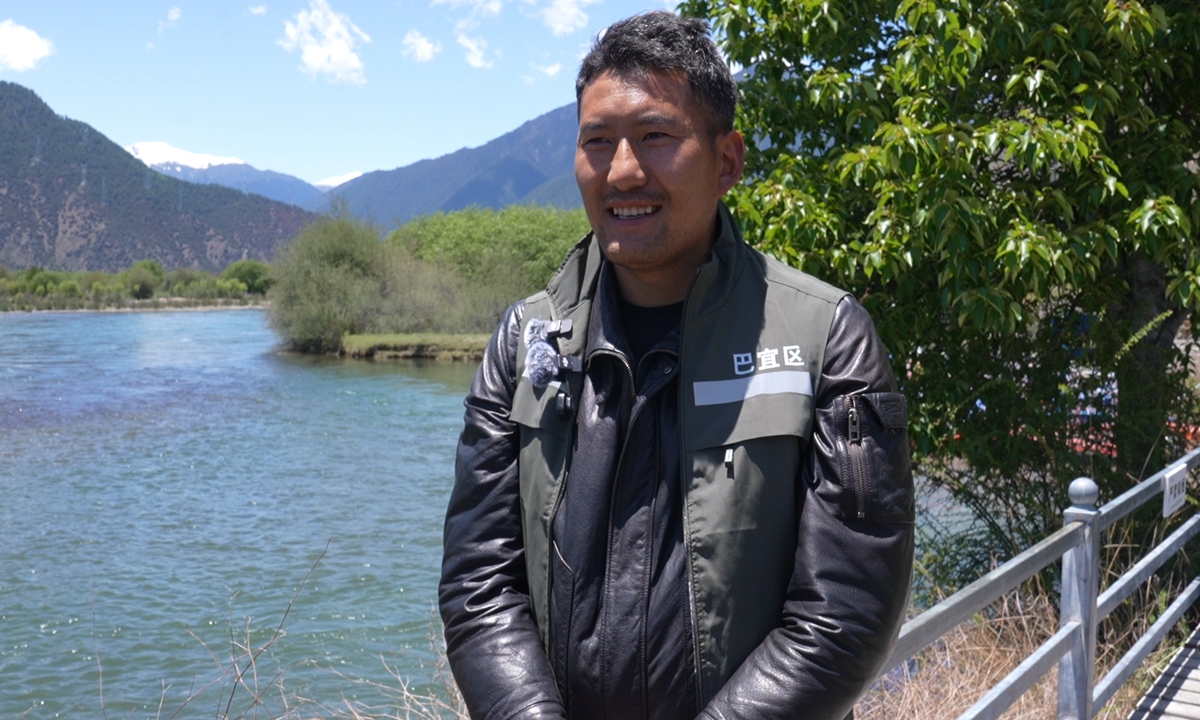
Pajia, a 31-year-old wetland ranger from Zhongsaba village in Bayi district, Nyingchi, is both a witness to the ecological changes in his hometown and a participant in the daily protection of the Nyang River wetland. Recently, Pajia and several other grassroots practitioners involved in the ecological protection of the Nyang River shared their stories of protecting clear waters and wetlands on the snowy plateau with the Global Times.
A pair of eyes by the river
By early morning, sunlight has already lit up large stretches of willow forest along the Nyang River. Pajia sets out from his village and slowly walks along the wetland. Snowy mountains stand in the distance, while river water and woodland lie before him. Under his feet is a path that villagers pass by every day. For him, this river flowing past his home is both a familiar landscape and a place that needs daily protection.
The Nyang River, a tributary of the Yarlung Zangbo River, means "tears of a goddess" in the Tibetan language. Stretching 307.5 kilometers, it is known as the mother river of the Kongpo area of Xizang. In 2016, the Yani national wetland park, located at the confluence of the Yarlung Zangbo River and the Nyang River, was officially established. Local authorities selected 45 residents from villages around the wetland to serve as wetland rangers, allowing people who live by the river to participate in its daily protection.
Five years ago, Zhongsaba village voted to select two wetland rangers, one being Pajia. Since then, the wetland beside the Nyang River has had an extra pair of local eyes watching over it.
The work may not seem complicated, but it is specific and requires long-term commitment.
During their daily patrols, Pajia and his colleague walk around the wetland to check whether there is illegal grazing or damage to wetland fences. If a fence is damaged, they repair it straight away. If there is garbage along the riverbank, they clean it up. When tourists or villagers fail to pay attention to environmental protection, they step forward to offer a reminder. They also keep a lookout for any injured animals in the wetland, and report any such cases immediately.
In addition to patrol work, Pajia also farms, herds cattle and drives a truck for freight transport. He walks along the riverbank in the morning and returns to his fields and cattle during the day. His life is closely connected with this wetland.
Pajia remembers that there used to be more garbage in the river channel and around the corners of the village. Later, under the organization of forestry and grassland authorities, local residents carried out river garbage cleanups, and the village gradually established a garbage collection and transfer mechanism. Today, there is much less garbage in the river channel, and villagers have gradually developed the habit of putting garbage into the trash cans.
As the wetland environment has improved, more tourists have come for sightseeing. Some villagers have opened guesthouses and restaurants, while others have increased their incomes through providing transport, farming and animal husbandry. In 2025, Yani national wetland park received a total of 150,000 tourist visits, generating more than 10 million yuan ($1.48 million) in additional income.
During patrols, Pajia also explains the importance of wetland protection to tourists and villagers. He said many tourists come here to see the wetland, the river and the plateau scenery, therefore, it is vital that everyone understands the importance of not littering or damaging the wetland environment.
In Pajia's view, protecting the wetland is also connected with the natural values passed down among local people from generation to generation. His words are simple: "I do this work not only for myself, but for future generations."
Coordinated protection
The daily patrols carried out by Pajia and his colleague represent the part of Nyang River protection work that is closest to the riverbank. Viewed within the broader protection practices of the whole watershed, local authorities have followed the concept of integrated protection and systematic governance of mountains, rivers, forests, farmland, lakes, grasslands, deserts and glaciers, gradually forming a protection pattern involving multiple participants and coordinated efforts.
According to the Ministry of Ecology and Environment, the overall ecological environment of the Nyang River Basin is relatively good, but the basin has also faced problems such as uneven distribution of water resources across time and space, a fragile and sensitive ecosystem, and relatively prominent non-point source pollution in rural areas. Ecological issues including the shrinkage of floodplain forests and grasslands, declining water conservation capacity, grassland degradation and soil erosion have also been observed in the basin.
Kelsang Tashi, director of the Nyingchi ecology and environment bureau's Bayi district branch, told the Global Times that in recent years, Nyingchi has further clarified the responsibilities of different departments in wetland and watershed protection through an environmental protection responsibility list.
Kelsang Tashi said that since 2021, local authorities have further strengthened ecological governance. In the past, there were some small sand mining sites along the Nyang River. These were gradually rectified to restore the areas around the river to their original natural ecology as much as possible.
In his view, governing a river requires not only projects, but also public understanding and participation. Kelsang Tashi and his colleagues have translated concepts related to ecological civilization to help local residents better understand why ecological protection matters. He said local people now have a clear understanding that "the purpose of prioritizing ecology is to benefit the people."
Judging from the governance case released by the Ministry of Ecology and Environment, Nyang River governance is a "package of coordinated measures," jointly advanced through water resource protection, water environment treatment, aquatic ecological restoration and daily maintenance. Local authorities have completed the Nyang River comprehensive governance and protection project, with 45.29 kilometers of river channels comprehensively treated. From 2018 to 2023, a total of 912,000 fish fry were released.
Another important part of wetland protection is scientific monitoring. Drolma Tsering, a staff member of the Nyingchi forestry and grassland bureau, told the Global Times that in 2021, local authorities signed an agreement with Xizang University to jointly build the Xizang Yani wetland ecosystem positioning observation and research station, monitoring the ecological environment in terms of water quality, soil, climate and birds.
Kelsang Tashi said protecting the ecological environment here is an important part of maintaining the ecological security barrier of the Qinghai-Xizang Plateau. "In the final analysis, prioritizing ecology is about benefiting the people and better protecting this pure land," he said.
Green practices on snowy plateau
At multiple ecological protection sites in Xizang, the Global Times found that more and more people across the Qinghai-Xizang Plateau are taking part in efforts to protect and restore the ecology of major river basins.
In Lhasa, the greening project for the northern and southern mountains is changing the appearance of the mountains surrounding the city. Lozang Yonten, head of the No. 32 section of the greening project, told the Global Times that the area he is responsible for covers about 120 hectares of planted land, with main tree species including Chinese pine, Qilian spruce and sea buckthorn, all native species suited to cold, high-altitude conditions.
Planting trees on slopes at an altitude of 3,700 to 4,400 meters is not easy. As the mountain roads are steep, the project once tried to transport saplings by mule. Later, drones were used to carry saplings to designated points, where workers then planted them. This method proved to be more efficient.
"At present, the survival rate of the saplings can be guaranteed at above 95 percent," Lozang Yonten said.
In Medog, a remote border county that is difficult to access, ecological protection is also being carried out in great detail. Located deep in the Yarlung Zangbo River Grand Canyon, Medog has huge elevation differences and rich biodiversity.
In recent years, researchers have entered the dense forests to collect samples, preserve seeds and monitor wildlife activity. They also use infrared cameras, drones and remote sensing technologies to record ecological changes. Since 2021, more than 50 new species have been discovered there. This area is being understood and protected in a more scientific way.
According to Xinhua, since the 18th National Congress of the Communist Party of China, Xizang has upheld ecological protection as a priority, built 22 ecological functional protection zones and provided 700,000 ecological jobs for local residents. Xizang has also established a protected natural area system with national parks as the mainstay, bringing more than 600,000 square kilometers of land under ecological protection red lines.
Walking along the wetland and looking at every familiar plant and tree, with the Nyang River behind him, flowing through the open and quiet valley, winding toward the distance, Pajia feels a deep sense of satisfaction and pride.
The year 2026 marks the start of the 15th Five-Year Plan period (2026-30). The outline of the 15th Five-Year Plan dedicates a chapter to "accelerating the green transition across the board and building a Beautiful China."
From the guiding philosophy that "lucid waters and lush mountains are invaluable assets," to the strategic guidance of China's "dual carbon" goals, and further to the systematic arrangements for comprehensive green transition, China has, under the guidance of Xi Jinping Thought on Ecological Civilization, accelerated its green and low-carbon transition and continued to improve the quality of its ecological environment.
The book series Xi Jinping: The Governance of China includes a number of President Xi's important ideas on ecological conservation. These ideas profoundly reflect the inheritance, enrichment and development of the theoretical framework for ecological civilization construction, as well as the continuity, elevation and focus of its goals and tasks.
Volume V of the book series includes "The Beautiful China Initiative" as a dedicated topic, systematically expounding the thinking and arrangements for building a Beautiful China.
In the 25th installment of the special series "Decoding the Book Xi Jinping: The Governance of China," the Global Times, along with the People's Daily Overseas Edition, continues to invite Chinese and foreign scholars, translators of Xi's works, practitioners with firsthand experience, and international readers to focus on the theme of "accelerating the green transition across the board and building a Beautiful China." Together, they explore the vivid practices through which China, under the guidance of Xi Jinping Thought on Ecological Civilization, applies the concept of green development throughout the process of economic and social development, and discuss its major practical significance and contemporary value.
This is the 23rd installment of "Practitioners' Insights." We visited the banks of the Nyang River in Nyingchi, Southwest China's Xizang Autonomous Region, to interview grassroots wetland rangers and officials from the local departments of ecology and environment, forestry, and grassland. The Nyang River is an important ecological corridor in Nyingchi, and also a window for observing the construction of ecological civilization in Xizang. The protection practices carried out along this river record local grassroots explorations in safeguarding the plateau's pure land and maintaining the national ecological security barrier.
The view of Nyang River in Nyingchi, Southwest China's Xizang Autonomous Region Photo: Shan Jie/GT
In May, the sunlight in Nyingchi is bright and strong. Looking out from the viewing platform of the Yani national wetland park, the valley ahead is open and flat, with the Nyang River winding through vast stretches of willow forest into the distance. Mountains rise layer upon layer in the distance, their peaks still capped with snow. The blue sky, snowy mountains, river, woodland and villages all appear within the same field of vision, forming a distinctive plateau ecological landscape along the Nyang River.
This quiet, open valley is a scenic landscape for tourists, but it is also part of everyday life for people living along the river. In recent years, as wetland protection, river management and public participation have continued to advance, the water has become clearer, the trees denser, and the birds more numerous.
In July 2021, Chinese President Xi Jinping arrived at the Nyingchi Mainling Airport and went to the Nyang River Bridge, where he learned about the ecological preservation of the Yarlung Zangbo River and its tributary Nyang, as well as the construction of nature reserves. He underscored the importance of protecting and restoring the ecology of major river basins, according to the Xinhua News Agency.
"The eco-environment has no substitutes. We tend to be neglectful of this when we exploit it, yet it is irretrievable once lost. Our eco-environment is crucial for the quality of economic development, and exerts a profound impact on the wellbeing of all individuals. The preservation of China's blue skies, lush mountains, and lucid waters can only be ensured through collective action, the fulfillment of individual responsibilities, and a society-wide dedication to environmental stewardship." This important statement appears in the article "Balance Major Relationships Concerning Eco-Civilization," included in the fifth volume of Xi Jinping: The Governance of China.
His earnest instructions are being transformed into concrete practices on both banks of the Nyang River.
Pajia, a 31-year-old wetland ranger from Zhongsaba village in Bayi district, Nyingchi, is both a witness to the ecological changes in his hometown and a participant in the daily protection of the Nyang River wetland. Recently, Pajia and several other grassroots practitioners involved in the ecological protection of the Nyang River shared their stories of protecting clear waters and wetlands on the snowy plateau with the Global Times.
A pair of eyes by the river
By early morning, sunlight has already lit up large stretches of willow forest along the Nyang River. Pajia sets out from his village and slowly walks along the wetland. Snowy mountains stand in the distance, while river water and woodland lie before him. Under his feet is a path that villagers pass by every day. For him, this river flowing past his home is both a familiar landscape and a place that needs daily protection.
The Nyang River, a tributary of the Yarlung Zangbo River, means "tears of a goddess" in the Tibetan language. Stretching 307.5 kilometers, it is known as the mother river of the Kongpo area of Xizang. In 2016, the Yani national wetland park, located at the confluence of the Yarlung Zangbo River and the Nyang River, was officially established. Local authorities selected 45 residents from villages around the wetland to serve as wetland rangers, allowing people who live by the river to participate in its daily protection.
Five years ago, Zhongsaba village voted to select two wetland rangers, one being Pajia. Since then, the wetland beside the Nyang River has had an extra pair of local eyes watching over it.
The work may not seem complicated, but it is specific and requires long-term commitment.
During their daily patrols, Pajia and his colleague walk around the wetland to check whether there is illegal grazing or damage to wetland fences. If a fence is damaged, they repair it straight away. If there is garbage along the riverbank, they clean it up. When tourists or villagers fail to pay attention to environmental protection, they step forward to offer a reminder. They also keep a lookout for any injured animals in the wetland, and report any such cases immediately.
In addition to patrol work, Pajia also farms, herds cattle and drives a truck for freight transport. He walks along the riverbank in the morning and returns to his fields and cattle during the day. His life is closely connected with this wetland.
Pajia remembers that there used to be more garbage in the river channel and around the corners of the village. Later, under the organization of forestry and grassland authorities, local residents carried out river garbage cleanups, and the village gradually established a garbage collection and transfer mechanism. Today, there is much less garbage in the river channel, and villagers have gradually developed the habit of putting garbage into the trash cans.
Pajia, a wetland ranger in Nyingchi Photo: Yang Ruijia/GT
Now, when Pajia patrols the wetland again, he sees clearer river water, cleaner banks and more water birds stopping in the wetland. Black-necked cranes, ruddy shelducks and bar-headed geese are no longer rare sights for local residents.As the wetland environment has improved, more tourists have come for sightseeing. Some villagers have opened guesthouses and restaurants, while others have increased their incomes through providing transport, farming and animal husbandry. In 2025, Yani national wetland park received a total of 150,000 tourist visits, generating more than 10 million yuan ($1.48 million) in additional income.
During patrols, Pajia also explains the importance of wetland protection to tourists and villagers. He said many tourists come here to see the wetland, the river and the plateau scenery, therefore, it is vital that everyone understands the importance of not littering or damaging the wetland environment.
In Pajia's view, protecting the wetland is also connected with the natural values passed down among local people from generation to generation. His words are simple: "I do this work not only for myself, but for future generations."
Coordinated protection
The daily patrols carried out by Pajia and his colleague represent the part of Nyang River protection work that is closest to the riverbank. Viewed within the broader protection practices of the whole watershed, local authorities have followed the concept of integrated protection and systematic governance of mountains, rivers, forests, farmland, lakes, grasslands, deserts and glaciers, gradually forming a protection pattern involving multiple participants and coordinated efforts.
According to the Ministry of Ecology and Environment, the overall ecological environment of the Nyang River Basin is relatively good, but the basin has also faced problems such as uneven distribution of water resources across time and space, a fragile and sensitive ecosystem, and relatively prominent non-point source pollution in rural areas. Ecological issues including the shrinkage of floodplain forests and grasslands, declining water conservation capacity, grassland degradation and soil erosion have also been observed in the basin.
Kelsang Tashi, director of the Nyingchi ecology and environment bureau's Bayi district branch, told the Global Times that in recent years, Nyingchi has further clarified the responsibilities of different departments in wetland and watershed protection through an environmental protection responsibility list.
Kelsang Tashi said that since 2021, local authorities have further strengthened ecological governance. In the past, there were some small sand mining sites along the Nyang River. These were gradually rectified to restore the areas around the river to their original natural ecology as much as possible.
In his view, governing a river requires not only projects, but also public understanding and participation. Kelsang Tashi and his colleagues have translated concepts related to ecological civilization to help local residents better understand why ecological protection matters. He said local people now have a clear understanding that "the purpose of prioritizing ecology is to benefit the people."
Judging from the governance case released by the Ministry of Ecology and Environment, Nyang River governance is a "package of coordinated measures," jointly advanced through water resource protection, water environment treatment, aquatic ecological restoration and daily maintenance. Local authorities have completed the Nyang River comprehensive governance and protection project, with 45.29 kilometers of river channels comprehensively treated. From 2018 to 2023, a total of 912,000 fish fry were released.
Another important part of wetland protection is scientific monitoring. Drolma Tsering, a staff member of the Nyingchi forestry and grassland bureau, told the Global Times that in 2021, local authorities signed an agreement with Xizang University to jointly build the Xizang Yani wetland ecosystem positioning observation and research station, monitoring the ecological environment in terms of water quality, soil, climate and birds.
Kelsang Tashi said protecting the ecological environment here is an important part of maintaining the ecological security barrier of the Qinghai-Xizang Plateau. "In the final analysis, prioritizing ecology is about benefiting the people and better protecting this pure land," he said.
Green practices on snowy plateau
At multiple ecological protection sites in Xizang, the Global Times found that more and more people across the Qinghai-Xizang Plateau are taking part in efforts to protect and restore the ecology of major river basins.
In Lhasa, the greening project for the northern and southern mountains is changing the appearance of the mountains surrounding the city. Lozang Yonten, head of the No. 32 section of the greening project, told the Global Times that the area he is responsible for covers about 120 hectares of planted land, with main tree species including Chinese pine, Qilian spruce and sea buckthorn, all native species suited to cold, high-altitude conditions.
Planting trees on slopes at an altitude of 3,700 to 4,400 meters is not easy. As the mountain roads are steep, the project once tried to transport saplings by mule. Later, drones were used to carry saplings to designated points, where workers then planted them. This method proved to be more efficient.
"At present, the survival rate of the saplings can be guaranteed at above 95 percent," Lozang Yonten said.
In Medog, a remote border county that is difficult to access, ecological protection is also being carried out in great detail. Located deep in the Yarlung Zangbo River Grand Canyon, Medog has huge elevation differences and rich biodiversity.
In recent years, researchers have entered the dense forests to collect samples, preserve seeds and monitor wildlife activity. They also use infrared cameras, drones and remote sensing technologies to record ecological changes. Since 2021, more than 50 new species have been discovered there. This area is being understood and protected in a more scientific way.
According to Xinhua, since the 18th National Congress of the Communist Party of China, Xizang has upheld ecological protection as a priority, built 22 ecological functional protection zones and provided 700,000 ecological jobs for local residents. Xizang has also established a protected natural area system with national parks as the mainstay, bringing more than 600,000 square kilometers of land under ecological protection red lines.
Walking along the wetland and looking at every familiar plant and tree, with the Nyang River behind him, flowing through the open and quiet valley, winding toward the distance, Pajia feels a deep sense of satisfaction and pride.
RELATED ARTICLES