China stages two flagship international events, underscoring openness and cooperation
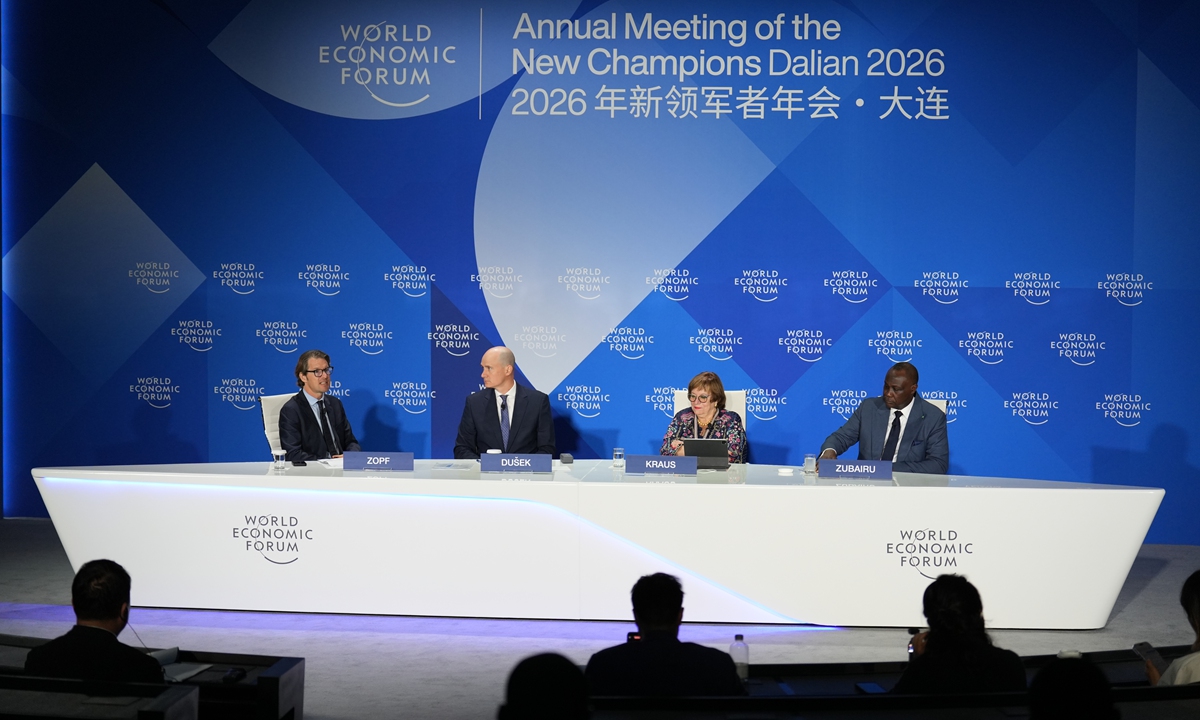
Particpants attend the World Economic Forum's Annual Meeting of New Champions, also known as the Summer Davos, in Dalian, Northeast China's Liaoning Province on June 23, 2026. Photo: VCG
The Dalian International Conference Center was alive with activity on Tuesday as the World Economic Forum's Annual Meeting of the New Champions, better known as Summer Davos, opened in Northeast China's Liaoning Province.This year's gathering has drawn a noticeably larger international presence, with foreign participants up nearly 30 percent from last year. Attendance by China's "little giant" firms — specialized and sophisticated small and medium-sized enterprises — and unicorn companies has also risen by 40 percent. Over three days, more than 100 sessions will explore topics spanning technology, the economy, energy, culture and other fields.
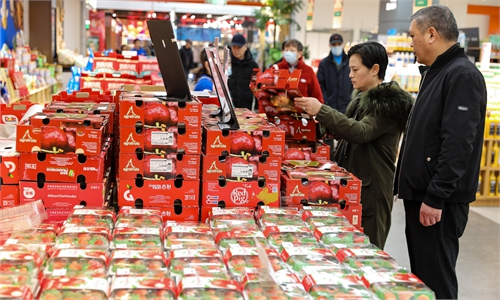
Meanwhile, in Beijing, the China International Supply Chain Expo (CISCE) is in full swing, bringing together 676 companies and institutions, including leading supply-chain players, from 85 countries, regions and international organizations.
Together, the two events underscore China's continued push for high-standard opening-up and its willingness to share development opportunities with the world.
At a time of rising protectionism and unilateralism, experts said China's forums and expos offer open and practical platforms for global businesses. They said the approach stands in contrast to countries that are raising barriers and fueling confrontation, while showing that win-win cooperation remains the prevailing trend in the global economy.
Openness, transformation
Outside the main Summer Davos venue, new energy vehicles, hydrogen buses and autonomous driving shuttles are neatly lined up. Inside, a cool atmosphere prevails, powered by a stable 100 percent green electricity supply, expected to cut carbon dioxide emissions by about 800 tons, the Xinhua Daily Telegraph reported.
Green is an important theme of this year's Summer Davos, though not the only one. It is being held in Dalian from Tuesday to Thursday, under the theme "Innovating at Scale."
The agenda of this year's forum shows strong anticipation around topics such as artificial intelligence (AI), robotics and green transition. More than 30 AI-related sessions make it the clear centerpiece, expanding beyond pure technical discussion into applications, according to media reports.
This year, world leaders, including Prime Minister of Bangladesh Tarique Rahman, Prime Minister of Guinea Amadou Oury Bah, Prime Minister of Kazakhstan Olzhas Bektenov and Prime Minister of the Republic of Korea Kim Min-seok will attend the forum. More than 1,700 representatives from the political, business, academic and media communities from over 90 countries and regions will take part in the event.
Al Mamun Mridha, former secretary general of the Bangladesh China Chamber of Commerce and Industry, said he is closely following the key topics at this year's Summer Davos, particularly AI, advanced manufacturing, robotics and green energy technologies.
"China has made remarkable progress in these sectors over the past decade. What attracts my attention is not only the technological advancement itself but also how quickly China has been able to commercialize innovation and apply it across industries," Mridha told the Global Times on Tuesday.
For Bangladesh, AI and intelligent manufacturing can help improve productivity, especially in sectors such as garments, logistics, agriculture and financial services, Mridha said, noting that he is also closely following how China is integrating AI into business operations and public services. "There is much that developing countries can learn from this experience," the Bangladeshi business representative said.
"Events such as Summer Davos provide an important platform for policymakers, business leaders, and innovators to exchange ideas and identify new opportunities for international cooperation in these emerging sectors," Mridha said.
DSM-Firmenich has participated in the Summer Davos Forum for three consecutive years. Zhou Tao, DSM-Firmenich China Country President, told the Global Times on Tuesday that this year's forum, themed "Innovating at Scale," explores how frontier technologies can be transformed into tangible drivers of economic growth and social progress, a vision that aligns closely with the company's commitment to integrating global scientific expertise with local insights in China, bringing science-driven solutions to hundreds of millions of consumers.
"For the Swiss company operating in the nutrition, health and beauty sectors, China has always been one of the most strategic markets, and its growth certainty provides a more predictable environment and long-term strategic confidence for us," Zhou said. "We also clearly see the Chinese government's continued efforts to optimize the consumer market and foster deeper integration between technological and industrial innovation... these measures further strengthen their confidence as a multinational company committed to long-term development in China."
Clifford Kang, director, board of directors & vice president of Chinese automaker the SERES Group, is also participating at this year's Summer Davos. Talking about his biggest takeaway, Kang told the Global Times that AI is driving a new wave of intelligent transformation, noting "this year's forum, which focuses on 'Innovating at Scale' in the AI era, is highly relevant to the global auto industry's evolution."
Connecting the world
If Summer Davos is a window into China's openness and transformation, the supply chain expo is a platform for seeking practical cooperation and sharing China's development opportunities.
At the expo, being held in Beijing from Monday to Friday, a Global Times reporter noticed the expo's theme displayed in 12 languages: "Connecting the World for a Shared Future." The event itself is a vivid embodiment of that message.
The number of exhibitors at the fourth CISCE has increased from 515 at the inaugural edition to 676 this year. Foreign exhibitors account for 36.5 percent, while Fortune Global 500 companies and industry-leading firms make up more than 65 percent of participants, CCTV Finance Channel reported.
Australia participates as the Guest Country of Honor at the 4th CISCE, marking its first official national-level participation in the event, the Global Times learned from a media release shared by the Australian Trade and Investment Commission.
During the CISCE, there were opportunities for Australian and Chinese companies to engage in cooperation in areas such as solar, wind and energy storage through matchmaking sessions.
Dominic Trindade, general manager at the Australian Trade and Investment Commission (Austrade), said: "In an increasingly complex global environment, resilient and efficient supply chains are critical to economic growth."
"China remains Australia's largest trading partner, and the two economies are highly complementary. CISCE provides a valuable platform for businesses to connect, explore opportunities and develop partnerships," Trindade said.
Vaughn Barber, chair of AustCham China, told the Global Times on Tuesday that this year's expo is a significant moment for Australia, as it marks Australia's first national-level participation. "It's also the first time as Guest Country of Honor - in China's APEC host year - anchored by a national pavilion that leads with clean and smart energy, alongside agriculture, health and services," he said.
For Australian businesses, taking part at this level says something straightforward - that this is a relationship our members want to build on, not simply manage, Barber said.
"Over the past 20 years, we have established a strong network of Chinese suppliers that provide goods to our company and our customers. China is a vast market, offering suppliers ranging from low to top quality, and our role is to help our customers identify and work with the right partners," Fabrizio Galluzzi, CEO of TB Engineering, an Italian consulting and trading company and a first-time participant, told the Global Times on Tuesday at the CISCE.
Speaking of the CISCE, Galluzzi said that the expectation is to find suitable suppliers or customers to expand business, adding that he has already had some promising initial contacts with companies on the second day.
Xu Feng, CEO of Rio Tinto China, said that the CISCE has continuously enhanced its internationalization and professionalism, becoming an important platform for promoting global industrial and supply chain cooperation over the past four years, according to a corporate statement sent to the Global Times.
"This year marks the third consecutive year that Rio Tinto and Baowu Steel Group Co are jointly exhibiting, demonstrating the deepening of our partnership. Amid the profound adjustments in the global industrial landscape, China's firm commitment to openness and cooperation is particularly significant," Xu said.
Nebiyu Mohamed Bogale, a minister in the Embassy of Ethiopia in Beijing, told the Global Times on Tuesday that this is his third time participating in the CISCE, and that he appreciates the event as a platform to seize the opportunity to explore the Chinese market.
Bogale noted that in the dynamic world, the global fair-trade model advocated by China has provided important support to developing countries. The zero-tariff import policy offers African countries policy convenience and a green channel to enter the Chinese market. By utilizing this mechanism, Ethiopia will further expand its access to the huge consumption market, he added.
This is the fourth time that Loh Wee Keng, chairman of the Malaysian Chamber of Commerce and Industry in China, has attended the supply chain expo. Compared with previous editions, Loh said that he noticed "there are more foreign companies participating this year, and AI is being applied more extensively, with exhibits covering everything from industrial uses to household appliances and everyday life."
Loh said that more than 60 Malaysian companies have come to take part in forums and business matchmaking events, and "they have spoken highly of the expo and have also gained many business opportunities."
From Summer Davos to the CISCE, China has kept up a strong development momentum, injecting greater stability and predictability into the global economy.
Looking back to 2007, when the World Economic Forum came to China for the first time after expanding beyond Switzerland, China's GDP stood at about 25.7 trillion yuan, ranked fourth in the world and accounting for roughly 6 percent of the global economy. By 2025, China's GDP had surpassed 140 trillion yuan, ranking second globally and making up about 17 percent of the world total, firmly establishing the country as a major engine of global growth, CCTV Finance Channel reported.
Against the backdrop of rising protectionism and unilateralism, China has hosted a series of major international forums and expos to offer foreign companies open and practical platforms for cooperation. This stands in sharp contrast to the barriers and confrontation promoted by some countries and once again underscores that win-win cooperation, rather than zero-sum games, will define future global economic development, Hu Qimu, a professor at the Maritime Silk Road Institute of Huaqiao University, told the Global Times.
RELATED ARTICLES