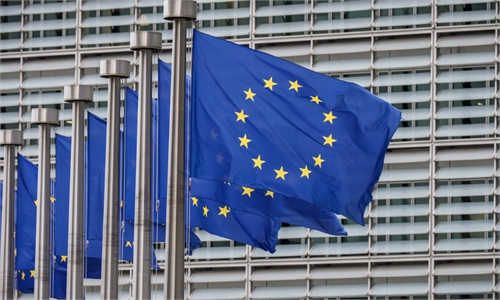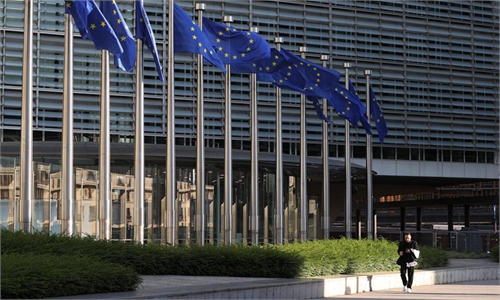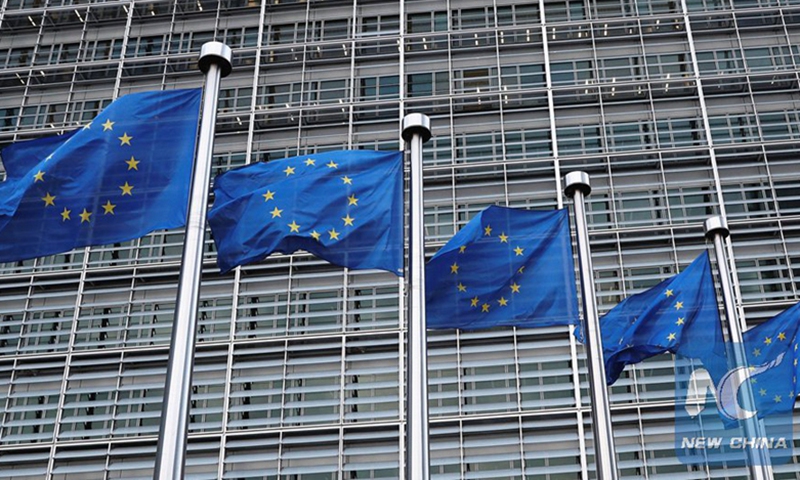
The European Union flags in front of EU headquarters in Brussels, Belgium. Photo: Xinhua
The EU has joined the US-led "Pax Silica" initiative, according to under-secretary of state for economic affairs and the initiative's architect Jacob Helberg in a Financial Times report on Wednesday. A Chinese expert warned that if Europe further deepens its dependence on the US technology system and adopts an exclusionary stance toward China in AI and semiconductors, it would further erode its industrial chain autonomy and strategic independence.
Several European countries, including the Netherlands, Germany and Greece, have announced their participation at the opening of the "Pax Silica" summit held in Washington, the US. Helberg said Argentina, Chile, Costa Rica, Kazakhstan and Panama would also join this week, bringing the total number of member countries to 24, according to the report.
Pax Silica, an American-led effort to bolster AI-related tech supply chains as the West and its allies face rising competition from China. According to a report by the Euronews, the UK, Japan, South Korea, India and Australia, as well as Finland and Sweden, have already joined the initiative.
Under the framework of the initiative, Europe may face US extraterritorial constraints in key areas such as chips and AI equipment, and could be forced to purchase more US-related products and technologies, thereby undermining its own industrial competitiveness and long-term development capacity, Ding Chun, director of the Center for European Studies at Fudan University, told the Global Times on Thursday.
At the same time, the initiative has also faced criticism within the EU. France is among the most vocal sceptics, describing it as nothing short of an attempt to "colonize Europe," and arguing that it runs counter to the EU's "tech sovereignty" agenda, which aims to reduce strategic dependence on external suppliers, including the US, said the Euronews report.
Ding said that the US has consistently prioritized its own interests in relations with Europe, and does not treat allies as fully equal partners. Against this backdrop, it remains uncertain whether mechanisms such as "Pax Silica" can form a truly efficient and stable cooperation framework, he said.
The report also noted that the European Commission confirmed the "Pax Silica" declaration is not legally binding; it is a political statement that will not interfere with EU internal decision-making. Ding stressed that this further highlights the initiative as a geopolitical expression rather than an enforceable institutional arrangement.
The latest development came as the US continues to rally allies in an effort to use "small yard, high fence" strategy to exclude China from key industrial supply chains. Analysts argue that experience has already shown that such exclusionary "small circles" — particularly in AI and chip cooperation - cannot stop China's technological progress.
The 4th China International Supply Chain Expo is being held in Beijing, with 676 companies and organizations from 85 countries and regions participating, reaching a record scale. The event once again demonstrates China's role as a responsible major country through concrete moves to safeguard the stability of global supply chains.
In response to US efforts to build a global supply chain excluding China, Xiang Ligang, director-general of the Zhongguancun Modern Information Consumer Application Industry Technology Alliance, told the Global Times on Thursday, noting that the core prerequisite is capability building rather than external exclusion.
"If there is insufficient industrial capability, relying solely on political means to exclude China will not only increase costs and reduce efficiency, but also fail to establish a stable supply chain system," he said.
RELATED ARTICLES