Coffee holds secret to crispy French fries, showing China’s supply-chain benefits

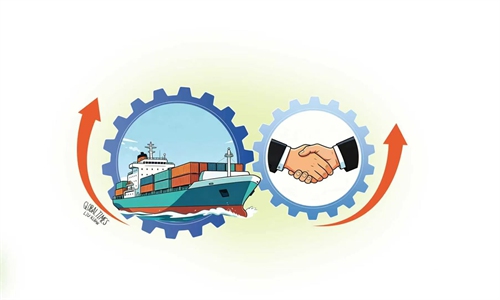
Illustration: Xia Qing/GT
The question of what makes French fries crisp finds an unexpected answer at the CISCE: coffee. A restaurant chain exhibiting at the expo provided a concrete illustration.
Every day, its restaurants generate tons of used coffee grounds. In 2025, the company formed a partnership with a Chinese biotech firm to convert this waste into a fulvic-acid biofertilizer, which was then applied to potato fields in Northwest China's Gansu Province. One of the outcomes, according to the companies involved, was an improvement in dry matter content, which industry experts have said is associated with crispier French fries.
Another question that has attracted industry attention - how to ensure consistent quality and taste in French fries - also found a response at the CISCE.
A restaurant company, a Swiss agri-tech firm and a Canadian frozen-food multinational held discussions last year at the event, where they looked at the potato's journey end to end, from seed breeding and cultivation to cold-chain logistics and final frying.
This year, the three companies officially signed a cooperation memorandum to launch a pilot project in China focusing on upstream potato planting.
Such supply-chain collaboration is rarely visible to consumers, yet it quietly helps define the quality of a product as familiar as the French fries.
Recent international commentary on China's industrial supply chains has focused on high-tech sectors, which depend on tightly coordinated, precision manufacturing ecosystems. This focus is understandable, given their role in China's broader industrial development. Yet beyond these areas, across a wide range of sectors, including more traditional industries such as food and catering, even something as ordinary as the French fries sits within a layered supply chain that begins with seed breeding and potato cultivation.
China has a comprehensive modern industrial system comprising 41 major categories, 207 medium-level categories and 666 subcategories, making it the only country with full coverage of industrial categories under the UN industrial classification system. This breadth, supported by extensive infrastructure, provides a broad base for sectors ranging from advanced manufacturing to more traditional industries to draw on a flexible network when upgrading and improving their products. In this sense, even a simple French fry, produced within such an interconnected supply-chain ecosystem, can ultimately be made with greater consistency and crispness.
A French fry, in this sense, is more than a consumer product; it offers a small window into a broader industrial system in which China's complex supply-chain network is generating new opportunities for companies, including foreign-invested firms. Many multinational companies are already deeply embedded in this domestic ecosystem, operating not alongside it but within it, together with Chinese firms as part of the same interconnected network. They both share in the opportunities this system creates and contribute to its ongoing upgrading and evolution. These dense, interconnected and continuously active interactions contribute to the resilience of China's supply chains.
China's supply-chain opportunities and its resilience are, to a considerable extent, interlinked. This is a matter of economic reality. Yet in recent years, some in the West have sought to view global industrial supply chains through a geopolitical lens, and to promote the idea of "decoupling" from China's production system. This rhetoric has proved difficult to translate into action, not least because it sits uneasily with how supply chain networks actually function. Even a French fry, as this chain illustrates, depends on a dense web of suppliers, processes and cross-border inputs that cannot be easily disentangled.
China has consistently sought to advance supply-chain development through openness. It has established a series of public platforms, such as the CISCE, that connect global companies. These platforms enable partners from around the world to connect, share resources and pursue mutually beneficial cooperation.
Compared with the "decoupling" rhetoric promoted by some in the West, China's market-oriented efforts to strengthen and upgrade its supply chains appear more persuasive in practice. The collaboration and opportunities embedded in the supply-chain journey of something as simple as a French fry may offer a micro-level illustration of this.
The author is a reporter with the Global Times. bizopinion@globaltimes.com.cn
RELATED ARTICLES