China’s NDRC rebuts subsidy claims by international institution, opposes weaponization of trade issues
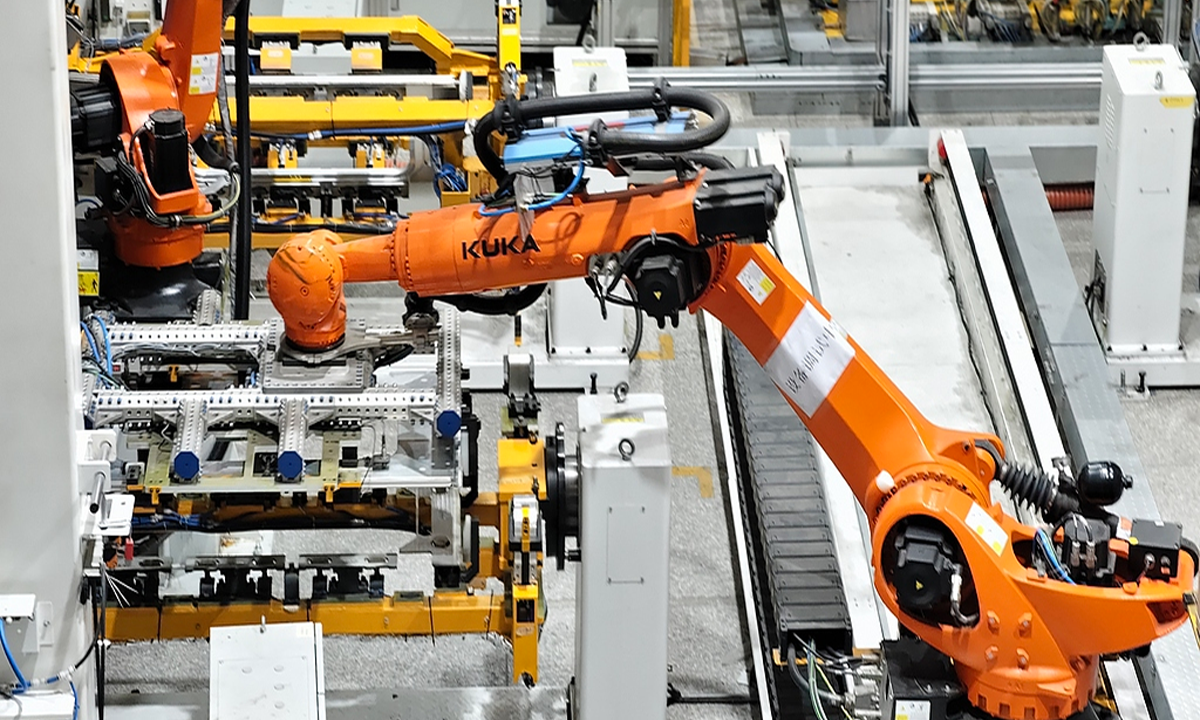
Robotic arms perform precision operations at an intelligent factory in Nanjing, East China's Jiangsu Province, on September 20, 2025. Photo: VCG
Attributing China's industrial competitiveness simply to "subsidies" is not only one-sided but completely wrong, as China's industrial competitiveness is the result of multiple factors working together, a spokesperson with China's National Development and Reform Commission (NDRC) said on Thursday, in response to a question about a report by an international institution claiming that the growth of Chinese companies' global market share in certain key areas mainly benefits from government subsidies.
"We oppose politicizing and weaponizing economic and trade issues. We stand ready to work with all parties to deepen pragmatic cooperation and jointly build a global industrial and supply chain system that is secure, stable, smooth, efficient, open, inclusive, and mutually beneficial," Li Chao, a spokesperson with the NDRC, said at a regular press briefing on Thursday.
China's modern industrial system has been developed through long-term practice, marked by continuous exploration, summarization, and improvement. A modern industrial system is an immensely complex structure, and it is imperative to maintain a holistic vision and systems-based thinking, formulate development strategies in a scientific manner, and drive their implementation with perseverance and sustained effort. China's industrial competitiveness is the result of multiple factors working in concert, Li said, citing several key factors.
First, China's industrial competitiveness stems from the rigorous tempering of its ultra-large market. While China's market offers a massive pie, it is by no means easy for any enterprise or product to claim a share amid over 180 million business entities. Only by continuously pursuing innovation, breakthroughs, and iterative upgrades can companies stand out. Recently, a report by the US-China Business Council showed that 95 percent of surveyed US enterprises believe that China's diverse testing scenarios and intense competitive pressures are vital to maintaining their global competitiveness, the spokesperson said.
Second, China's industrial competitiveness arises from the efficient synergy of its complete industrial system. China possesses the world's largest, most comprehensive, and most sophisticated manufacturing system. In recent years, "Yiwu, please mass-produce this!" has become a viral phrase on social media. It is precisely the powerful adaptability, rapid response capability, and stable delivery capacity of China's complete industrial system that turn imaginative ideas into products in record time. Enterprises rooted in this system - where "everything can be made, and everything is made well" - can achieve rapid renewal and upgrading of their competitiveness.
Third, China's industrial competitiveness is built on the long-term accumulation of education, science and technology, and talent. By the end of the 14th Five-Year Plan period (2021-25), the average years of schooling for those aged 16-59 had risen to 11.3 years, the gross enrollment rate of higher education reached 61.3 percent, skilled workers exceeded 220 million, and China's full-time equivalent of R&D personnel has ranked first globally for 13 consecutive years. During the 15th Five-Year Plan period (2026-30), these indicators will continue to rise, providing immense vitality and confidence for the development of China's industrial system, according to the spokesperson.
Fourth, China's industrial competitiveness benefits from the continuous optimization of its business environment. China consistently provides a sound environment for fair competition and development among all types of enterprises. Many foreign-invested enterprises have experienced firsthand the convenience of doing business in China. For instance, the Tesla Shanghai Gigafactory achieved the milestones of starting construction, commencing production, and making deliveries all within the same year. Such a business environment and service system has been hailed as a miracle by US entrepreneurs, serving as a vivid example of how China's business environment supports enterprise development, Li said.
RELATED ARTICLES