Japanese businesses flock to supply chain expo in Beijing
MOFCOM calls on firms to urge Tokyo to ‘correct its mistakes’
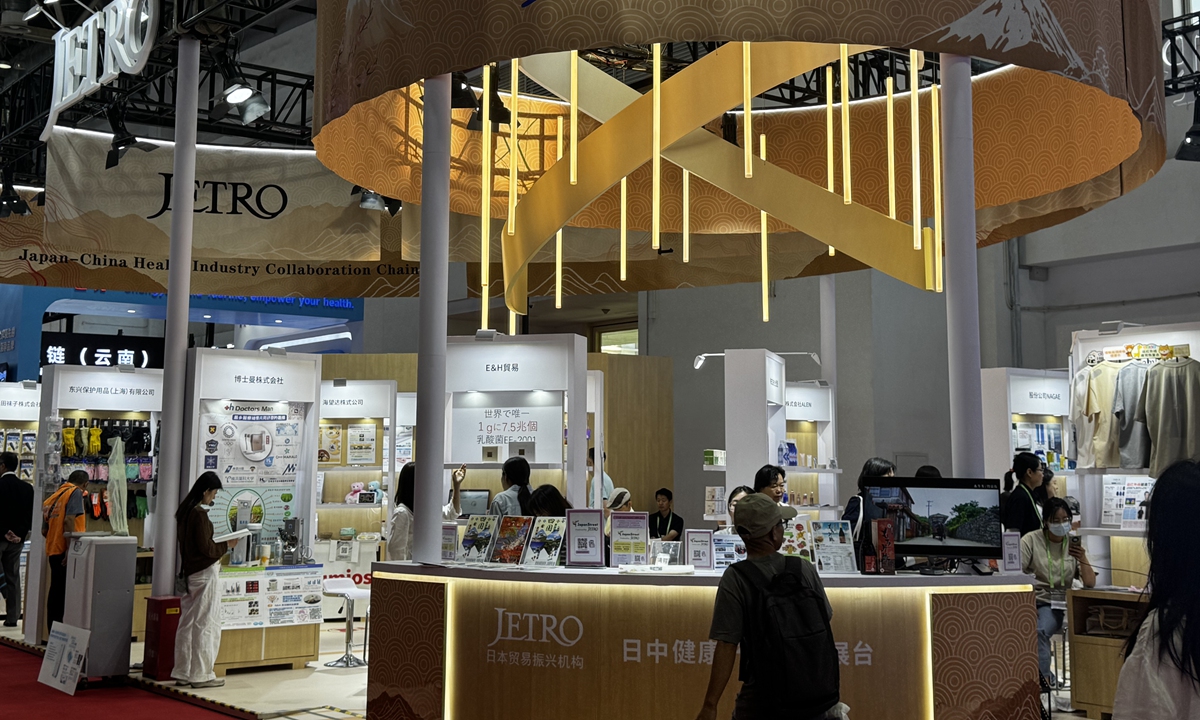
Visitors to the 4th China International Supply Chain Expo (CISCE) walk past the booths of JETRO and the Japan-China Agricultural Business Promotion Association on June 25, 2026. Photo: Liu Yang/GT
A total of 10 Japanese business chambers are attending the ongoing 4th China International Supply Chain Expo (CISCE) in Beijing, demonstrating that they continue to attach great importance to the Chinese market, the Global Times learned from the organizer and several Japanese chamber representatives on Thursday.
The widespread participation of Japanese business groups at the CISCE is notable amid worsening China-Japan relations due to Japanese Prime Minister Sanae Takaichi's erroneous remarks on the Taiwan question. This represents extensive efforts by the Japanese business community to stabilize business ties amid Tokyo's irresponsible handling of relations with China, a Chinese expert said.
At a press briefing on Thursday, Chinese Commerce Ministry (MOFCOM) spokesperson He Yadong said that Takaichi has made erroneous remarks on the Taiwan question, which seriously undermines the political foundation of China-Japan relations and exerts a severe negative impact on China-Japan economic and trade cooperation.
He made the remarks when asked about China's attitude toward the Japanese business community's visits and exchanges in China and about China's expectations for Japanese firms amid their successive visits to China.
"It is hoped that the Japanese business community, bearing its own interests in mind, will urge the Japanese government to earnestly reflect upon and correct its mistakes, so as to create the conditions for bilateral economic and trade cooperation to return to the track of sound development," He said.
The Japanese business chambers participating in the CISCE include the Japan Business Federation, Japan External Trade Organization (JETRO) and the Kansai Economic Federation, the Global Times learned from a list compiled by the CISCE's organizer.
The Global Times also observed that JETRO and the Japan-China Agricultural Business Promotion Association set up exhibition booths at the CISCE, with 25 Japanese enterprises jointly participating in the expo at JETRO's booth.
Osamu Onodera, chief representative for China and Northeast Asia of the JETRO, told the Global Times on Thursday that the JETRO has participated in each of the past three editions of the CISCE and this year it has the largest participation, with 25 Japanese companies featuring the health and elderly care industries.
Participating Japanese companies include industry-leading players such as Panasonic, AGC, Suntory, Sumitomo Electric, and Mizuho Bank, among others. Hirotaka Sagisaka, director of JETRO Beijing, told the Global Times at the CISCE that the active participation of a large number of Japanese companies demonstrates that they continue to attach great importance to the Chinese market.
Talking about the importance of China-Japan economic and trade relations for the Japanese business community, Onodera cited remarks made by Tetsuro Homma, president of the Japanese Chamber of Commerce and Industry in China (JCCIC), who said that "China is a market, research and development center, place for innovation, training center and source of human capital."
"Japanese and Chinese supply chains are closely knit together and Japanese companies consider themselves a part of the supply chain and hope to continue to contribute," Onodera stressed. "We hope for continued interaction in the economy, culture, and people-to-people exchanges despite strained relations."
For Japanese companies, strong trade and economic relations between the two countries are extremely important, Onodera said.
According to Yuyuantantian, a social media account affiliated with the China Media Group, Japan fielded the largest presence in terms of group participation among countries in Asia.
Yoshihiro Kohno, chief of the sales management section of Umios Corp, a Japanese food processing company, told the Global Times during the CISCE that the main purpose of participating in the expo is to promote nutritional soft meals and actively expand into the Chinese market.
Regarding the Chinese market, Kohno noted that China has a large population, and he hoped that through this expo, more Chinese consumers would come to know and use the company's products.
According to a recent white paper released by the JCCIC, a majority of Japanese firms plan to maintain their investment in China. The proportion of Japanese-funded enterprises in China choosing to stay committed to the Chinese market is as high as about 85 percent, demonstrating the firm determination of the vast majority of Japanese companies to deeply cultivate the Chinese market.
Da Zhigang, a research fellow at the Institute of Northeast Asian Studies at the Heilongjiang Provincial Academy of Social Sciences, told the Global Times on Thursday that repeated efforts to visit China by Japanese business communities, which saw a phased culmination at this year's CISCE, has reflected continuous efforts by Japanese corporations to try, at every available opportunity, to stabilize business ties, following worsening bilateral relations as a result of Takaichi's irresponsible remarks.
Takaichi's erroneous remarks on the Taiwan question have caused bilateral ties to deteriorate and this has in many aspects affected Japanese corporations' practical interests, Da pointed out.
"The extensive and strong representation of the Japanese business community at this year's CISCE sends a clear signal: they want the Takaichi administration to stop loss immediately," Da said.
China continues to expand high-standard opening-up and foster a world-class business environment that is market-oriented, law-based and internationalized, carrying out mutually beneficial economic and trade exchanges and cooperation with countries around the world and sharing development opportunities, He, the MOFCOM spokesperson, said at the press briefing on Thursday.
RELATED ARTICLES