ARTS / BOOKS
Chinese writers experience rural change via village residencies
Rooted stories
By Published: Jun 25, 2026 10:25 PM

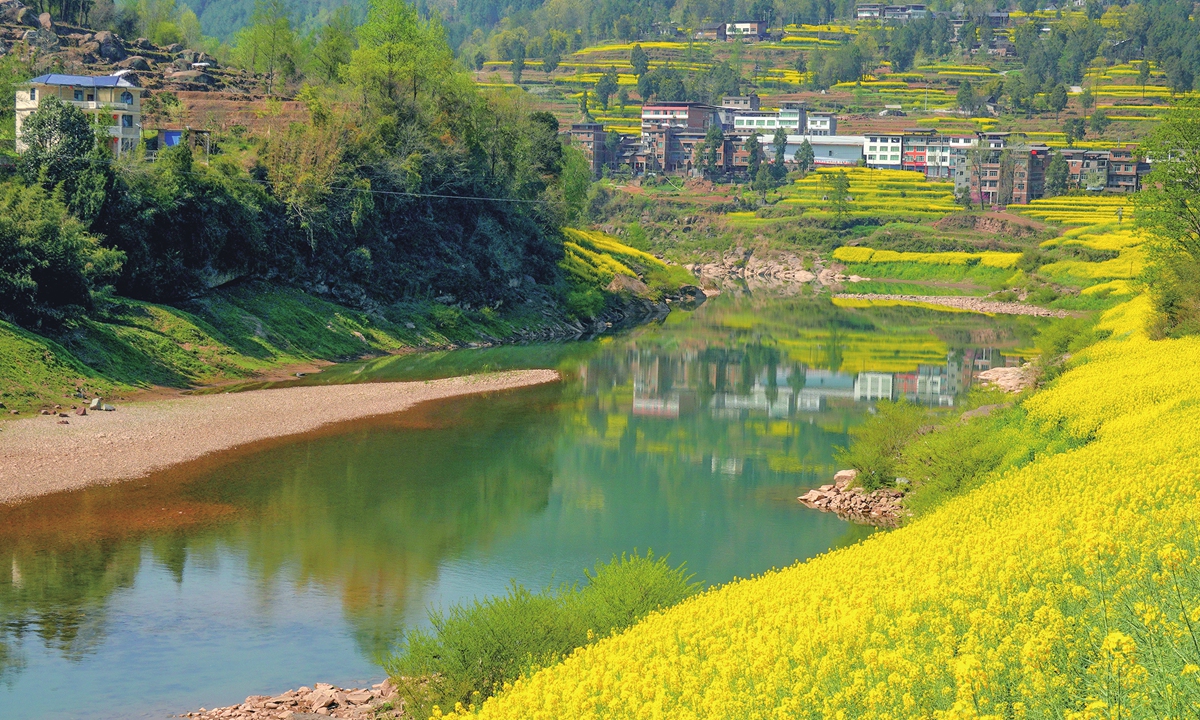
Rapeseed flowers in full bloom in Liyuanba village, Tongjiang county, Southwest China's Sichuan Province. Photo:VCG
Writer Hu Xuewen has just ended his stay in Zigong's rural villages, Southwest China's Sichuan Province. He still cannot forget the dedicated look on the face of a silkworm farmer, watching over the cocoons through the window. The farmer's devotion to hard work and hope for a good harvest deeply touched Hu - emotions he experienced again and again during his residency in the countryside.Hu, a winner of the Lu Xun Literary Prize, was invited to Zigong for the second phase of the China writers' village residency project. Currently, several Chinese writers are traveling to different regions in Sichuan Province, spending at least ten days living in villages. During this time, the writers eat, live, and work together with locals, conduct field research, and closely study the natural surroundings, local history, and culture.
Another writer, Wei Sixiao, traveled from East China's Shandong Province to Sichuan's Bazhong region. He told the Global Times that he enjoyed chatting with locals while walking around the village. He met migrant workers returning home and also retired village officials. Wei described these villagers' life stories as "windows" that reveal decades of change in Chinese rural society and the local economy.
"In recent days, I have noticed that the lifestyle and spirit of today's farmers have changed greatly," Hu told the Global Times. "We cannot rely on the old image of rural people in traditional literature anymore. Both the narrative perspective and character-building in rural writing need updating." Hu, who often writes stories set in the countryside, adding that firsthand experience is essential.
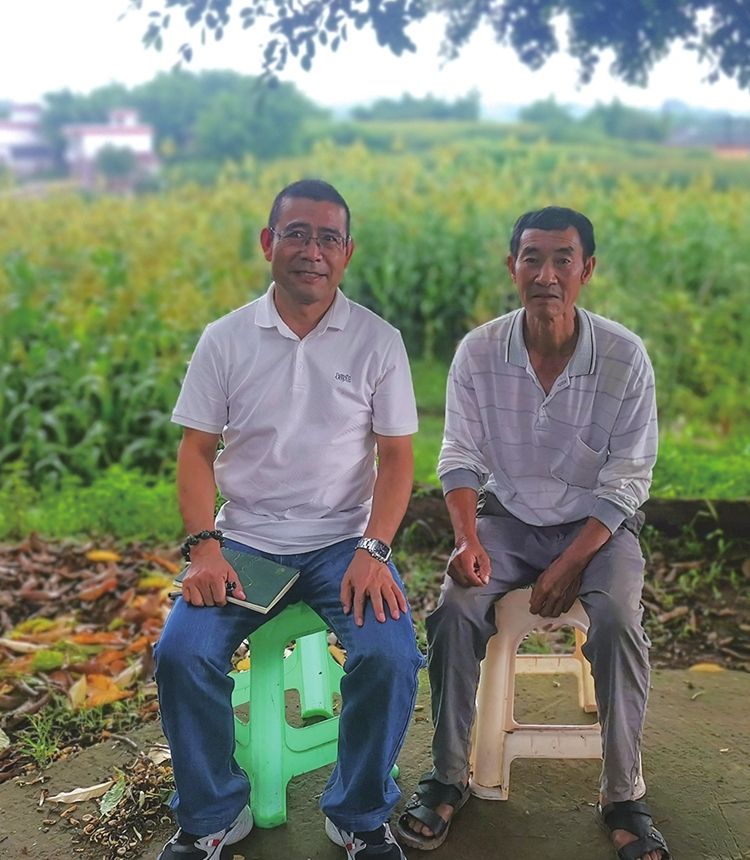
Writer Hu Xuewen sits with a villager. Photo: Courtesy of Hu Xuewen
Leaving study room and entering the fieldsIn Liuzhou community, Baiyi town of Pingchang county, neat rows of homes face a broad road. On either side stretch fields of corn, standing tall and dense. In farmhouse yards, green beans climb into thick canopies taller than a person, and tomato vines are heavy with fruit. One elderly villager handed Wei a freshly picked tomato to taste.
Such encounters are common for the resident writers. Whether tending fields or visiting villagers' homes, warm conversations are everywhere. During an exchange with a villager, Wei learned about his work experiences in places like Shandong, giving him new ideas on how to write about the changes in rural life.
Hu considered that writers cannot just stay in their study rooms relying on books or their phones for inspiration. Real and fresh material only comes from being present in the countryside. He recalled two villagers from this trip who left a deep impression and might become models or sources of inspiration for characters in his future novels.
"One is a watermelon grower in Sanhe Village. He grew a watermelon weighing over 37 jin (about 18.5 kilograms), which sold for 30,000 yuan ($4, 412.7)," Hu said. "While others may know all the growing techniques, few can match his quality. The key lies in treating each watermelon like he is raising a child, paying close attention to every stage. Any carelessness will hurt the harvest." This diligence and patience remind Hu of a character in his earlier novel, Yousheng, who spent years mastering the craft of growing beans and making tofu.
The second was Gong Qian, an inheritor of the intangible cultural heritage of Gong fans. Hu visited her while she was making a traditional palace fan. The process is extremely complex, even more challenging than writing a novel. To craft a Gong fan, bamboo must be sliced as thin as 0.01 to 0.015 millimeters - thinner than a human hair. Each centimeter of fan face requires weaving 22 bamboo threads. Fan makers bend over their workbenches for years; it can take from half a year up to three years to make a single fan, requiring immense patience and focus.
"To me, both the watermelon grower and the fan-maker represent thousands of rural people, each perfecting their own 'works' through years of devotion," Hu reflected. "Their dedication has inspired my way of writing."
Hu stressed that only through field research can a writer capture details that words or images alone cannot convey. He was pleasantly surprised by how much the villages have changed. Paved concrete roads now connect everywhere, and even regular farming households live in two- or three-story houses. Besides the developing living conditions, the confident, impressive spirit of the villagers that struck him most.
Mutual enrichment of literature and rural life
At the launch ceremony of the residency program, Li Shaojun, editor-in-chief of the magazine Poetry Periodical, commented that writers, by going deep into the villages, can dig out lively language resources and folk culture from the soil, while also getting rare, fresh experiences and heartfelt emotions different from city life. This experience, he said, is a two-way nourishment - writers also give something back to the villages. One day, villagers may realize that their everyday lives are full of poetry.
Wei agrees that the countryside is fertile ground for literary creation. This residency changed his perspective and allowed him to see the tremendous changes in rural China more clearly. "The changing faces of rural life are full of literary quality. I always want to know the real stories behind them," he said.
After this village residency, Hu plans to first write essays to organize his thoughts and observations. "Honestly, if I had not come to Zigong, I probably would never have written about the people and history here," he admitted. "Now these experiences will become invaluable material for my future essays and fiction."
As for literature's impact on the countryside, Hu thought that a short stay cannot directly change a village overnight. But by spreading local stories to the outside world, their literary works can steadily raise the cultural influence of rural regions.
RELATED ARTICLES