Cambodian senate president Hun Sen begins goodwill visit to China
China-Cambodia ties unwavering, highlighting ‘ironclad friendship’ of stability, trust and mutual support: experts
By Published: Jun 25, 2026 11:34 PM

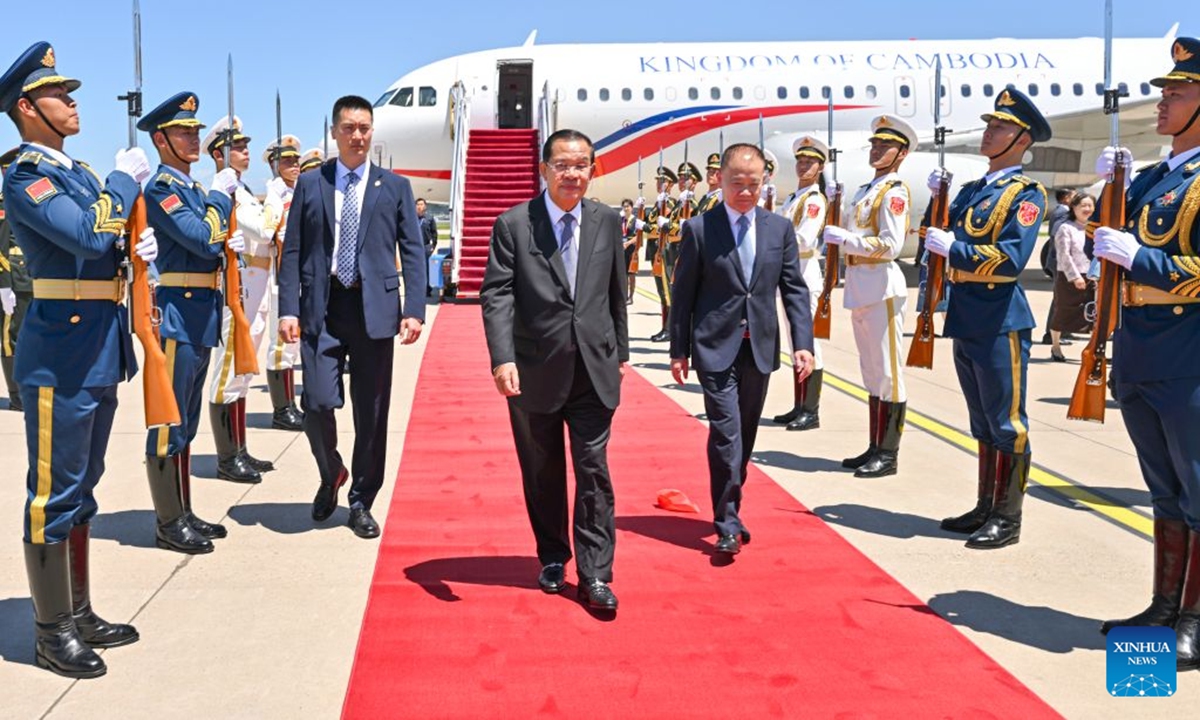
Cambodian People's Party (CPP) President and Senate President Samdech Techo Hun Sen arrives in Beijing, capital of China, June 25, 2026. At the invitation of the Communist Party of China (CPC), CPP President and Senate President Samdech Techo Hun Sen arrived in Beijing on Thursday for an official goodwill visit to China from June 25 to 27. (Xinhua/Li Xin)
At the invitation of the Communist Party of China (CPC), Cambodian People's Party (CPP) President and Senate President Samdech Techo Hun Sen arrived in Beijing on Thursday, beginning an official goodwill visit to China, according to the Xinhua News Agency.
Zhao Leji, chairman of China's National People's Congress (NPC) Standing Committee, met with Hun Sen on Thursday in Beijing. Zhao, also a member of the Standing Committee of the Political Bureau of the Communist Party of China Central Committee, said China stands ready to work with Cambodia to follow the important consensus reached by the leaders of the two parties and the two countries, carry forward the traditional friendship, strengthen strategic coordination, and jointly pursue development and revitalization, according to Xinhua.
Noting that China-Cambodia ties have been elevated to an all-weather community with a shared future in the new era, Hun Sen reaffirmed Cambodia's firm commitment to its friendly policy toward China, Xinhua said.
During the visit, Hun Sen is expected to meet the Chinese leader and officials to exchange views on deepening bilateral ties between the two countries and issues of common concern, the Cambodia China Times said.
This visit indicates the unwavering commitment of the two countries to continuing to strengthen ties and promote ironclad friendship as well as to encourage cooperation of partnership, comprehensive strategy, aimed at building the fate of the Cambodia-China community in all seasons in the new era to be more successful, according to a post published on the Facebook page of Hun Sen on Thursday.
"From the perspective of its contemporary significance, the most distinctive features of the China-Cambodia 'ironclad friendship' are its enduring vitality, steadfast stability, mutual support, and family-like closeness," Zhou Shixin, director of the Center of Southeast Asia Studies, Shanghai Institutes for International Studies, told the Global Times on Thursday.
No matter how the international situation changes, China-Cambodia relations have remained stable and unwavering. China has consistently regarded Cambodia as one of its most important and reliable partners in Southeast Asia, while Cambodia has always viewed China as its most trustworthy development partner. The two sides have never let each other down, Chinese experts said.
Since the establishment of diplomatic relations, especially following the launch of the comprehensive strategic partnership and the building of a China-Cambodia community with a shared future, high-level exchanges between the two countries have become increasingly frequent and cooperation has continued to deepen across a wide range of fields, Zhou noted.
In December 2024, Hun Sen visited China, saying that China is Cambodia's most trusted friend. Friendship with China is a consensus within the CPP, which will not undergo any changes with intergenerational leadership transitions in Cambodia, according to Xinhua.
On June 17, Chinese Foreign Minister Wang Yi visited Cambodian King Norodom Sihamoni and Queen Mother Norodom Monineath Sihanouk, who are in Beijing for medical check-ups and recuperation, according to Xinhua.
Under the strategic guidance of the two heads of state, China-Cambodia relations have entered a new stage in building an all-weather community with a shared future in the new era, Wang said, per Xinhua.
He expressed China's willingness to deepen practical cooperation with Cambodia and deliver greater benefits to the two peoples.
Cambodia has long supported China's participation in regional cooperation and the deepening of China-ASEAN relations. In turn, China has actively supported Cambodia in playing a greater role within ASEAN. The two countries have thus developed a mutually reinforcing and highly supportive relationship, Zhou noted.
"China-Cambodia ties have gone beyond the conventional definition of a partnership. The relationship increasingly resembles that of relatives and family members, characterized by a high degree of mutual trust and deep emotional bonds," Zhou said.
During a meeting between Cambodian Prime Minister Hun Manet in Phnom Penh with Chinese Foreign Minister Wang Yi and Chinese Defense Minister Dong Jun on April 22, Hun Manet said Cambodia looks forward to strengthening high-level exchanges with China, expanding institutional dialogues, and deepening practical cooperation in areas such as clean energy, agriculture, infrastructure and talent cultivation, so as to jointly build an all-weather Cambodia-China community with a shared future in the new era, according to a readout on the website of the Chinese Foreign Ministry.
Cambodia welcomes Chinese enterprises to invest in the country and resolutely combats online gambling and telecom fraud, and is willing to strengthen cooperation with China in this regard, Hun Manet said.
In the future, China-Cambodia cooperation will have broad prospects, Chinese experts said.
Industrial cooperation and industrialization will remain key areas of focus. There is significant potential for collaboration in emerging sectors, including the digital economy, cross-border logistics, new energy, and new-energy vehicles, all of which are expected to become new growth drivers of bilateral cooperation, Ge Hongliang, deputy director of the College of ASEAN Studies at Guangxi University for Nationalities, told the Global Times on Thursday.
China's modernization offers a new development reference for countries in the Global South. China does not require other countries to copy its model; instead, it presents to the world a development path that suits its own national conditions, thereby broadening the range of modernization options for developing countries, including Cambodia, Ge said.
RELATED ARTICLES