Four countries try to team up to back 'Taiwan independence'? Not a chance: Global Times editorial
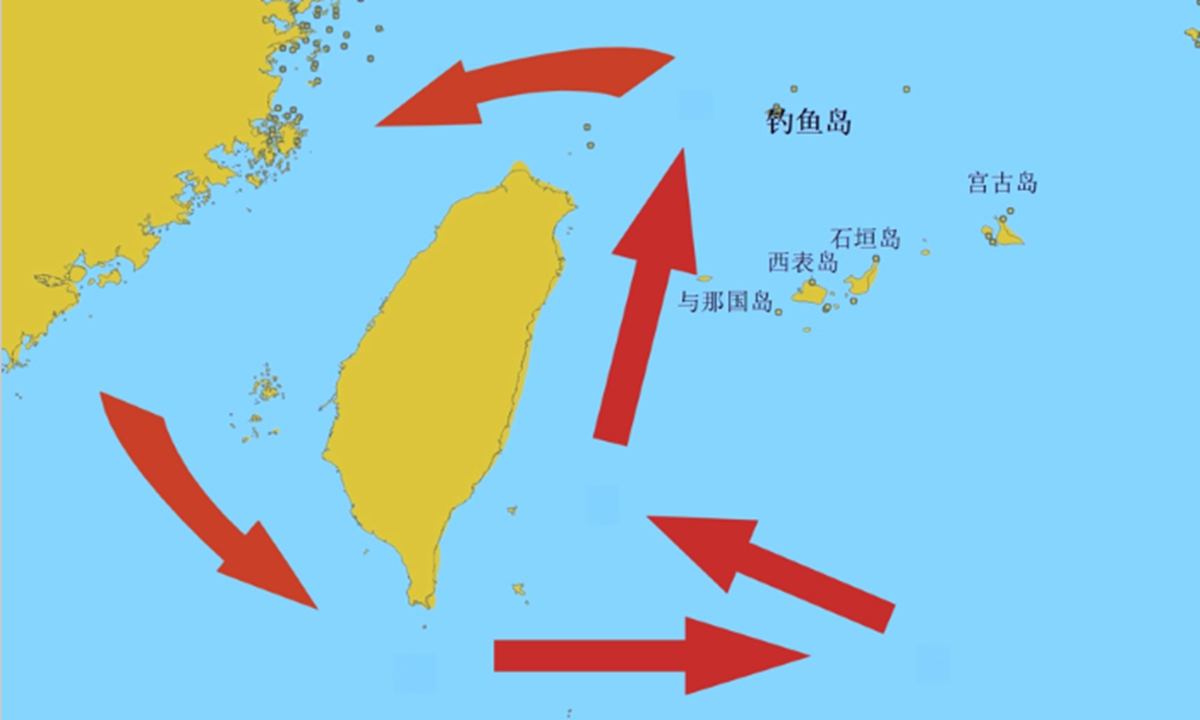
A schematic map of the special maritime traffic law enforcement and hydrographic survey operation in waters east of Taiwan island. Photo: Xinhua News Agency, courtesy of the Fujian Maritime Safety Administration
On Wednesday, "representative offices" of the UK, France and Germany in Taipei issued a "rare" joint statement expressing "concern" over the Chinese mainland's intensified law enforcement and patrol operations in the waters east of China's Taiwan island, claiming that these actions "threaten regional stability, and the freedom of navigation and safety of international shipping." On the same day, the American Institute in Taiwan also chimed in to "support" the statement. The "concerns" expressed by these four countries, in lockstep with the "protests" from the Democratic Progressive Party (DPP) authorities, staged a political farce. These external countries think they can back "Taiwan independence" separatist forces by simply making irresponsible claims about China's legitimate law enforcement patrols? Not a chance.Relevant Chinese authorities' law-enforcement patrols were mainly aimed at Japan and the Philippines for illegally initiating the so-called "delimitation negotiations" concerning the waters east of China's Taiwan island. Japan and the Philippines are attempting to use China's maritime rights and interests as bargaining chips in their own deals, the nature of which is extremely reprehensible. China certainly cannot accept this and will absolutely not stand idly by.
The coordinated statements by the US, the UK, France and Germany not only "hand a knife" to the "Taiwan independence" separatist forces, but also provide cover to Japan and the Philippines in their illegal actions, in a vain attempt to portray the waters east of China's Taiwan island as a new foothold for external forces to intervene in the Taiwan Straits. China's legitimate actions to safeguard its rights and enforce the law are aimed at protecting its national rights and interests, upholding the fundamental bottom line under the one-China principle, as well as maintaining peace and stability in the region. The so-called "concerns" expressed by the US, the UK, France, and Germany are tantamount to criticizing a homeowner for cleaning their own yard - an utterly preposterous notion. The prime minister of one of these countries has just resigned, and a new one has not even been selected; yet they still have the leisure to take the lead in stirring up trouble in the Taiwan Straits.
China has an exclusive economic zone and continental shelf in the waters east of China's Taiwan island. Chinese authorities' law enforcement and patrol activities there are legitimate and lawful actions to exercise China's jurisdiction, safeguard regional stability and uphold order at sea in accordance with the law. The law-enforcement patrols conducted this month by the China Coast Guard (CCG) task group led by CCGS Daishan, the Ministry of Transport's special maritime traffic enforcement, and the marine environmental survey organized by the Ministry of Natural Resources all fully comply with China's domestic laws and international laws, including the United Nations Convention on the Law of the Sea. This series of well-organized actions demonstrates that China's management and control of the waters east of Taiwan island has entered a new phase, with a coordinated management model involving multiple departments now in place.
The US, the UK, France, and Germany have jointly hyped up "freedom of navigation" and "maritime security," appropriating the terminology of international law while in reality conflating concepts and shifting the focus away from the core issue. No country has the right to interpret "freedom of navigation" as "the freedom to disregard China's sovereignty and maritime rights and interests." For years, the US and other Western countries have used "freedom of navigation" as a cover for maritime hegemony and "a rules-based order" to mask their military encroachment. US military vessels and aircraft have frequently conducted close-in operations near China's coast. Meanwhile, Japan has accelerated efforts to break free from its postwar constraints, and the Philippines is colluding with the US and Japan to create trouble in the South China Sea and east of Taiwan island.
These actions have already gone beyond normal commercial passage and routine navigation, instead bearing the clear hallmarks of military deployment, political coercion, and strategic containment. By criticizing China's law enforcement activities today in the name of "freedom of navigation," they are in effect demanding that China relinquish jurisdiction, abandon its legitimate rights protection, and forgo its ability to shape order in waters off its own coast. This approach is the real threat to freedom of navigation.
Through routine patrols, special law enforcement operations, and marine scientific surveys, China is steadily building a framework for protecting its maritime rights and interests and improving governance in the waters surrounding Taiwan island. For example, the marine environmental survey organized by the Ministry of Natural Resources this month collected data on seawater environmental DNA, birds, whales and dolphins, marine chemistry, hydrology and meteorology.
During the survey, researchers recorded brown boobies and masked boobies, both of which are listed as protected animals of national class II in China, providing a scientific basis for marine biodiversity conservation in the area. External forces have sought to portray China's efforts to strengthen governance capacity as "coercion," which only reveals their real concern: China's growing ability to lawfully govern, effectively manage, and shape order in the waters surrounding Taiwan island.
The DPP authorities have turned a blind eye to Japan's and the Philippines' infringements, yet have eagerly aligned themselves with external forces to attack and smear the central government's legitimate rights protection efforts while promoting the fallacy of "Taiwan independence." This once again exposes their entrenched separatist agenda and their betrayal of the fundamental interests of the Chinese nation.
CCG vessels broadcasting routine inquiries to merchant ships about their ports of departure and destinations is a standard means of asserting jurisdiction. Nevertheless, the DPP authorities have claimed that three merchant vessels were "harassed" by the CCG, a baseless accusation that distorts facts and serves only to put on the guise of a "victim" to solicit external sympathy and seek "independence" by relying on external forces.
The waters east of Taiwan island are not a strategic testing ground for external forces, nor are they a political vacuum where Japan and the Philippines can privately draw boundaries. No amount of external backing can change the indisputable fact that both sides of the Taiwan Straits belong to one China, nor can it halt China's efforts to lawfully safeguard its rights, strengthen governance, and shape order in the Taiwan Straits.
The more external forces want to stir up trouble under the pretext of "freedom of navigation," the more China will exercise control over the maritime areas that fall under its jurisdiction and fully enforce the laws that should be enforced, ensuring that national sovereignty and maritime rights and interests remain firmly in its own hands. This is also a proper step for a responsible major power to take in order to maintain regional peace and stability.
RELATED ARTICLES