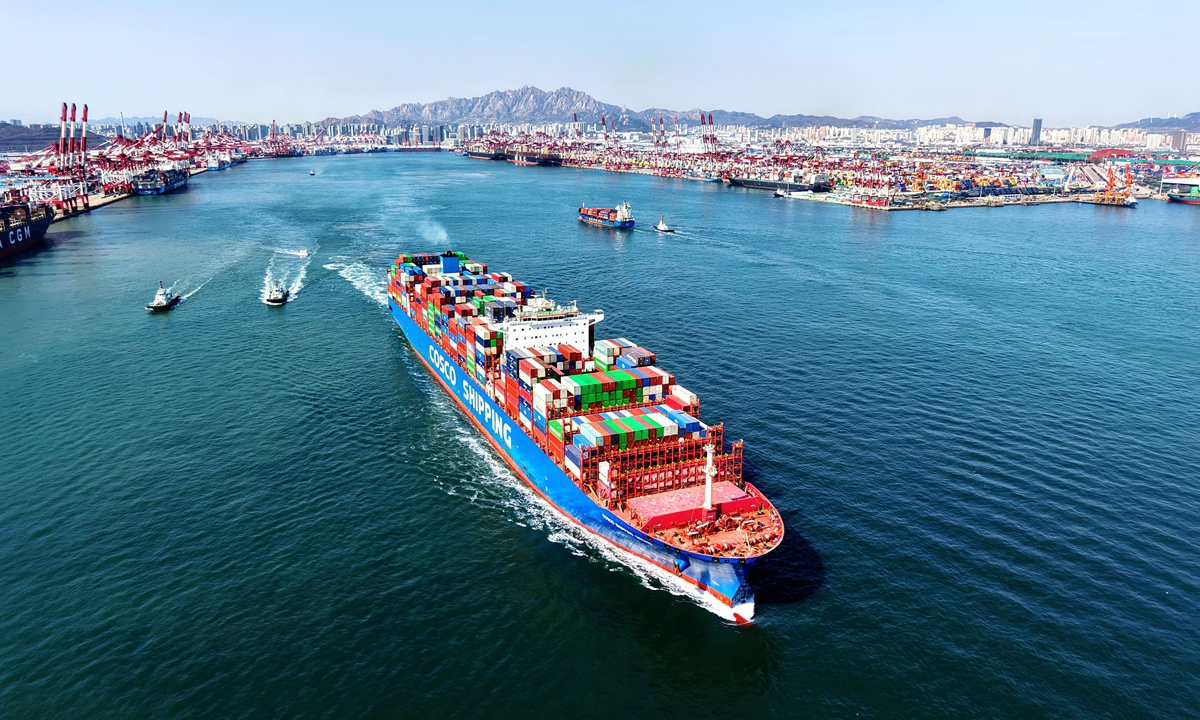
View of a container vessel near Qingdao port in East China's Shandong Province on April 7, 2026 Photo: VCG
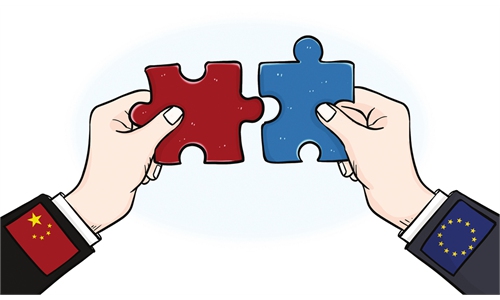
Despite the ongoing frictions in EU-China economic and trade relations, we see that dialogue between the European Commission and China continues. In addition to the recent meeting between Chinese Vice Commerce Minister Ling Ji and Ditte Juul Jorgensen, director-general for Trade and Economic Security at the European Commission. China and the EU reportedly will hold ministerial consultations soon.
This ongoing engagement is essential. I remain confident that structured dialogue can help de-escalate tensions. I do not believe that we are witnessing a complete shift from cooperation to systemic rivalry, nor do I expect a full-blown trade war between the two giant economies. My hope is that both sides will demonstrate sufficient pragmatism and political wisdom to reach consensuses that preserve economic cooperation while addressing legitimate concerns.
Trade frictions are normal between major economic powers. The challenge is to prevent such disputes from escalating to the point where they seriously disrupt the broader bilateral relationship. Ultimately, sustained dialogue remains the best instrument for managing disagreements while preserving long-term cooperation.
Competition is normal and, when fair, it is beneficial. Cooperation, meanwhile, remains a necessity for the prosperity of both economies and, more broadly, for global progress. Both sides remain deeply interdependent. China is a crucial market for European companies, while Europe remains an important destination for Chinese exports and investment. For these reasons, competition will intensify, but both sides have strong incentives to avoid uncontrolled escalation of disputes.
There is considerable scope for expanding cooperation between the EU and China. In particular, the EU should create conditions that will attract more Chinese investment into Europe, especially in high-technology sectors. Cooperation in green technologies, electric mobility, artificial intelligence, health, and scientific research could generate significant mutual benefits.
The EU's current concern stems primarily from concerns over industrial competitiveness, technological dependence, supply-chain vulnerabilities, and trade imbalance. There is also growing concern that Europe could become dependent on external actors in critical sectors.
This is arguably the major economic question facing Europe today. It is addressed extensively in the Draghi Report, which highlights several structural weaknesses in Europe, including insufficient investment, fragmented capital markets, elevated energy costs, and regulatory complexity.
To address these problems, I would add the need for much stronger efforts in innovation, technological development, and scaling up European companies. Europe has world-class research capabilities but often struggles to transform scientific excellence into globally competitive industries.
In this regard, China and the EU remain each other's crucial economic partners characterized by complementarity and mutual benefit. Despite the political rhetoric surrounding "de-risking," the data tells a different story: China has once again cemented its status as Germany's largest trading partner, proving that the economic gravity between Europe's industrial engine and Asia's manufacturing giant is simply too powerful to resist.
At a time when the global economy faces mounting uncertainty, cooperation should be prioritized over rivalry. The EU's economic security agenda toward China has hardened noticeably in 2026, coming up with a series of defensive instruments on trade and investment. However, the pursuit of a more balanced bilateral economic relationship should be based on deepening cooperation and broadening shared interests, rather than resorting to restrictions and confrontation.
Despite various complexities, there is one thing that both the EU and China share: the recognition that they must find ways to cooperate, however not easy. The upcoming talks present an opportunity to reset the tone of their relationship and set a course toward constructive engagement. While there is no denying the mounting challenges, there is also much to gain from collaboration.
Both sides converge on issues like multilateralism and climate change, and these commonalities provide the foundation for a more cooperative future. In an increasingly fragmented world, where geopolitical and economic divides are deepening, the EU and China must lead by example. Their partnership can serve as a bridge to a more connected, stable, and prosperous world - whether by safeguarding the integrity of global supply chains, driving innovation in green technologies, or upholding a reformed and functional multilateral trading system.
This article is compiled based on an interview by the Global Times with David Gosset, a specialist in global affairs and sinology, is the founder of the China-Europe-America Global Initiative. bizopinion@globaltimes.com.cn
RELATED ARTICLES