Europe faces record heatwave, as Beijing embraces ‘mild’ summer; climate change makes global weather patterns more unstable: expert
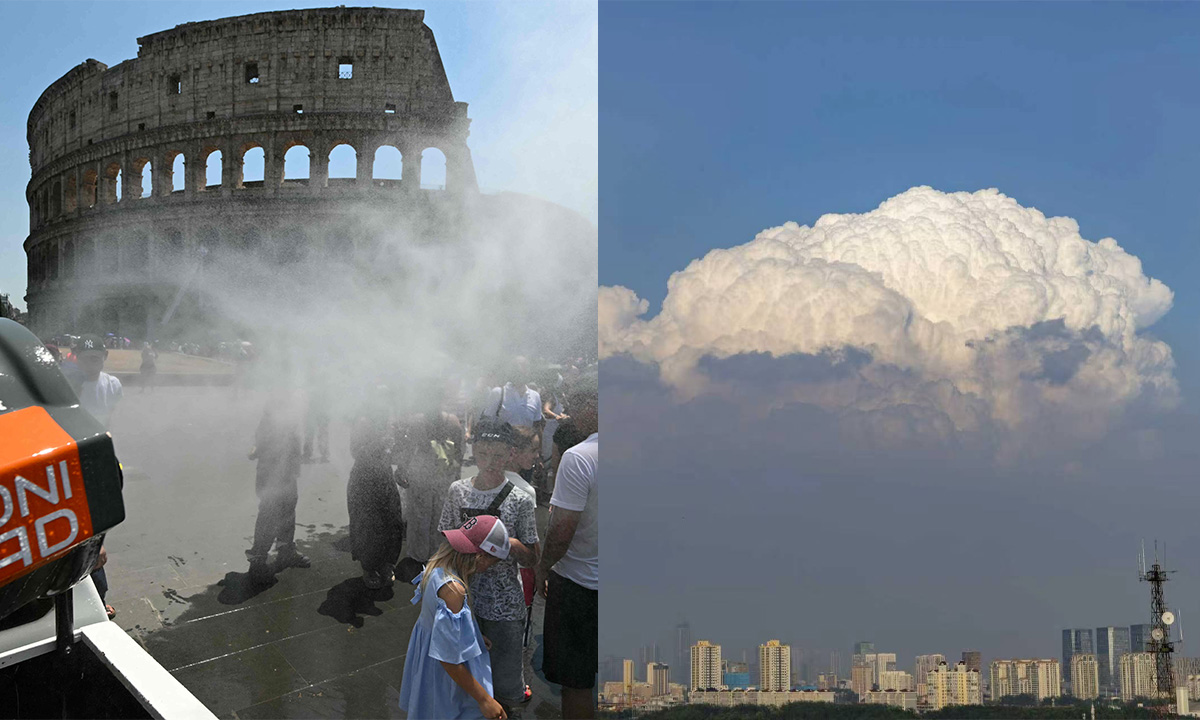
Left: People refresh in front of a water-sprinkling cannon brought by Rome's municipality to relieve tourists visiting the Colosseum and Roman Forum as temperatures reach record highs, in Rome, on June 26, 2026. Right: A massive cloud appeared — fluffy, full, and soft as a piece of cotton candy, over Tongzhou district, Beijing on June 24, 2026. Photos: VCG
As Europe is currently experiencing "the most severe recorded" heatwave, with several regions seeing record-breaking high temperatures, Beijing is witnessing a relatively "mild" summer so far this year, according to media reports.
This contrast is also vividly highlighted by some scenes in media reports and online social media posts: while many Europeans reportedly rush to purchase air conditioners, some netizens in Beijing noted they had barely needed air conditioning, describing the weather as feeling more like early autumn than midsummer.
Beyond the comparison, the contrast has also sparked some discussions: Why is there such a difference in temperatures? How do different regions respond to global climate change? And how should the world strengthen cooperation to tackle extreme weathers?
A Chinese expert said on Saturday that the contrast comes down to the wildly varied impacts that increasingly severe climate change brings to different parts of the world, with long-term coordinated action needed to address these shifts.
Data showed that several cities across Europe have endured record-breaking high temperatures. According to the BBC, on Friday, temperatures broke June records in Germany, Belgium and the Netherlands, at 41.3 C, 40 C, 39.4 C, respectively.
A top temperature of 39.4 C was recorded in the southern Dutch province of Limburg. Meanwhile, in the UK a provisional June record of 37.1 C was recorded at Cavendish in Suffolk, the report said.
Besides, temperatures in Paris hit a June record of 40.9 C, a day after France recorded its hottest day since records began nearly 80 years ago, when temperatures peaked at 44.3 C in the southwestern town of Pissos, according to Reuters.
The Associated Press reported that much of western Europe has been baking under a "heat dome" this week, with temperatures soaring above 40 C in many places, while according to calculations by the AFP news agency, at least 150 million people across the European continent were facing temperatures higher than 35C on Friday.
The continuous heatwave is triggering social impact. Around 1,000 schools across England and Wales have shuttered or shortened the school day, while authorities said attendance had dropped at those remaining open as parents keep children at home, Reuters said on Thursday.
Meanwhile, from the Eiffel Tower and the Louvre to Buckingham Palace's Changing of the Guard, soaring temperatures are forcing attractions to close, shorten opening hours and cancel events as a heatwave grips Europe, per Euronews.
By contrast, Beijing is experiencing a relatively mild summer so far this year. According to the Beijing Daily, between June 1 and 23, Beijing logged an average temperature of 23.4 C, 1.6 C cooler than the long-term average of 25.0 C for the same period. "This is summer, but why does it feel like we are already entering autumn ahead of time," one online netizen wrote.
As of Wednesday, not a single heat day has been recorded in the city in June. Beijing recorded eight heat days in June 2025. Some netizens wrote on social media, "It's already June, yet we've barely turned on the air conditioner—what mild weather!" according to the Beijing Daily report.
Li Zhiqing, a professor specializing in environmental economics and China's economy at Fudan University, told the Global Times on Saturday that climate change is making weather patterns around the world more unstable.
The likely reason behind the contrast between Beijing's "mild" weather and Europe's "heatwave" is that climate change hits different parts of the world in vastly different ways. Europe's geographic location makes it far more prone to extreme heat, while other regions may face downpours or prolonged droughts. All these are separate manifestations of long-term global warming, with impacts varying widely across areas, Li said.
Regarding the heatwave in Europe, the burning of fossil fuels is one of the main long-term drivers, given that massive greenhouse gas emissions have steadily warmed the planet. "This is not caused by emissions from a single period, but the combined buildup of greenhouse gases accumulated throughout history," Li said.
Some European media also attributed the heatwave to human impact. "Continued fossil-fuel emissions are directly responsible for the disruption people are experiencing this week," climate scientists warn, according to Euronews. DW reported that as humans continue to burn oil, gas and coal, releasing greenhouse gas emissions causing climate change, Europe is becoming the fastest-warming continent.
Li noted that addressing global climate change constitutes a long-term task. It involves efforts to conduct in-depth climate research to identify its evolving patterns, improving infrastructure's ability to cope with climate impacts.
Notably, China has taken a slew of concrete measures to help address climate change. In September, China unveiled its new Nationally Determined Contributions, setting ambitious goals for 2035, including reducing economy-wide net greenhouse gas emissions by 7 percent to 10 percent from peak levels, increasing the share of non-fossil fuels in China's total energy consumption to over 30 percent, and expanding the installed capacity of wind and solar power sixfold from 2020 levels, the Xinhua News Agency reported on June 5.
In Beijing, faced with poor air quality and other issues over a decade ago, the city has accelerated its green transformation, including measures tackling coal burning, promoting new-energy vehicles, scaling up the use of green electricity, reducing dust and noise pollution, and supporting the transition of polluting industries. As a result, in 2025, Beijing saw its best air quality since monitoring began, with record low annual average PM2.5 concentrations and a record high number of days with good air quality, according to a separate Xinhua report on April 2.
As for the extreme weather in Europe and elsewhere, Li said that relevant efforts should be made to upgrad transport and buildings, improve weather warning and emergency response systems, as well as encourage wider public awareness of climate hazards to better guard against potential risks.
RELATED ARTICLES