Fresh US-Iran strikes expose fragility of MoU, with contest over Strait of Hormuz: Chinese expert
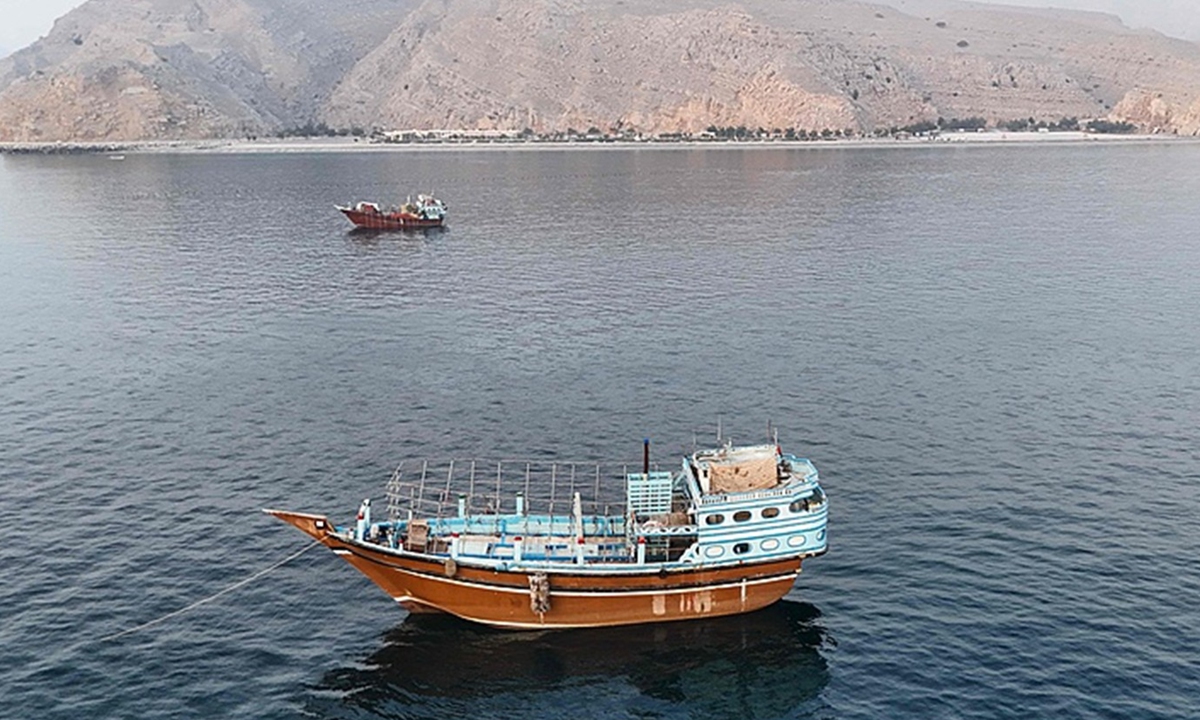
Boats anchor off Oman's northern Musandam Peninsula near the Strait of Hormuz on June 27, 2026. Photo: VCG
Less than a week after the US and Iran signed a Memorandum of Understanding (MoU) aimed at reducing tensions, the situation has taken another twist with both sides exchanging military strikes during the weekend. A Chinese expert said the latest military confrontation once again exposed the ambiguity of the agreement with mistrust between two countries, and behind the military exchanges remains a contest over navigation initiative through the Strait of Hormuz, although the likelihood of a large-scale military confrontation remains low.
The US Central Command released a post on its X account on Saturday night local time saying that it had carried out strikes against 10 Iranian military targets at multiple locations in and near the Strait of Hormuz, describing the operation as a direct response to Iran's drone attack on the oil tanker Kiku.
In retaliation, Iran's Islamic Revolutionary Guard Corps (IRGC) said it has launched missiles and drones at US infrastructure in Kuwait and Bahrain, warning that violating the ceasefire is against the agreement signed between the two nations and "will lead to a complete halt to the process," BBC reported.
This is not the first oil tank US claimed to be attacked by Iran after the MoU was signed, and the US Central Command said US Navy and Air Force fighter jets conducted the strikes after Iran "elected not to" honor the ceasefire agreement by launching a one-way attack drone that hit the Panama-flagged tanker, which was carrying more than 2 million barrels of crude oil while transiting near the Strait of Hormuz, according to a statement.
US President Donald Trump also issued a fresh warning on Truth Social, writing that "It is very possible that they will never learn!" He added that "There may come a point when we are no longer able to be reasonable, and will be forced to militarily complete the job that we very successfully started," warning that if such a scenario unfolds, "the Islamic Republic of Iran will no longer exist."
The Iranian side said the US had attacked five coastal posts in Iran under what it called "the pretext of the IRGC Navy confronting the offending ship," and that under the MoU signed earlier this month, Iran has arrangements for controlling passage and navigation in the Strait of Hormuz, and from now on, violating ships will be dealt with more forcefully than in the past, per BBC's report.
The latest developments once again exposed the ambiguity and vulnerability of the MoU, as both sides appear to have fundamentally different interpretations of some of its vaguely worded provisions, Li Haidong, a professor at China Foreign Affairs University, told the Global Times on Sunday, adding that the latest military exchange remains centered on the contest over navigation rights in the Strait of Hormuz.
Li noted that Iran is seeking to reinforce its control over the strategic waterway. After the Strait of Hormuz reopened, Iran insisted that commercial vessels to only use routes through the strait approved by Tehran, after Oman announced a new shipping transit route through it on Wednesday, saying it had coordinated the route with the International Maritime Organization as maritime traffic slowly resumes following weeks of disruption, per Al Jazeera.
According to CENTCOM's statement, the first attacked vessel, Ever Lovely, was transiting along the Omani coast.
Li said that US hopes to regain the initiative in the Strait of Hormuz through limited military action while reinforcing its deterrence posture. The New York Times reported that the ambiguities in the language that US negotiators agreed to in their interim cease-fire agreement with Iran appear to be coming back to haunt them.
Although the latest developments once again highlighted the lack of mutual trust between the two sides, Li noted US appears to be using limited military action to counterback than expanding the conflict, as the US has little appetite for a prolonged conflict, and the likelihood of a large-scale military confrontation remains low.
On June 23, Chinese Foreign Minister Wang Yi said in New Delhi that while "the law of the jungle may prevail temporarily, it is not sustainable," stressing the importance of upholding international rules. "The resolution of any regional or international hotspot issues should be based on compliance with international rules," Wang said.
Chinese Foreign Ministry spokesperson Guo Jiakun also said on June 24 that China believes dialogue and negotiation remain the proper way to resolve regional hotspot issues and differences among parties, and opposes the threat or use of force.
"The US and Iran signed the memorandum, in which they undertake to respect each other's sovereignty and territorial integrity, not initiate military operations against each other, and refrain from interfering in each other's internal affairs. The document has sent a positive signal to the world and should be jointly safeguarded and implemented," Guo said.
RELATED ARTICLES