Douyin permanently bans 2-mln-follower vlogger for smearing late Father of Hybrid Rice Yuan Longping’s scientific achievements
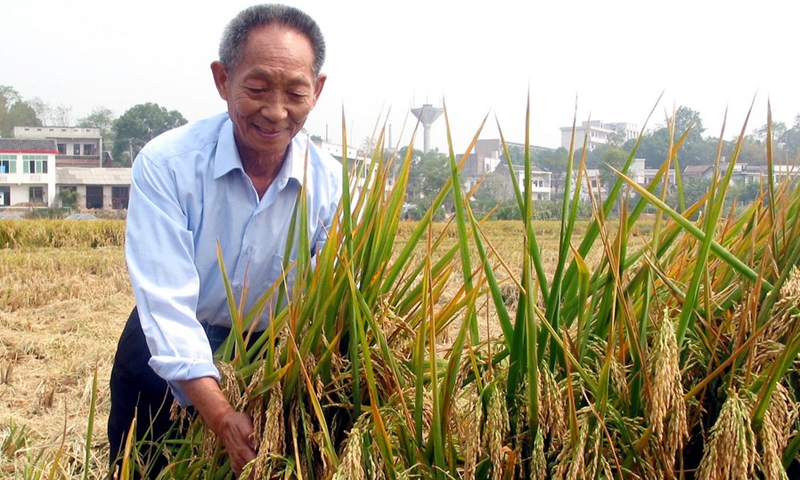
Late Yuan Longping appraises rice in an experimental plot of super hybrid rice in Xiangtan county, Central China's Hunan Province, October 9, 2003. File Photo: Xinhua
Chinese social media platform Douyin said on Sunday that it permanently banned the account that posted false information about the three-line hybrid rice breeding system, which was first proposed by the late "father of hybrid rice" Yuan Longping. The platform said the false information disrupted social and economic order and could cause public panic, in violation of the platform's community guidelines.
China Food Newspaper on Saturday reported that per information from netizens, an internet influencer who self-proclaimed to advocate "protecting traditional seed varieties," with more than 2 million followers across social media platforms, labeled the "three-line hybrid breeding system" as "abnormal" and "pathological," falsely claiming that the "male-sterile rice" could make consumers infertile "like mules," while attacking modern crop breeding technologies.
Yuan was the founder of the breeding system attacked, which is part of modern breeding technologies that have long served as the cornerstone of China's food security.
The newspaper pointed out that rice is a self-pollinating plant. Only when it is male sterile, can the rice plant receive pollen from other plants, which is the biological basis for hybridization.
Hybrid rice is traditionally developed using the three-line breeding system, which involves three parental lines: one female parent and two male parent lines. Based on their distinct roles, the three lines are known as the male sterile, the maintainer, and the restorer. The maintainer line and restorer line are both capable of self-pollination and self-propagation. The maintainer line is used to preserve and reproduce the male-sterile line, producing offspring that remain male sterile. The restorer line is crossed with the male-sterile line to produce hybrid seeds for cultivation, the newspaper said.
Yuan introduced the three-line breeding system to overcome the challenge of harnessing hybrid vigor in rice. The breeding system remains widely used across China today, according to the newspaper.
From the proposal of the "three-line hybrid breeding system" to the validation of the "one-line system," generations of plant breeders have spent nearly 60 years advancing hybrid rice breeding through continuous field research, the newspaper said, arguing that without the hybrid breeding technologies some people label "abnormal" or "pathological," agricultural output would fall short of demand, and food security enjoyed by hundreds of millions of families would be at risk.
The hybrid rice technologies have not only safeguarded food security of China, but also benefitted many developing countries. Guinean Prime Minister Amadou Oury Bah had sent a bag of locally harvested hybrid rice to Yuan's wife in April, per media reports. He said in a recent interview that hybrid rice strains developed by Chinese scientist Yuan are bringing real benefits to Guinea. The country hopes to expand rice production, reduce dependence on imports and move toward becoming a regional food supplier.
Global Times
RELATED ARTICLES