ARTS / CULTURE & LEISURE
Understanding ancient skies reveals roots of Chinese civilization
By Liu Ming and Published: Jun 28, 2026 10:43 PM

Editor's Note:
Videos featuring Feng Shi, in which the renowned archaeoastronomer and member of the Chinese Academy of Social Sciences discusses topics such as ancient Chinese cosmology and the origins of Chinese civilization, have sparked heated discussions on social media.
The videos have ignited strong curiosity among many young people about the wisdom of ancient sages and the unique characteristics of Chinese civilization.
In an exclusive interview with the Global Times reporters Liu Ming and Xu Liuliu (GT), Feng stated that love for traditional culture begins with identification with that culture. Learning Chinese culture requires the right methods and a spirit of hongyi, which roughly translates to broad-mindedness and resolute perseverance.
GT: Why are young people showing a strong interest in astronomical archaeology and ancient civilizations? How can we foster greater love for traditional culture and ensure its transmission?
Feng: Chinese civilization is a high-dimensional and outstanding civilization. Excellent spiritual achievements naturally possess infinite appeal. As ancient historian Sima Qian wrote, quoting the Book of Songs, "The high mountain is looked up to; the grand road is traveled along." Even if one cannot reach it, the heart yearns for it. Upon reading the works of Confucius, one can imagine his character. This reflects a common human psychology of being attracted to beautiful things.
Chinese culture is vast and profound. Archaeoastronomy can reveal the deep heritage of ancient civilization, allowing people to appreciate its true charm and awaken a cultural identity that lies deep within. Love for traditional culture begins with identification, and identification comes from understanding. Only by knowing its beauty can one identify with it, love it, and ultimately pass it on.
Such a rich civilization could not have formed without thousands of years of accumulation. Ancient Chinese philosopher Zhuangzi said, "Beauty is accomplished over time." Beautiful things require long accumulation. Learning Chinese culture demands the right methods and a spirit of hongyi (broad-mindedness and resolute perseverance).
GT: What is the difference between archaeoastronomy and archaeology?
Feng: Archaeology is the study of ancient social history through the remains and artifacts left by our ancestors. Human history includes both material and spiritual dimensions. Therefore, archaeological research should not focus only on how ancient people lived, but also on how they thought. The knowledge and ideas created by ancient sages represent humanity's most precious civilizational achievements.
Archaeoastronomy helps fill gaps in our understanding of ancient knowledge, thought and cosmology. Traditional Chinese cosmology emphasizes the interrelationship between heaven, earth and humanity, a framework far broader than social views alone. It pursues tianren heyi (the unity of heaven and humanity). In this sense, astronomy is truly the source of Chinese civilization.
Ancient people observed the heavens primarily to serve agricultural production by providing a calendar. This not only established systems of space-time knowledge but also shaped ancient politics, religion, rituals, official systems, philosophy and science. It even fostered the concept of integrity, which forms the core of cultural virtue and embodies the distinctive characteristics of Chinese civilization.
Without understanding these aspects, one cannot grasp Chinese culture at its roots. Reconstructing the astronomical views and cosmology of the ancients is the way forward, and this is precisely what archaeoastronomy accomplishes.

GT: What is the significance of interdisciplinary integration in advancing the exploration of Chinese civilization's origins and building a Chinese knowledge system?
Feng: Studying ancient history is like an intellectual competition with our ancestors. If we understand what they understood, we are qualified to study them; if not, we have no basis. Ancient scholarship did not divide into narrow disciplines. Over-fragmenting knowledge prevents us from truly comprehending the ancients.
Exploring the profound connotation of Chinese civilization requires broad knowledge. Excessive disciplinary division runs counter to the need for interdisciplinary approaches. Re-understanding Chinese civilization must rely on an autonomous knowledge system, beginning with autonomous concepts. Without proper concepts, research goes astray.
Civilization is not merely about the existence of a state; a state without civilization can still engage in barbaric acts. Conversely, civilization can exist even without a state. Clarifying the concept of civilization gives clear direction to origin studies.
GT: In your new book On Civilization, how do you reinterpret the concept of civilization? How does archaeoastronomy help us better understand the uniqueness of Chinese civilization?
Feng: History comprises both material and spiritual culture. Focusing only on material aspects leaves history incomplete. The true value of Chinese civilization lies in the knowledge and thought created by the ancients. By reconstructing ancient spiritual history through archaeoastronomy, the unique value of Chinese civilization becomes evident.
Chinese documents have continuously discussed civilization from the pre-Qin era through the Ming and Qing (1368-1911) dynasties. The concept dates back 7,000 years. In contrast, the concept of Western civilization did not emerge until the mid-18th century, as a product of the European Enlightenment. Civilization is thus a quintessential autonomous Chinese concept, not an imported one.
GT: Why, despite humanity's aspiration for civilization, have some countries throughout history engaged in barbaric plunder and killing?
Feng: Civilization is defined relative to barbarism and is not strictly tied to eras. The birth of a state does not automatically make it more civilized than pre-state societies, nor is the 21st century necessarily more civilized than the 21st century BC. If killing is done without morality and solely for profit, whether in ancient or modern times, this is barbarism. Humanity has not necessarily become more civilized. The core of civilization is moral self-cultivation. Failing this, one remains barbaric.
Videos featuring Feng Shi, in which the renowned archaeoastronomer and member of the Chinese Academy of Social Sciences discusses topics such as ancient Chinese cosmology and the origins of Chinese civilization, have sparked heated discussions on social media.
The videos have ignited strong curiosity among many young people about the wisdom of ancient sages and the unique characteristics of Chinese civilization.
In an exclusive interview with the Global Times reporters Liu Ming and Xu Liuliu (GT), Feng stated that love for traditional culture begins with identification with that culture. Learning Chinese culture requires the right methods and a spirit of hongyi, which roughly translates to broad-mindedness and resolute perseverance.
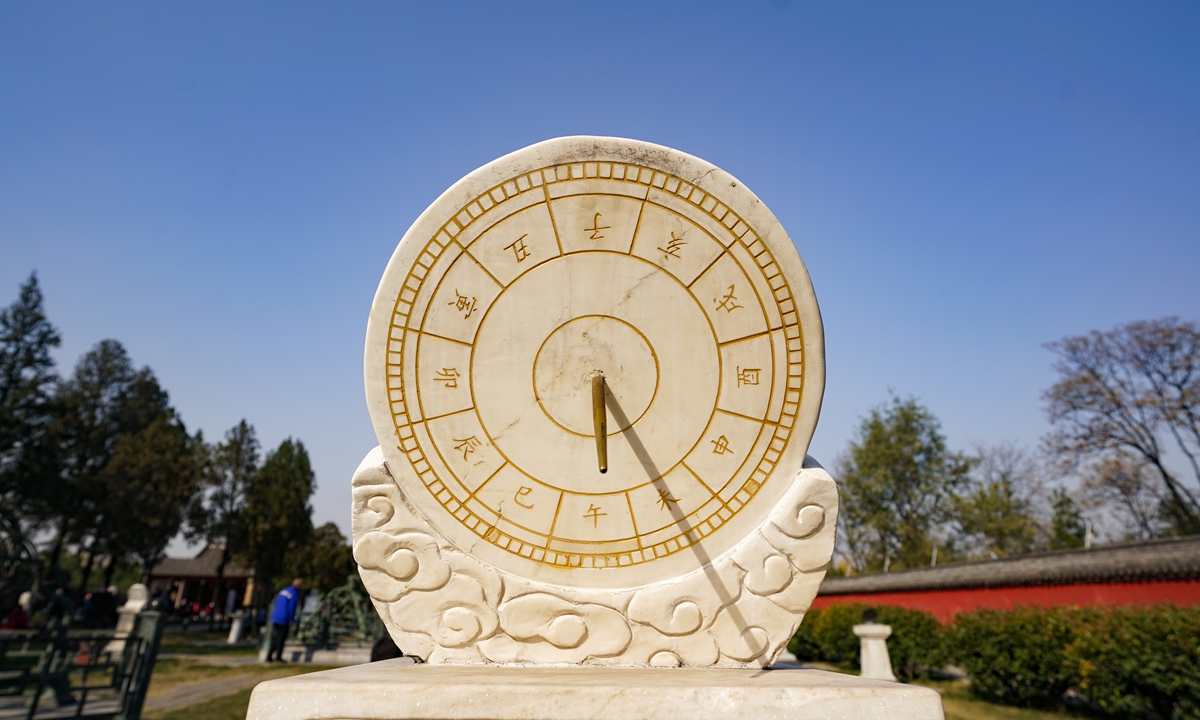
A sundial is displayed at the Gaocheng Astronomical Observatory in Dengfeng, Central China's Henan Province. Photo: VCG
GT: Why are young people showing a strong interest in astronomical archaeology and ancient civilizations? How can we foster greater love for traditional culture and ensure its transmission?
Feng: Chinese civilization is a high-dimensional and outstanding civilization. Excellent spiritual achievements naturally possess infinite appeal. As ancient historian Sima Qian wrote, quoting the Book of Songs, "The high mountain is looked up to; the grand road is traveled along." Even if one cannot reach it, the heart yearns for it. Upon reading the works of Confucius, one can imagine his character. This reflects a common human psychology of being attracted to beautiful things.
Chinese culture is vast and profound. Archaeoastronomy can reveal the deep heritage of ancient civilization, allowing people to appreciate its true charm and awaken a cultural identity that lies deep within. Love for traditional culture begins with identification, and identification comes from understanding. Only by knowing its beauty can one identify with it, love it, and ultimately pass it on.
Such a rich civilization could not have formed without thousands of years of accumulation. Ancient Chinese philosopher Zhuangzi said, "Beauty is accomplished over time." Beautiful things require long accumulation. Learning Chinese culture demands the right methods and a spirit of hongyi (broad-mindedness and resolute perseverance).
GT: What is the difference between archaeoastronomy and archaeology?
Feng: Archaeology is the study of ancient social history through the remains and artifacts left by our ancestors. Human history includes both material and spiritual dimensions. Therefore, archaeological research should not focus only on how ancient people lived, but also on how they thought. The knowledge and ideas created by ancient sages represent humanity's most precious civilizational achievements.
Archaeoastronomy helps fill gaps in our understanding of ancient knowledge, thought and cosmology. Traditional Chinese cosmology emphasizes the interrelationship between heaven, earth and humanity, a framework far broader than social views alone. It pursues tianren heyi (the unity of heaven and humanity). In this sense, astronomy is truly the source of Chinese civilization.
Ancient people observed the heavens primarily to serve agricultural production by providing a calendar. This not only established systems of space-time knowledge but also shaped ancient politics, religion, rituals, official systems, philosophy and science. It even fostered the concept of integrity, which forms the core of cultural virtue and embodies the distinctive characteristics of Chinese civilization.
Without understanding these aspects, one cannot grasp Chinese culture at its roots. Reconstructing the astronomical views and cosmology of the ancients is the way forward, and this is precisely what archaeoastronomy accomplishes.
Feng Shi Photo: Courtesy of Feng Shi
GT: What is the significance of interdisciplinary integration in advancing the exploration of Chinese civilization's origins and building a Chinese knowledge system?
Feng: Studying ancient history is like an intellectual competition with our ancestors. If we understand what they understood, we are qualified to study them; if not, we have no basis. Ancient scholarship did not divide into narrow disciplines. Over-fragmenting knowledge prevents us from truly comprehending the ancients.
Exploring the profound connotation of Chinese civilization requires broad knowledge. Excessive disciplinary division runs counter to the need for interdisciplinary approaches. Re-understanding Chinese civilization must rely on an autonomous knowledge system, beginning with autonomous concepts. Without proper concepts, research goes astray.
Civilization is not merely about the existence of a state; a state without civilization can still engage in barbaric acts. Conversely, civilization can exist even without a state. Clarifying the concept of civilization gives clear direction to origin studies.
GT: In your new book On Civilization, how do you reinterpret the concept of civilization? How does archaeoastronomy help us better understand the uniqueness of Chinese civilization?
Feng: History comprises both material and spiritual culture. Focusing only on material aspects leaves history incomplete. The true value of Chinese civilization lies in the knowledge and thought created by the ancients. By reconstructing ancient spiritual history through archaeoastronomy, the unique value of Chinese civilization becomes evident.
Chinese documents have continuously discussed civilization from the pre-Qin era through the Ming and Qing (1368-1911) dynasties. The concept dates back 7,000 years. In contrast, the concept of Western civilization did not emerge until the mid-18th century, as a product of the European Enlightenment. Civilization is thus a quintessential autonomous Chinese concept, not an imported one.
GT: Why, despite humanity's aspiration for civilization, have some countries throughout history engaged in barbaric plunder and killing?
Feng: Civilization is defined relative to barbarism and is not strictly tied to eras. The birth of a state does not automatically make it more civilized than pre-state societies, nor is the 21st century necessarily more civilized than the 21st century BC. If killing is done without morality and solely for profit, whether in ancient or modern times, this is barbarism. Humanity has not necessarily become more civilized. The core of civilization is moral self-cultivation. Failing this, one remains barbaric.
RELATED ARTICLES