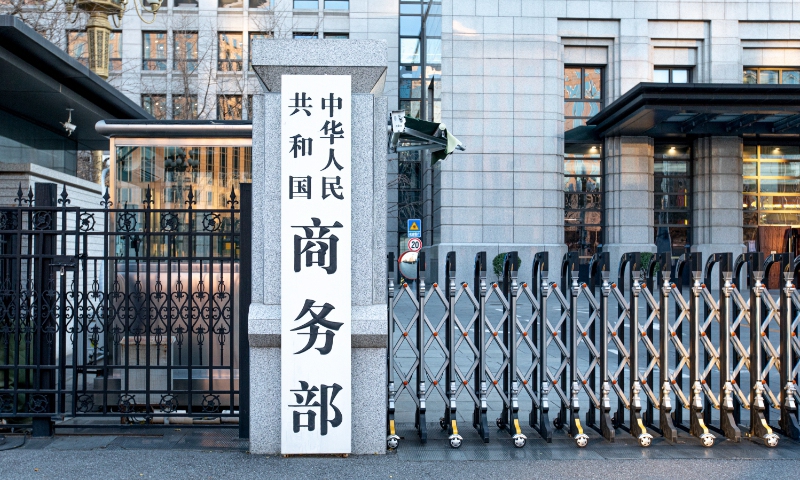
The Ministry of Commerce of China File photo: VCG
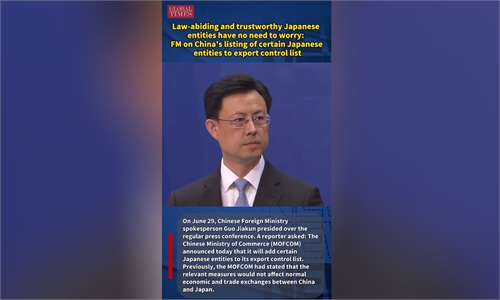
On Monday, China took further action. The Ministry of Commerce placed 20 Japanese entities - including the National Institute for Defense Studies - on the export control list and another 20 - such as MITSUI E&S Co, Ltd. - on a watch list. Following the initial lists released on February 24, this second batch of designations aims to resolutely curb Japan's reckless moves of "neo-militarism." Through this move, China intends to ensure that the Japanese side pays a tangible price for any adventurist schemes fueling this "neo-militarism," making every provocative act acutely painful and ultimately counterproductive. China remains steadfast in its commitment to safeguarding its own security as well as regional peace and stability, and possesses the full capability to do so.
Unlike the initial round of controls targeting the manufacturing sector, this latest move focuses on military research institutes and core supporting enterprises - effectively targeting the "brain" of Japan's entire defense-industrial complex - to curb the upgrading of offensive weaponry at the very source: design, R&D, and technological iteration. If the release of the first list served as an initial warning, the latest step signals that China can - depending on Japan's subsequent actions - add more military-linked entities to the list at any time, thereby establishing a long-term, sustainable control mechanism. Japan should fully anticipate this.
According to Japanese media reports, exports of key materials for high-performance magnets such as dysprosium and terbium to Japan have become zero, and the supply of tungsten-related products has also been disrupted. Japanese institutions have estimated that if rare earth imports from China were cut off for a year, compounded by restrictions on components, Japan's real GDP could contract by approximately 1.3 percent, or around 7 trillion yen ($43 billion). These figures demonstrate the deep reliance of Japan's defense and high-end manufacturing sectors on Chinese supply chains. Having chosen to turn this dependency into a "security threat from China," Japan cannot expect China to continue providing supplies unconditionally. China cannot and will not allow its resources and market to fuel a military machine that undermines its own sovereign security.
China has played its hand openly. The objective behind both rounds of export control measures is the same: to curb Japan's "remilitarization" and its ambitions to acquire nuclear capabilities. When China first played this card in February, it clearly struck a nerve with the Japanese side. Yet, instead of mending its ways, the Sanae Takaichi administration has doubled down, intensifying its push for "neo-militarism" and accelerating "remilitarization" by deploying offensive weapons and launching offensive missiles beyond its borders. Meanwhile, on the international stage, Japan has exploited multilateral forums to distort the truth and fabricate a false narrative of being "coerced by China," attempting to rally Western nations to its side while aggressively promoting the creation of supply chains that exclude China. The cause-and-effect relationship between Japan's actions and China's countermeasures is clear.
Japanese militarism, once an ideology and state system, subordinated the nation's politics, economy, culture, education, and the lives of its citizens to military affairs and wars of external aggression, inflicting immense disasters on the peoples of Asia and the world. Determining whether contemporary Japan is sliding back toward militarism depends not on whether the Rising Sun Flag is hoisted again, but on whether the machinery of the state is being used to mobilize Japanese society onto a war footing. This "neo-militarism" eschews the rhetoric of the "Greater East Asia Co-Prosperity Sphere" in favor of more moderate language: Instead of "military expansion and war preparations," it speaks of "strengthening self-defense capabilities;" instead of "projecting military power abroad," it emphasizes the "Japan-US alliance;" and instead of "external expansion," it cites the need to "address shared threats." It translates and repackages the pre-war logic of national mobilization into language compatible with the postwar system, slowly advancing its agenda.
This is precisely what makes "neo-militarism" so dangerous. Its concealed, systematic, and normalized path toward military expansion is not only more deceptive but also more destructive. Unlike the overt militarism of the past, Japan's current military buildup is advancing through comprehensive and institutionalized means across multiple domains. In this context, it is particularly important to remind certain wavering countries that any country or bloc that undermines China's sovereignty, security, or development interests should not expect China alone to bear the costs while remaining unscathed themselves. Japan is not an exception - it is a case in point.
China's measures are justified because they are targeted, restrained, and fully consistent with the law. By establishing both a control list and a watch list, China combines hard constraints with sustained regulatory pressure, encouraging the relevant companies and institutions to disengage from military-related activities and uphold peace. This approach safeguards national security while clearly distinguishing between military-related concerns and legitimate commercial activities. China's listings apply only to a limited number of Japanese entities, and the corresponding measures are confined to dual-use items. They do not affect normal China-Japan economic and trade relations, and Japanese businesses that operate lawfully and in good faith have no reason for concern. In fact, the more thoroughly "neo-militarism" is contained, the better protected normal people-to-people exchanges and commercial ties between China and Japan will be. The logic is not difficult to understand.
There is no room for compromise or appeasement when it comes to containing "neo-militarism." The decades of peace and prosperity in the Asia-Pacific have been hard won and are the shared achievement of all countries in the region. They must not be jeopardized by the military adventurism of a few. If Japan changes course, genuinely reflects on its actions, and returns to the right path, there will still be room to improve China-Japan relations. But if it continues down the path of "neo-militarism," China's countermeasures will only become more targeted and more robust. Japan would do well to act with prudence.
RELATED ARTICLES