China's Qinghai-Xizang Railway marks 20-year operation, handling 100 million passenger trips
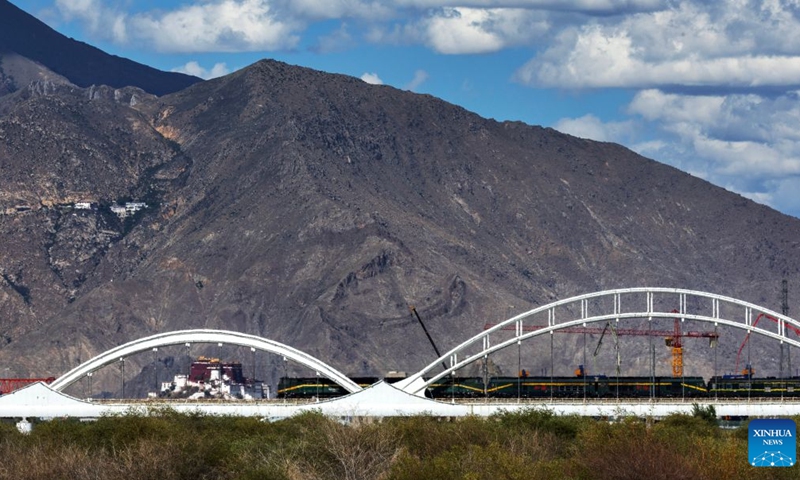
A train crossing a bridge over the Lhasa River on the Qinghai-Xizang Railway is pictured against the Potala Palace in Lhasa, southwest China's Xizang Autonomous Region, June 22, 2026. (Photo: Xinhua)
As the Qinghai-Xizang Railway marks the 20th anniversary of its operational launch on Wednesday, the landmark plateau railway has carried more than 100 million passenger trips, becoming a vital artery that has injected strong momentum into the high-quality development of Xizang.
The railway, a landmark project of China's western development strategy, has handled 104 million passenger trips and 824 million tons of cargo over the past two decades, state broadcaster CCTV News reported on Tuesday.
Over the past 20 years, the railway has evolved from an exceptionally challenging engineering project into a key transport corridor underpinning the development of the region, while supporting local growth, ethnic unity, border stability and better livelihoods along the route, analysts said.
The 1,956-kilometer railway, which fully opened on July 1, 2006, links Xining, capital of Northwest China's Qinghai Province, with Lhasa in Southwest China's Xizang Autonomous Region. It is the world's highest and longest plateau railway.
At the time, the project was widely regarded as one of the world's most difficult railway projects, as builders had to overcome extreme challenges including high altitude, severe cold, oxygen deficiency, fragile ecosystems and long stretches of permafrost, according to the Chinese Academy of Engineering.
"The significance of the railway goes beyond the successful construction of a railway under extreme natural conditions. Its greater value lies in two decades of stable operation and its continued support for regional development," Liang Haiming, dean of the Hainan University Belt and Road Research Institute, told the Global Times on Tuesday.
The railway has reduced the impact of geographic distance and strengthened Xizang and Qinghai's links with the national market. Its role goes well beyond transportation, as it has supported industrial development, tourism, employment and people-to-people exchanges, Liang said.
Official data shows that over the past two decades, Xizang's GDP has grown more than sevenfold, while Qinghai's GDP has increased more than sixfold. In 2025, average per capita disposable income of all residents in Xizang reached 33,600 yuan ($4,960), while income growth among both urban and rural residents ranked first nationwide.
During the same period, the number of scheduled daily passenger train pairs on the line has increased from five in 2006 to 13 in 2026, while passengers departing from Lhasa can now reach 14 municipalities and provincial capitals directly by train, strengthening exchanges between the plateau region and the rest of the country, according to CCTV News.
Railway authorities have also expanded plateau logistics services in line with local industrial needs. Freight trains now run directly to Lhasa and Xigaze from Xi'an, Northwest China's Shaanxi Province, Xining, Northwest China's Qinghai Province, Wuhu, East China's Anhui Province, and Guangzhou, South China's Guangdong Province.
The railway's freight network has also expanded beyond China. Regular China-Central Asia freight train services now reach six cities in four countries. The average number of daily freight trains on the railway has risen from 24 in 2006 to 136, while freight volume has grown at an average annual rate of 5.6 percent, according to the report.
Liang said the railway now carries broader strategic significance, having evolved from a route into Xizang into part of China's wider efforts to improve western infrastructure, promote high-quality development in border areas and strengthen regional opening-up as a corridor connecting China's southwest and northwest and facing South Asia.
Railway infrastructure in Qinghai and Xizang has expanded markedly over the past 20 years, with the two regions completing 117.02 billion yuan in fixed-asset railway investment and accelerating the formation of a plateau railway network with the railway as its backbone.
The combined operating mileage of railways in Qinghai and Xizang has risen 83.9 percent from 2,207.8 kilometers to 4,060.1 kilometers, significantly improving plateau railway infrastructure, regional connectivity and travel conditions for people along the routes, the CCTV report said.
With better logistics hubs, railway links and border port facilities, the railway is expected to further connect plateau economies with domestic and international markets, especially in tourism, specialty products, clean energy, mineral resources and cross-border trade, Liang said.
Looking ahead, railway authorities are accelerating the modernization of plateau rail transport through technological upgrades, including intelligent operations, energy-saving measures and improved service capacity. The continued development of the railway network is expected to provide stronger support for regional connectivity and the sustainable growth of industries along the route, according to CCTV News.
RELATED ARTICLES