China’s embodied intelligence revenue rises 22.4% in Jan-May as sector accelerates industrialization: expert
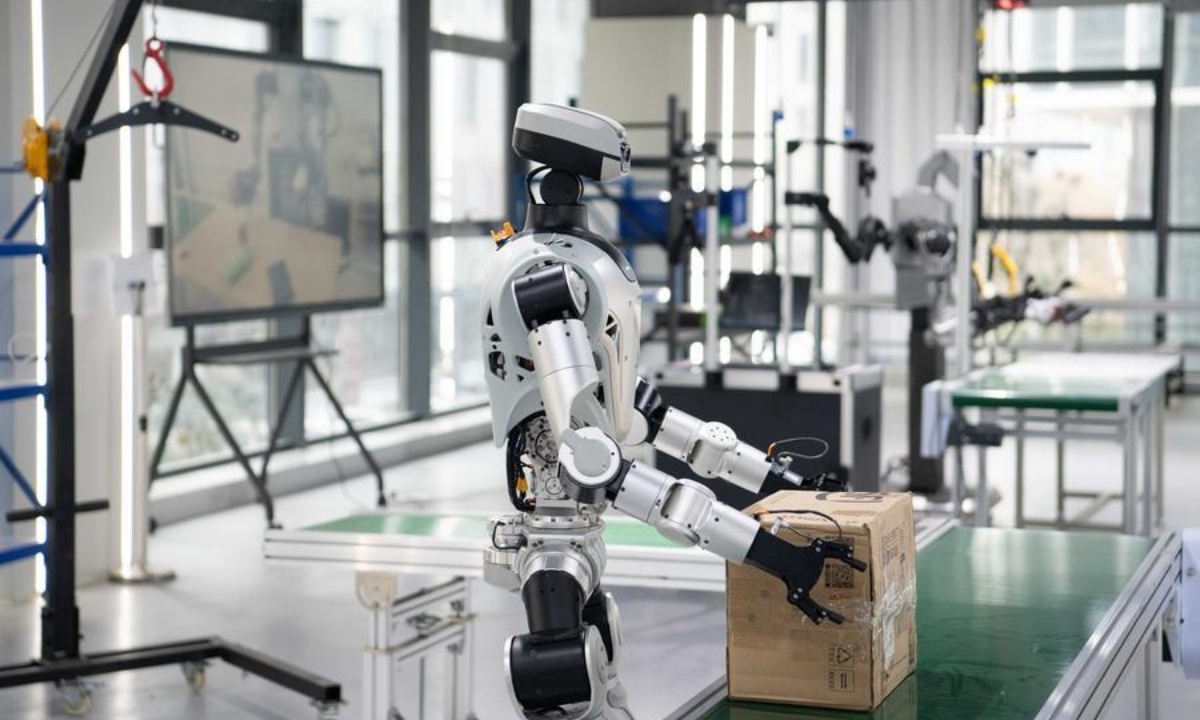
A humanoid robot conducts box-carrying training at a data collection pre-training center for humanoid robots in Hefei, east China's Anhui Province, Dec. 4, 2025. (Xinhua/Zhang Duan)
Sales revenue of China's embodied intelligence industry enterprises rose 22.4 percent year-on-year in the January-May period, indicating that the sector's overall development continues to trend positively, according to the State Taxation Administration on Tuesday.
The latest data once again underscores that, backed by strong policy support and technological innovation, China is accelerating the industrialization of the embodied intelligence sector, a Chinese industry analyst said.
From January to May, sales revenue of enterprises in the embodied intelligence industry grew at a relatively rapid pace of 22.4 percent, building on a 13.9 percent increase recorded for the full year of 2025, according to the official data.
By segment, revenue from robot bodies and complete machine manufacturing rose 30.1 percent year-on-year, that of AI algorithms and software integration increased 24.5 percent, and that of system integration and industry applications grew 27.9 percent, while revenue of core component manufacturers increased 6.8 percent.
Meanwhile, products and services are becoming increasingly aligned with enterprises' needs for transformation and upgrading. In the first five months, the total value of embodied intelligence robots purchased by industrial enterprises rose 2.3 times year-on-year, reflecting the continued deepening integration of embodied intelligence robots into industrial production, said the State Taxation Administration.
At the same time, supporting service revenue grew rapidly, with information system services represented by system integration, deployment, operation, and maintenance support recording a 1.9 times year-on-year increase in sales revenue, signaling stronger integration between embodied intelligence technologies and real economy applications.
Embodied intelligence has moved beyond the stage of technological validation and is entering an early phase of commercialization, highlighted by scalable procurement, sustainable payment models, Ma Jihua, a veteran industry analyst, told the Global Times on Tuesday, noting that the deployable real-world applications from factories to households and domestic services are also adding momentum to the industry's growth.
Moreover, strong market interest in related companies has made financing more accessible, which in turn is helping accelerate technological innovation and product iteration, Ma said.
While expanding rapidly, the embodied intelligence sector is also actively empowering the development of the domestic downstream high-tech service industries.
From January to May, sales revenue from the embodied intelligence industry to downstream software and information technology services and scientific research and technical services and of total industry sales revenue, respectively, with the shares rising by 11.9 percentage points and 4.8 percentage points from the same period last year.
The embodied intelligence industry's revenue from downstream software and information technology services accounted for 25.5 percent of total industry sales revenue, while revenue from scientific research and technical services accounted for 12.7 percent, with both shares increasing compared with the same period last year.
The industry is showing a pronounced cluster effect. Nearly 90 percent of embodied intelligence enterprises nationwide are concentrated in South China's Guangdong Province, Beijing, East China's Zhejiang and Jiangsu provinces.
Guangdong, in particular, has leveraged its dynamic market players and a complete industrial chain, maintaining the largest market scale in the country. From January to May, sales revenue of embodied intelligence enterprises in Guangdong accounted for as much as 78.7 percent of the industry's total sales revenue.
The 15th Five Year Plan (2026-30) outline incorporates embodied intelligence into the country's key strategic layout for future industries, placing it alongside quantum technology and biomanufacturing as one of six major future industries.
Against the backdrop of its inclusion in the 15th Five Year Plan as a key future industry and the continued strengthening of policy support, the sector is expected to accelerate its transition from technological exploration to large-scale application, with growth potential set to further strengthen going forward, Ma said.
RELATED ARTICLES