Paraguay's bid to trade with China while maintaining ties with Taiwan island deemed ‘wishful thinking’ and unacceptable: Chinese expert
By Published: Jul 01, 2026 12:14 PM Updated: Jul 01, 2026 06:20 PM

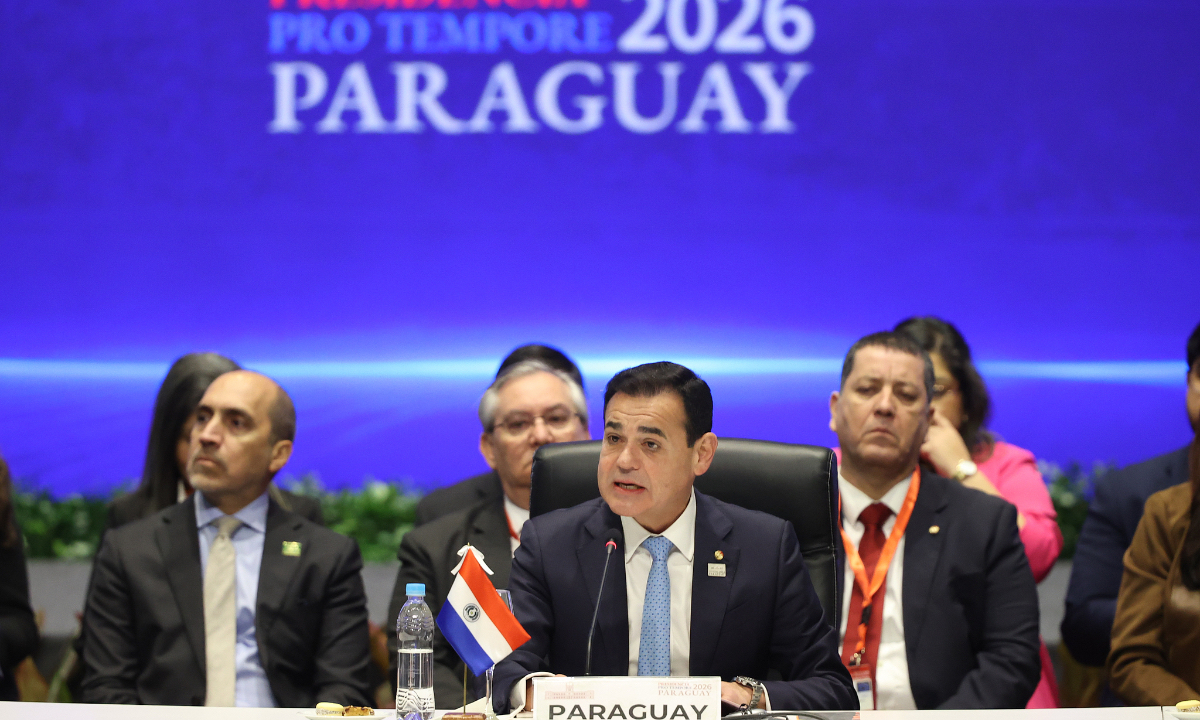
Paraguay's Minister of Foreign Affairs, Ruben Ramirez, speaks during the 68th meeting of the Common Market Council (CMC) in Luque, Paraguay, 29 June 2026. Photo: VCG
The government and leadership of Paraguay need to ask themselves what the people want, what best serves Paraguay's fundamental and long-term interest and where the arc of history bends, and decide whether they should stop being on the wrong side of history and join the overwhelming majority of countries instead, a spokesperson from China's Ministry of Foreign Affairs said on Wednesday after Paraguay's foreign minister claimed that the country is open to trade with China, as long as it does not have to sever its so-called ties with Taiwan island.
Chinese expert dismissed Paraguay's foreign minister's remarks as an attempt to "have it both ways." Seeking the economic benefits of closer ties with China while harming China's core interests is "wishful thinking," the expert said, adding that such a proposition would never be accepted by Beijing.
During a summit in Paraguay with leaders of the South American Mercosur bloc on Tuesday, where trade issues were discussed, Paraguay's Foreign Minister Ruben Ramirez said that Paraguay does not refuse to establish trade relations with China, as long as there are no conditions regarding Paraguay's so-called diplomatic ties with Taiwan island, according to the Strait Times.
Paraguay is the only South American country that has so-called diplomatic ties with Taiwan authorities, and is the only Mercosur member that does not maintain diplomatic relations with China.
The claims made by Paraguay's foreign minister are obviously trying to "have it all," Sun Hongbo, a researcher in China-Latin American relations at the Chinese Academy of Social Sciences, told the Global Times, noting that any move that undermines China's core interests will inevitably prompt a policy response. Economic and trade cooperation cannot be separated from political fundamentals, nor can it advance at the expense of China's core interests.
Sun said Paraguay's proposal to deepen trade ties with China while retaining so-called diplomatic relations with island of Taiwan amounted to "wishful thinking." Whether such an arrangement is possible ultimately depends on China's policy, not Paraguay's aspirations.
According to Foreign Trade Report released by the Paraguay's Department of External Sector Statistics, China remained Paraguay's largest supplier of goods as of the end of March 2026, the country's El Nacional reported.
Major imports from China included mobile phones, portable data-processing equipment, and tires.
Ramirez's remarks came after Brazilian President Luiz Inácio Lula da Silva said the South American bloc was advancing talks on an economic partnership with Japan, adding: "Very soon, we want to do the same with China," according to La Tribuna, a Paraguayan newspaper.
As other Latin America countries explore ways to deepen economic ties with China, Paraguay risks confining itself to an increasingly narrow diplomatic position, said Sun, noting that China is one of the world's largest consumer markets and a crucial destination for Latin American agricultural products, energy and minerals, as well as a key partner in infrastructure investment.
Seeking greater access to that market while rejecting the political foundation Beijing regards as non-negotiable ultimately risks hurting Paraguay's own interest. Sun said that the country has reached a point where it needs to reassess the limits of its current policy toward island of Taiwan.
When being asked that Paraguay's president Santiago Peña is visiting Taiwan with a delegation of business leaders in May, Lin Jian, a spokesperson from China's Ministry of Foreign Affairs, said that the one-China principle is a basic norm in international relations and a prevailing international consensus. On the basis of this principle, a total of 183 countries have established diplomatic relations with China.
"We urge the Paraguayan authorities to come to the right side of history as soon as possible, and make the right decision to recognize the one-China principle and sever so-called diplomatic ties with the Taiwan authorities," said Lin.
RELATED ARTICLES