Yuan viewed as effective portfolio diversification means: survey
Trend signals irreversible shift toward a multipolar monetary order: expert
By Published: Jul 01, 2026 09:08 PM

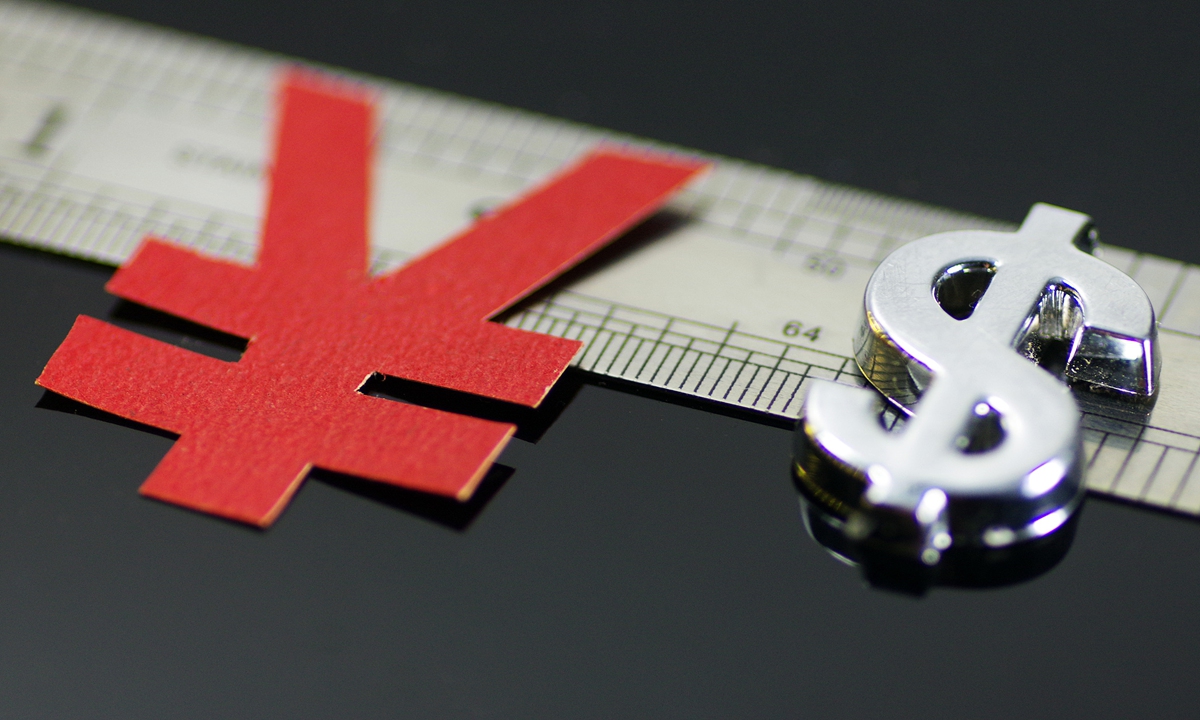
Concept picture of yuan and dollar Photo: VCG
Nearly all of the surveyed respondents viewed the Chinese yuan as an effective means of portfolio diversification, according to a report carried out by the London-based Official Monetary and Financial Institutions Forum (OMFIF) on Tuesday (local time).
That signals a substantial loosening of the unipolar dominance that has long characterized the global monetary system and an irreversible shift toward a multipolar monetary order, a Chinese expert said on Wednesday.
The most attractive markets were the US and China, in part driven by their role in the AI boom, according to the survey of 90 central banks, public pension funds and sovereign funds by the London-based thinktank set up in 2010. Survey participants collectively oversee some $10 trillion in assets.
However, for the first time, more central banks are set to shrink dollar holdings, as more of the world's central banks plan to cut dollar allocations than increase them in the coming decade as political risks associated with the US currency rise, the survey showed. It is the first time the OMFIF survey has found such a shift away from the dollar.
About 79 percent of central banks, and 60 percent of public funds, believe the global monetary system is transitioning toward a "multipolar" world. The survey also found that gold, which has hit a series of record-high prices and is held by 82 percent of central banks, "has moved to the center of reserve management strategy," per a Reuters report.
The survey also showed a perception shift toward emerging markets, with 38 percent of global public funds planning to increase allocation to emerging economies, up from last year's 27 percent, Reuters reported.
Interest in increasing emerging market allocation outstripped demand for increasing allocation to developed economies, which fell to 25 percent from last year's 47 percent.
Tian Lihui, dean of the Institute of Financial Development at Nankai University, told the Global Times on Wednesday that global public investors are no longer treating the US dollar as an absolute safe haven. Instead, they are accelerating efforts to diversify their assets in order to hedge against the risks inherent in over-reliance on a single currency.
Amid this diversification trend, the Chinese yuan faces a strategic opportunity to evolve from a mere payment and settlement instrument into a global transaction and reserve currency and the yuan's safe-haven attributes and stability have become increasingly prominent, with global central banks now viewing it as an "indispensable" component of portfolio diversification, Tian said.
In particular, in emerging markets such as those in the Asia-Pacific, Africa and Latin America, the willingness to increase holdings of yuan-denominated sovereign bonds has grown notably, Tian noted.
Notably, Brazil is set to become the first Latin American country to register for sovereign panda bond issuance, with the Brazilian Ministry of Finance submitting an application letter to the National Association of Financial Market Institutional Investors for the issuance of panda bonds, yuan-denominated bonds issued in China by overseas entities, according to a statement on the PBC's official WeChat account.
A number of global financial institutions have also expressed bullish views of the yuan. Recent data from Standard Chartered showed that its Renminbi Globalisation Index rose to 224.8 in April, up from a base of 100 in January 2015, indicating that the global use of the Chinese currency has more than doubled compared with a decade ago, according to a report sent to the Global Times earlier in June.
In a March report, Union Bancaire Privee, a Swiss private bank, expects the currency to keep rising against the dollar over the next decade due to improving fundamentals and policy reforms, Bloomberg reported. UBP, which manages over $190 billion, forecast the onshore yuan to reach 6.70 per dollar by the end of 2026.
RELATED ARTICLES