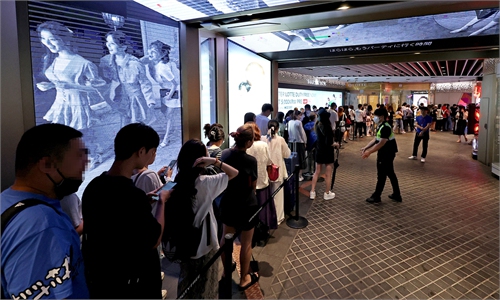
Chinese tourists arrive at Incheon Port International Passenger Terminal in Incheon, South Korea, preparing to spend the May Day holidays from May 1 to 5, on April 30, 2026. Photo: VCG
South Korea has stepped up efforts to attract Chinese visitors, as the country's justice ministry has announced to extend its waiver of group visa fees for travelers from six countries, including China, through the end of 2026. The move will further help boost people-to-people exchanges amid a growing number of Chinese visitors to South Korea, according to Chinese industry players on Wednesday.
According to a press release from the South Korea's Ministry of Justice, it is extending the waiver of visa issuance fees for group tourists from six countries - China, Vietnam, the Philippines, Indonesia, India and Cambodia - from the originally planned end date of June of this year to December 31, 2026.
With tourism demand to South Korea recovering, particularly from China and Southeast Asian countries, the number of group tourists has been steadily increasing, the ministry said, noting that the move is implemented to provide ongoing support for revitalizing group tourism by foreign visitors.
Xu Xiaolei, a marketing manager at CYTS Tours Holding Co, told the Global Times on Wednesday that the latest move is an important measure to promote tourism in South Korea and drive the development of the local tourism industry, as the earlier policy has produced good results.
In addition, this decision is a clear affirmation and strong emphasis on the importance of the Chinese tourism market, Xu said. "By reducing costs, South Korea aims to increase the enthusiasm of Chinese travel agencies in promoting tour groups. This will also directly boost people-to-people exchanges between the two countries and further deepen mutual understanding," the expert noted.
South Korea has rolled out a number of policies to attract Chinses tourists. According to Yonhap News Agency, the Ministry of Culture, Sports and Tourism of South Korea announced on June 18 that it will step up its marketing campaign targeting Chinese tourists with the slogan "Short, Frequent Trips to South Korea."
Since March 30, the South Korean government has been issuing multiple-entry visas valid for five years to Chinese and Southeast Asian nationals who have previously visited the country, and for 10 years to residents of 14 major Chinese cities, including Beijing and Shanghai, the Yonhap News Agency reported.
Chinese travel platform Qunar told the Global Times on Wednesday that from the perspective of hotel booking volume, South Korea ranks among the Top 10 most popular outbound travel destinations for the summer season this year.
According to Yonhap, South Korea welcomed a record number of foreign tourists in the first quarter of this year, with China leading inbound travel with about 1.45 million visitors, up 29 percent from the same period in 2025. The number of Chinese visitors to South Korea this year is expected to exceed 6 million, South Korean Ambassador to China Ro Jae-hun said.
Xu noted that the Chinese tourism market is important for South Korea's tourism industry, with spillover effects on retail, duty-free shopping, hospitality, catering and regional economies. He added that tourism by South Korean residents to China has also shown new characteristics.
According to Xu, in earlier years, it was mainly concentrated in first- and second-tier cities. In recent years, South Koreans have shown increasing interest in exploring China's rich cultural heritage, urban landscapes, and natural scenery. For example, Zhangjiajie in Central China's Hunan Province has been a popular destination, while places like Yibin, Southwest China's Sichuan Province, and Urumqi, Northwest China's Xinjiang Uygur Autonomous Region, have also emerged as top destinations.
"Increased people-to-people exchanges can enhance mutual understanding and reduce misunderstandings. China-South Korea personnel exchanges not only directly contribute to tourism and the services trade, but also indirectly support goods trade, investment and technological cooperation through 'heart-to-heart connectivity.' They serve as a 'catalyst' for the long-term stable development of bilateral relations," Xu said.
RELATED ARTICLES