How should Taiwan society properly recognize the governance capacity of the CPC?: Hai Feng
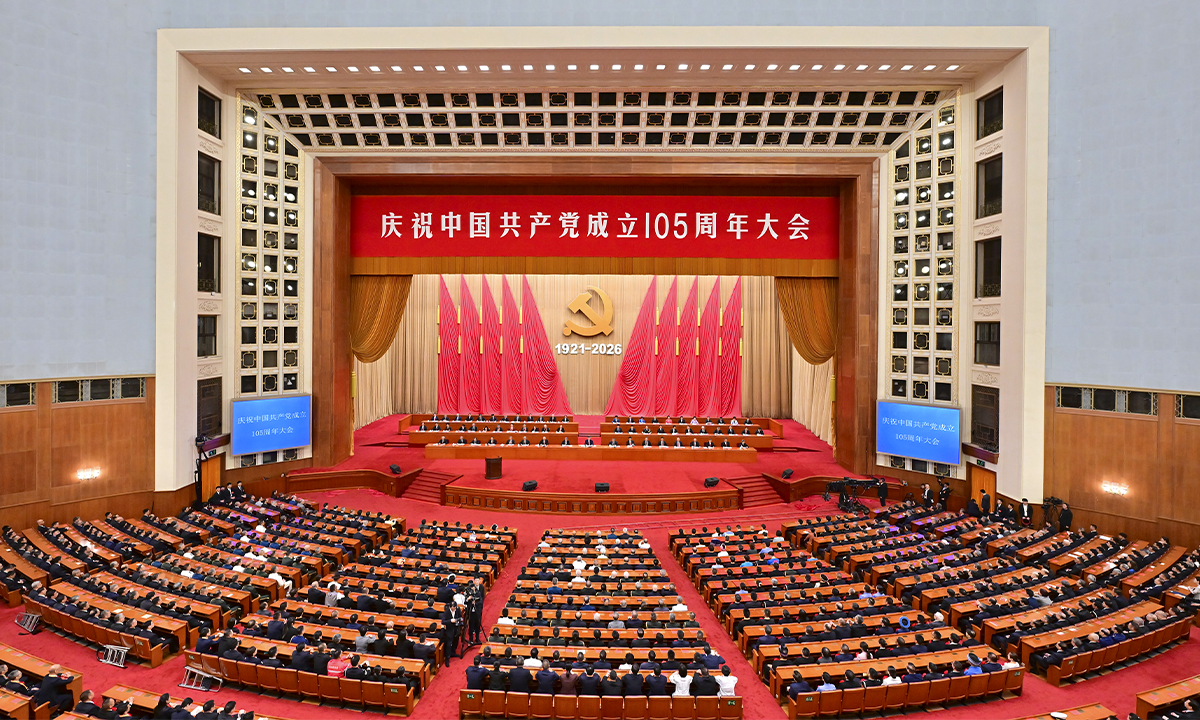
A gathering in celebration of the 105th founding anniversary of the Communist Party of China is held at the Great Hall of the People in Beijing, on July 1, 2026. Photo: Xinhua
Recently, the Chinese mainland has continuously released two sets of signals that are worth serious attention from Taiwan society.
The first set is top-level thinking. Xi Jinping, general secretary of the Communist Party of China (CPC) Central Committee, delivered an important speech at a gathering marking the CPC's 105th founding anniversary on July 1, systematically reviewing the Party's 105-year history of achievements and summarizing its six fine qualities that have formed through long-term governance. The second set is official data. The Organization Department of the CPC Central Committee released a report showing that, the CPC had nearly 101.29 million members as of the end of 2025, with over 5.43 million primary-level organizations.
Looking at these two signals together, a clear conclusion emerges: for today's Taiwan society, objectively understanding the CPC and rationally recognizing its governance capacity are issues that can no longer be avoided and must be faced directly.
The reason is simple: Today's CPC is no longer the abstract political symbol imagined by Taiwan public opinion. It is the world's largest ruling party, with over 100 million members, more than 5.43 million primary-level organizations, a well-structured organizational system, mature operational mechanisms, and deep integration into the national governance system. It is not only the core leading force of Chinses modernization, but also the most fundamental political guarantee and powerful driving force for advancing Chinese modernization. If Taiwan still interprets it through stereotypes from decades ago, ideological filters, and electoral rhetoric, it will be very difficult to truly understand today's mainland and even harder to judge how cross-Straits relations will develop in the future.
In the early years of the People's Republic of China, the country was impoverished, weak, and underdeveloped, with a fragile industrial base, a society in need of reconstruction. After more than 70 years of continuous development—especially since the rapid growth following reform and opening-up, and now with systematic advancement of Chinese modernization—China has grown into a major global power, possessing a complete industrial system, a massive domestic market, strong infrastructure capabilities, comprehensive national mobilization capacity, and influential roles in science, manufacturing, finance, and strategy worldwide. Looking at the recent history of global development, the rise of a major power across all dimensions—comprehensive, leapfrogging, and sustained—is impossible under a government led by a loosely organized, fragmented, and strategically confused political party.
Precisely because of this, the six fine qualities of the CPC's long-term governance summarized by General Secretary Xi in his speech on July 1 are worth the Taiwan society studying carefully. These six fine qualities are the key to understanding "why the CPC can succeed."
First, it accurately sets the direction forward. For a major party and a major country, the greatest danger is not temporary difficulties but deviation from the right direction and wavering strategies. The CPC always emphasizes the unity of theory, strategy, and strategic goals. From revolution, construction, reform to the new era, methods are adjusted, theories are innovated, but the direction remains consistent, and the pursuit and application of truth never change. For Taiwan society, it is crucial to understand this: the mainland's policies are strategic layouts based on long-term considerations, with carefully planned overall strategies, high stability, and continuous implementation.
Second, it has a solid foundation. An important feature of mainland governance is that the CPC has never been aloof or detached from the masses. Instead, it goes deep into the grassroots and frontline, firmly standing with the people. What does this number of primary-level organizations—over 5.43 million—mean? It means the Party has achieved full coverage of social governance across all fields and levels. Many in Taiwan are used to viewing the CPC as a purely "top-down" power structure, but in reality, it is a comprehensive organizational network that extends vertically and horizontally. This organizational capacity itself is the most core and unique advantage of governance.
Third, it masters strategic initiative. Over a century, the CPC's most distinctive governing ability is its skill in identifying the main axis, setting priorities, and planning the overall situation amid complex circumstances. Whether it is winning the fight against poverty, promoting industrial transformation and upgrading, deploying key technological projects, or calmly responding to external containment and suppression, as well as resolving various geopolitical risks and security challenges, the CPC has demonstrated strong strategic judgment and firm strategic execution. General Secretary Xi mentioned that the whole Party must "remain undaunted by passing clouds and stay on course through wind and waves." This is a sober and realistic assessment. If Taiwan society underestimates this risk awareness and strategic initiative, it is prone to misjudging the resilience of the mainland's policies and the strength of its actions.
Fourth, it stays at the forefront of the times. For a long time, some opinions in Taiwan liked to portray the mainland as rigid, conservative, closed, and lagging behind, but the reality is quite the opposite. Whether it's digital governance, infrastructure development, mobile payments, supply chain integration, or new energy, high-end manufacturing, and artificial intelligence, the mainland is advancing Chinese modernization with exceptional execution. The reality shows that the CPC has unique advantages in identifying trends, organizing resources, and responding institutionally. Fundamentally, this is because the CPC possesses qualities with no parallel among other political parties and forces.
Fifth, it maintains unwavering confidence in victory. A party with 105 years of history that can still sustain a strong sense of purpose and political will is itself a form of capability. Many observations in Taiwan society tend to focus on short-term public opinion or localized issues, mistakenly believing that the mainland will lose order under various pressures. But from a historical perspective, the CPC is precisely a party that is unafraid of struggles and challenges. Instead, it can continuously strengthen its cohesion and mobilization capacity under pressure. Failing to see this clearly will lead to systematic misjudgments about the resilience of China's development.
Sixth, it is full of vitality. General Secretary Xi stressed self-reform in his speech and to rid any "ailment" that erodes the Party's health. This amply demonstrates that the CPC never shies away from issues arising during development or shortcomings in governance; instead, it consistently upholds its governing capacity and leadership capabilities by enforcing strict discipline, combating corruption, strengthening its organizational structure, and refining its system of internal regulations. Whether a ruling party of such immense scale can maintain stable governance over the long term depends largely on its capacity for self-purification, self-improvement, self-renewal and self-enhancement. Practical results confirm that such capacity indeed exists.
When looking at the mainland today, the greatest cognitive challenge for Taiwan society is not a lack of information; rather, it is that some people fail to correctly recognize that China's current economic development, social stability, human rights protections, and technological advancements are inextricably linked to the governance, organizational, and political systems of the CPC.
Any discussion regarding the future of cross-Straits relations that is predicated on underestimating, misunderstanding and misinterpreting the governance capabilities of the CPC will only lead Taiwan society into deeper cognitive distortions. And this is precisely the lesson that Taiwan society most needs to learn today.
RELATED ARTICLES