Economy’s higher-quality growth is supported by high-tech innovation, massive market


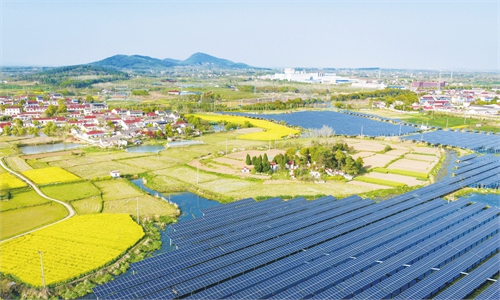
A view of Guangzhou, South China's Guangdong Province on June 11, 2026 Photo: VCG
This year marks the start of China's 15th Five-Year Plan (2026-30) period. As the year reaches its midpoint, China's economy has remained broadly stable despite a very complex international environment.
The resilience displayed by China's economy has continued to strengthen, positioning the country to achieve a solid mid-year performance powered by a set of new growth engines. Data from the first five months of the year show that the economy has been running on a stable trajectory, constantly gaining new steam.
Structurally speaking, the economic performance is shown in two major development trends - continuous strengthening of new growth drivers on the production side, and increasingly prominent role played by high-end modern services.
On the production side, new and robust growth engines have popped up one after another. Within the industrial sector, high-tech manufacturing and equipment manufacturing have emerged as major drivers of economic growth. According to data from the National Bureau of Statistics (NBS), value-added output of high-tech manufacturing and equipment manufacturing sectors expanded by 15.1 percent and 9.5 percent, respectively, in May, outpacing overall industrial growth rate.
To be specific, artificial intelligence (AI) innovation is advancing rapidly, helping drive growth across a broad range of emerging industries. In May, output of 3D printing equipment, lithium-ion batteries, and industrial robots rose by 54.4 percent, 40 percent, and 27.9 percent, respectively. This shows AI's growing role in empowering other sectors and fueling up growth momentum of Chinese economy.
The service sector is prospering too. In May, service sectors including information transmission and software development all recorded double-digit growth.
On the demand side, foreign trade has remained resilient. Not only has the overall trade volume kept expanding, but the structure of trade has also shifted toward higher technology content, greener products, and greater market diversification.
And, China's export structure continues to upgrade. Exports of mechanical and electronic products, high-tech goods, and electric vehicle charging equipment have grown rapidly, reflecting a broader transition from traditional labor-intensive goods shipment toward more capital-intensive and technology-intensive products.
The development of the service sector plays a particularly important role in boosting household incomes. China's consumption structure is currently shifting from one dominated by goods consumption to one increasingly led by services.
Meanwhile, the country's consumption patterns are undergoing profound changes. Data released by the NBS on Tuesday showed that China's total retail sales of goods and services increased by 2.8 percent year-on-year in the first five months of 2026.
Innovation on the supply side is helping drive consumption upgrade. Cultural consumption offers a clear example. Younger generations today are increasingly willing to spend on cultural tourism, live gala shows, and other experience-based activities. The trend reflects the broader upgrading of services consumption.
Despite persistent skepticism by some Western media toward China's economic growth outlook, the economy has continued to demonstrate strong resilience this year, which is shown in the fundamentals.
First, China benefits from the advantages of a huge domestic market. The depth and breadth of the massive consumer demand make it difficult for any external shocks to undermine the country's economic foundations. When external demand fluctuates, domestic demand is capable of providing timely support.
Second, China possesses a complete industrial system. It is the world's only country which covers all industrial categories defined under the United Nations industrial classification system. One key advantage of such a complete industrial system is high degree of industrial-chain resilience. Even when external restrictions target specific links in the supply chain, China can maintain normal economic operations through domestic innovation and substitution efforts.
A complete industrial system enables continuous industrial upgrading. Traditional sectors such as steel and textile can continue to develop alongside emerging industries such as new energy and biopharmaceuticals.
Third, China benefits from the integration of four critical chains -- the innovation chain, industrial chain, capital chain, and policy chain. Their coordinated development provides strong support for industrial upgrading and high-quality economic growth.
Also, China's contribution to the global economy is significant. China remains as a major stabilizer of global growth. For many years, the country has contributed roughly 30 percent of global growth, making it one of the world's most important growth engines.
Moreover, China remains a key anchor of global industrial and supply chains. It provides the world with a large volume of high-quality, cost-effective products while supporting global manufacturing through extensive trade in intermediate goods, which help stabilize global supply chains and consumer prices.
And, China is becoming an increasingly important driver of global technological innovation. On the one hand, its vast market provides abundant application scenarios for new technologies and new products. On the other hand, its complete industrial ecosystem tends to accelerate commercialization of new innovations.

An Zidong Photo: Courtesy of An Zidong
The author is a professor and associate dean at the School of Applied Economics under Renmin University of China. bizopinion@globaltimes.com.cn
RELATED ARTICLES