India’s selective opening to Chinese power firms reflects pragmatic adjustment to energy needs, but more open approach needed: expert
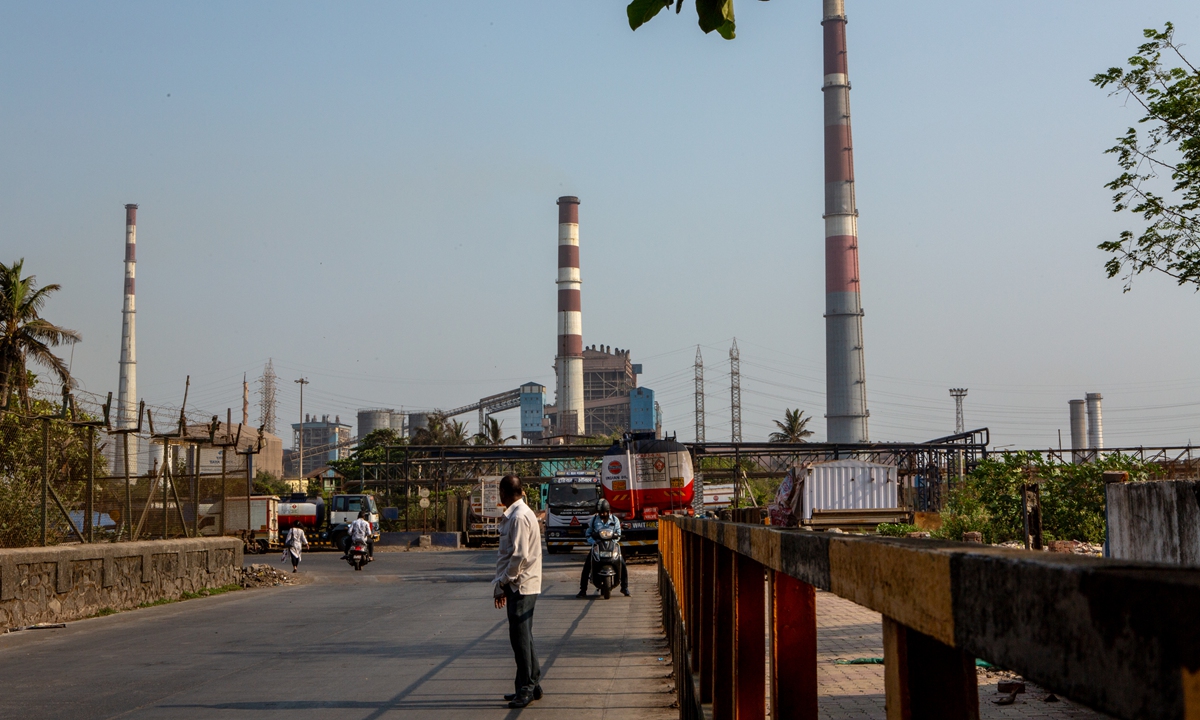
Chimneys stand at the Tata Power's Trombay Thermal Power Station in Mumbai, India on April 23, 2026. Photo: VCG
India has reportedly allowed four Chinese power equipment manufacturers with factories in the country to participate in government tenders for critical power projects. Chinese analysts described the move as "a pragmatic adjustment" to India's energy infrastructure needs, but New Delhi needs to take a more open and fair approach toward Chinese firms to strengthen economic cooperation.
The four companies are TBEA Energy, Nanjing Electric India, New Northeast Electric India and Taikai Electric (India), Reuters reported on Friday, citing a June 24 order from India's Ministry of Finance.
India's power ministry had sought the exemption in January for entities with manufacturing units in India involved in critical power projects, and the exemption comes as India accelerates the expansion of its transmission network to support rising electricity demand and renewable energy additions, according to the report.
Qian Feng, director of the research department at the National Strategy Institute at Tsinghua University, told the Global Times on Friday that the move marks a pragmatic adjustment in India's China policy and reflects some improvement in bilateral relations.
"For India, this is a practical step aimed at supporting its own economic development and easing pressure in electricity supply," Qian said, adding that the Indian government has likely recognized that Chinese enterprises' technology and equipment capabilities are indispensable for helping India improve its power infrastructure, given their high cost-effectiveness.
Previously, amid bilateral tension, New Delhi has required Chinese bidders to register with a government panel and secure political and security clearances before competing for any state contract, Reuters reported. In January, Reuters reported that India was examining broader relaxations on Chinese bidders for government contracts, amid easing of border tensions.
Still, the latest exemption does not suggest that India has abandoned its broader restrictions on Chinese companies, analysts said. The exemption is valid for two years and should not be treated as a precedent for other companies, according to Reuters.
Qian said this reflects India's two-sided perception of China. "India recognizes that cooperation with China can support its economic development and improve people's livelihoods, but domestic public opinion and political resistance still constrain a faster improvement in bilateral relations," he said.
The same dual approach has also appeared in India's handling of Chinese investment. In March, Reuters also reported that India would offer faster approval for investments involving minority Chinese stakes across a wider range of sectors, including electronics, batteries, rare-earth magnets and processing, provided Chinese ownership remained below 10 percent and majority control stayed with Indian residents.
However, Reuters citied an Indian official who said that security concerns related to Chinese investments remain and proposals will continue to undergo scrutiny.
Qian cautioned that against the backdrop of India's rising infrastructure and energy needs, excluding Chinese supply chains could increase costs, delay delivery and reduce the efficiency of infrastructure expansion.
The pressure on India's power system remains visible. Reuters reported in Friday that India's coal-fired power output in June rose to its highest level since November 2023, as rising electricity demand kept pressure on the country's power supply system.
China-India economic ties are highly complementary, and deeper cooperation with China would bring clear benefits to India. If India imposes restrictions, it may struggle to encourage Chinese enterprises to enter the Indian market and expand investment and cooperation, Qian noted.
In the first five months of this year, bilateral trade jumped more than 20 percent year-on-year, according to Chinese customs data, showing that economic complementarity remains strong despite lingering political frictions.
Recent economic interactions have also pointed to efforts to stabilize bilateral ties. Chinese Minister of Commerce Wang Wentao met Indian Minister of Commerce and Industry Piyush Goyal on the sidelines of the WTO's 14th Ministerial Conference in Yaoundé, Cameroon, China's Ministry of Commerce said in late March.
Wang said China is willing to work with India to make economic and trade cooperation a "ballast stone" in bilateral relations, and welcomes India's participation in events such as the "Shared Market: Export to China" series to expand its exports to China, according to the ministry.
At the industry level, exchanges have also resumed in key growth sectors. According to an April 9 statement by India's PHD Chamber of Commerce and Industry (PHDCCI), its renewable energy and EV delegation visited Shanghai and held B2B meetings with Chinese companies, with PHDCCI saying stronger India-China partnerships in these sectors could help accelerate innovation and reduce technology costs.
"The Indian government should take a longer-term view and adopt more active policies toward Chinese enterprises," Qian said. "That would give China-India economic and trade cooperation stronger momentum and create better conditions for improving bilateral relations."
RELATED ARTICLES