Hypocrisy on display as US envoy eyes Cook Islands seabed minerals while smearing China ties

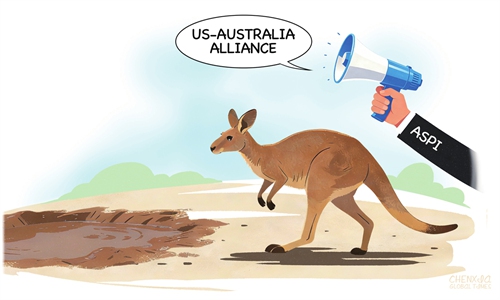
Illustration: Chen Xia/Global Times
It took Jared Novelly, the new US ambassador to New Zealand and several Pacific Island nations, almost no time to lay out a carefully coordinated narrative on South Pacific partnerships at his press conference on Friday.
In one breath, he emphasized that securing the Cook Islands' seabed minerals is a top strategic priority; in the next, he recycled the shopworn tropes of Chinese "debt traps." This pairing - coveting another nation's strategic resources while attempting to smear that country's other partnerships - offers a textbook demonstration of hypocrisy in modern geopolitics.
Why does the US suddenly show greater interest in securing the Cook Islands' critical minerals as a strategic priority? According to Reuters, this is against the backdrop that the US seeks to "reduce its reliance on China-dominated supply chains and support defence and clean-energy industries."
In February, the US and the Cook Islands agreed to a non-binding Framework for Engagement and Cooperation to strengthen supply chains for critical minerals and rare earths, including cooperation relating to deep-sea minerals. However, it seems Washington is seeking to push things even further. Chen Hong, director of the Country and Region Studies Institute at the School of Foreign Languages, East China Normal University, told the Global Times that Washington is now aggressively tying deep-sea minerals to its domestic military-industrial complex, clean energy manufacturing, and supply-chain security. The real US playbook is to leverage its superpower heft to secure US corporate capital's monopolistic foothold over resource access, processing rules, and market control in other countries, Chen noted.
In short, what Washington brands as "securing the supply chain" is simply an attempt to pre-emptively absorb the sovereign resources of smaller nations into its own strategic ledger.
The Cook Islands is not the only nation Washington is courting. During the 2026 Critical Minerals Ministerial in Washington in February, US officials painted a rosy, collective future, explicitly promising the country's allies and partners that the new bilateral critical minerals frameworks and memorandums of understanding signed at the event would "lay the groundwork for nations to collaborate" in many areas.
However, it is questionable how much of this is driven by a genuine concern for the development of US partners and allies, including the Cook Islands, and how much by a calculating desire to use them as a geopolitical wedge in Washington's supply chain showdown with Beijing. Besides, it is reasonable to doubt how much Washington could actually deliver, as US promises often amount to little more than empty checks.
To camouflage the undercurrent, Washington has operated under a double standard when it comes to China. It deliberately conflates the strategic significance of critical minerals with so-called threat from Beijing into a single, security-driven narrative. This systematic mudslinging is designed to force regional countries to pass a Washington-mandated "loyalty test," while eroding the goodwill and solid reputation China has built in the region over many years.
Clearly, the "geopolitical demand" is the real driver behind the US growing interest in the South Pacific. The fact that Washington only rediscovers the importance of the South Pacific region when it feels the chill of "competition with China" speaks volumes about its deep-seated strategic anxiety.
The deeper casualty of this approach is the erosion of regional autonomy. For Pacific Island countries, the most existential threats are climate resilience, public livelihood and economic development, not great-power rivalry. By casting Chinese engagement in a "concerning" framework, Washington is attempting to enforce exclusive "cliques" in the South Pacific to serve its own interests and gain the upper hand over China. As a result, local development risks being hijacked, while urgent priorities are forced to take a back seat to Washington's security checklist, threatening to fracture the fragile regional solidarity built around the "Blue Pacific" architecture.
True stability in the region will not be achieved by Washington engineering artificial panic to extract exclusive commitments. It will come only when sovereign choices are respected, allowing international cooperation to return to a transparent, open, and non-exclusionary track. The Pacific Ocean should be a grand stage for countries to pursue shared development, not one country's private chessboard.
RELATED ARTICLES