What do routine law enforcement patrols in the waters east of China's Taiwan Island signify?: Hai Feng
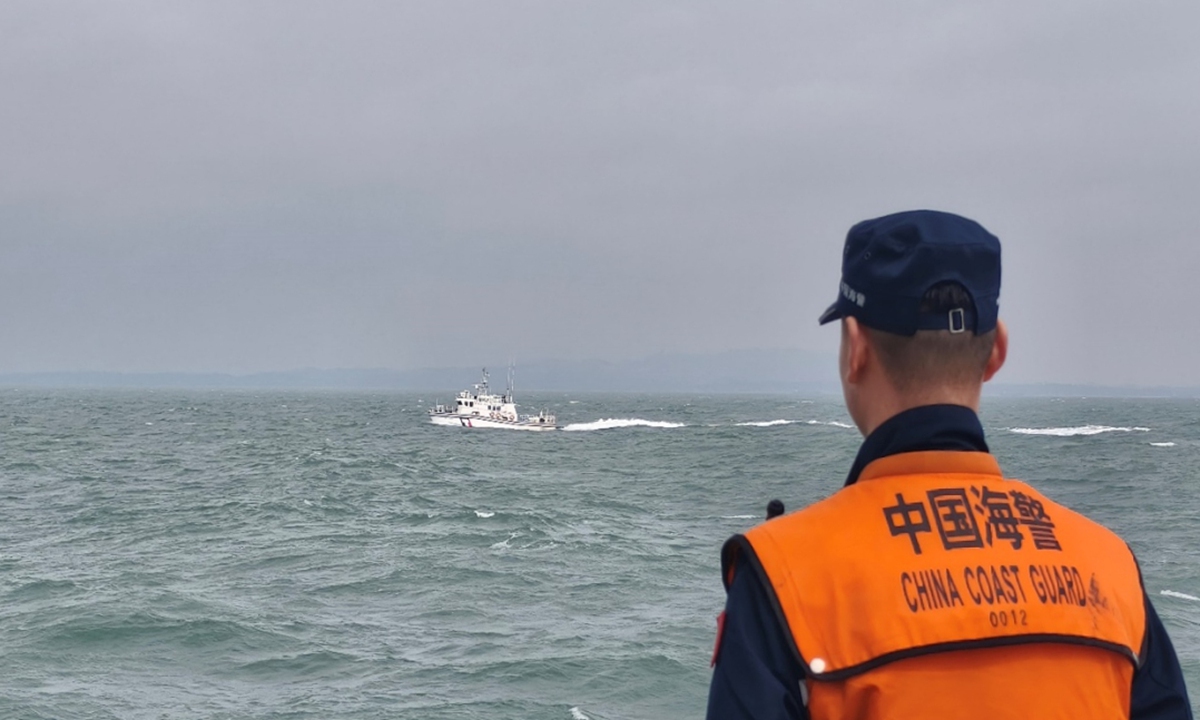
The Fujian Coast Guard organizes a flotilla and conducts a law enforcement patrol in waters near Kinmen on February 25, 2024. Photo: Courtesy of the China Coast Guard
On Saturday, the China Coast Guard (CCG) continued to conduct routine law enforcement patrols in the waters east of China's Taiwan Island. This is a direct response to recent provocations by external forces and the continued escalation of maritime tensions. Against the backdrop of the recent so-called "delimitation" negotiations initiated by Japan and the Philippines, as well as the continued interference by external forces in affairs related to the Taiwan Straits, the message sent by the series of actions is crystal clear: China will never merely make verbal statements on issues concerning its territorial sovereignty, maritime rights and interests, and the one-China principle; instead, it will resolutely defend its core interests with sustained and steady concrete actions.
The waters east of China's Taiwan Island hold extraordinary geostrategic significance. Connecting the Taiwan Straits, the East China Sea, and the Western Pacific, this area is a crucial link in the chain of China's maritime rights and interests. Anyone who attempts to manufacture the so-called "fait accompli" in these waters, bypass China in pushing maritime delimitation talks, or hollow out the one-China principle, is directly infringing upon China's core interests. For this very reason, the CCG's continuous patrols and law enforcement efforts aim not only to maintain normal navigation and operational order, but also to send a clear message to the world: China has indisputable jurisdiction over relevant waters and both the capability and the resolve to uphold this sovereign claim through routine operations.
It is particularly noteworthy that this operation is described as "routine law enforcement patrols." These words carry significant weight. They signify that China's approach to safeguarding its maritime rights is evolving toward a more systematic, institutionalized, and long-term framework. In the past, external observers used to speculate on the situation based on isolated military exercises or individual patrols, but now China is gradually advancing its approach to sovereignty protection from "drawing the sword when necessary" to a new phase characterized by "a constant presence, all-weather capability, and instant operational readiness." For external provocateurs, such a normalized presence itself exerts pressure. At the same time, it demonstrates that China's "toolkit" for safeguarding its maritime rights and interests is becoming increasingly diverse, and its methods are growing more sophisticated.
The gradual expansion of the "toolkit" is also reflected in the coordinated advancement of legal measures, public opinion, law enforcement actions, and strategic deterrence. In response to the "maritime delimitation talks" between Japan and the Philippines, China not only organized the Coast Guard and relevant forces to strengthen its on-site presence but also simultaneously drew red lines through statements of position, explanatory commentary, and arguments based on international law, forming a "combined approach" across multiple levels - including legal, diplomatic, law enforcement, and military. Such systematic countermeasures more fully demonstrate a major power's resolve, will, and strong capability to safeguard its maritime rights and interests.
Behind this series of measures lies a country's comprehensive national strength. Without sufficient maritime capabilities, organizational capacity, command systems, and logistical support, routine patrols would be out of the question; without the continuous enhancement of the nation's comprehensive strength, it would be impossible to resolutely counter external provocations and "walk the walk." Today, the fundamental reason we are able to continuously roll out more precise and more calibrated countermeasures in complex maritime and air environments lies in the all-around enhancement of the nation's hard power as well as institutional mobilization capacity and strategic execution capability.
Ultimately, conducting routine law enforcement patrols in the waters east of China's Taiwan Island conveys a new normal: Any attempt to challenge China's sovereignty, distort the one-China principle, or undermine the framework of China's maritime rights and interests will be met with more comprehensive, sustained, and forceful countermeasures. In the face of provocation, China does not seek conflict, but it is certainly not afraid of it. China's territorial sovereignty and maritime rights and interests are inviolable, and they are absolutely not up for negotiation.
RELATED ARTICLES