IN-DEPTH / IN-DEPTH
From primary to high schools, students showcase AI-powered projects, highlighting China's long-term AI education drive nurturing next generation of innovators
Preparing tomorrow's minds
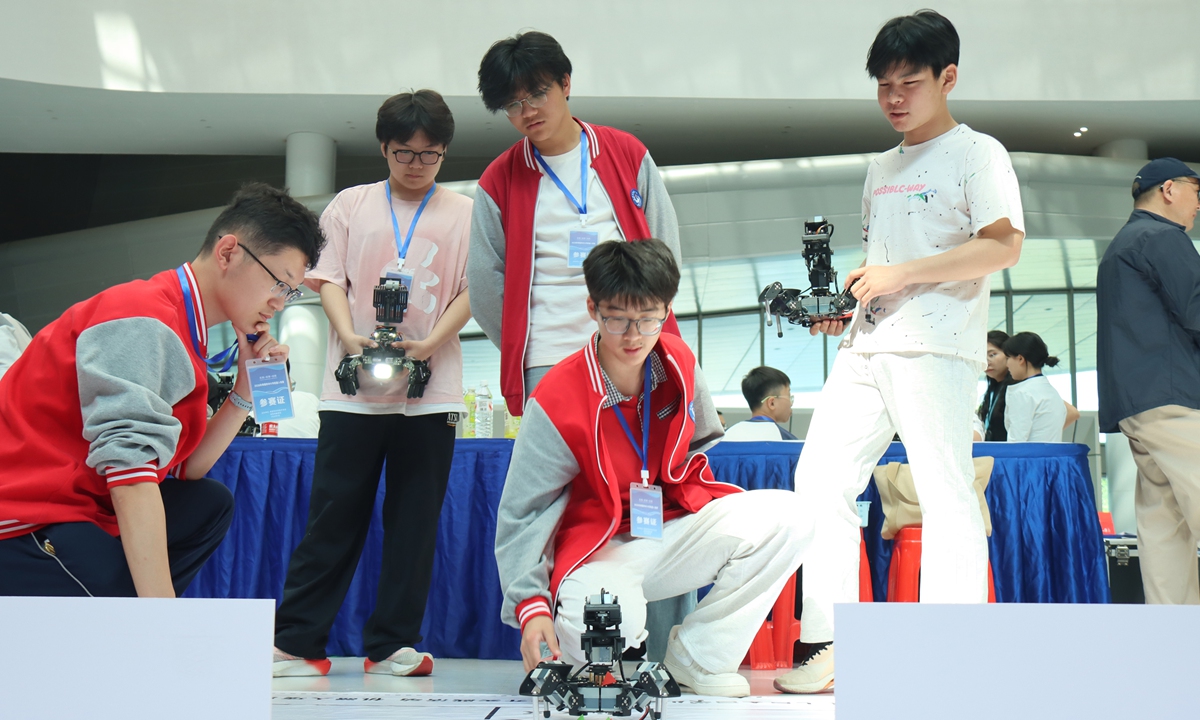
Teenage contestants take part in a robotics competition for primary and secondary school students in Fuyang, East China's Anhui Province on May 16, 2026. Photo: VCG
The atmosphere at an AI-themed forum in Beijing this June felt different from the usual technology conferences. Instead of executives in suits unveiling the latest products, seven primary and secondary school students from across China took turns stepping into the spotlight. A primary school participant was too young to have fully mastered typing on a keyboard, yet each student confidently presented an AI-powered solution designed to tackle real-world challenges.
How can someone with a broken arm still enjoy racing games? How can visually impaired women "see" their makeup? How can pollutants in rivers be remotely monitored and analyzed in real time? These were functioning AI projects created by children whose average age was under 15 - members of what many now call China's "first generation of AI natives."
The showcase came as China continues to expand AI education nationwide. In May 2025, the Ministry of Education released two landmark guidelines introducing AI literacy and generative AI education for primary and secondary schools.
More recently, on June 29, the Ministry of Education said that China's State Council has issued the outline plan for the development of the education sector during the 15th Five-Year Plan period (2026-2030), calling for AI education across every stage of schooling and greater efforts to strengthen students' AI literacy.
The country's growing emphasis on AI education has also attracted international attention. In late May, Newsweek published an article titled "China's Kids Are Getting an Edge With AI," noting that AI is playing an increasingly significant role in Chinese education, with a heavy push from a government that is keen not only to get children to use AI to improve their performance, but also to master the technology behind it.
An industry expert told the Global Times that the steady investment in AI education is beginning to produce visible results, with more students applying AI as a means of solving practical problems. At the same time, educators stressed that technological capability must be guided by correct values.
Turning curiosity into innovation
Among the youngest presenters was Jin Yihong, a primary school student from Shanghai and an avid video game enthusiast. He began his presentation with a photograph showing his right arm in a cast after a fracture.
"If your hand looked like this," he asked the audience, "would you still be able to play video games?"
The personal experience sparked an unexpected journey. During an AI education course, Jin learned about the world's 1.3 billion people living with disabilities, a community he had rarely thought about before.
"My teacher introduced me to a friend living with Wilson's disease," Jin recalled. "His body can't properly process copper, making it difficult for him to control his limbs."
Inspired by the encounter, Jin decided to build an accessible racing game for people with rare diseases, visual impairments and limited mobility.
The project evolved steadily, from a simple 2D obstacle-avoidance game to an early version controlled by foot movements, before eventually becoming a fully immersive 3D racing game.
"I still can't type very well," Jin said with a smile. "But with voice input, I can still create all of this using AI."
His comments unintentionally captured one of AI's most transformative impacts: lowering the barriers to creativity and enabling children to turn ideas into reality long before mastering traditional technical skills.
After Jin sent the game to the friend with Wilson's disease, he received an encouraging response: "I'd like to give it a try."
At another public event in 2025, a participant born with cerebral palsy tested the game and told him he could "play it all day," while also offering suggestions on introducing different accessibility levels for players with varying physical conditions.
The experience changed Jin in unexpected ways. "It made me pay much more attention to accessibility in everyday life," he said. "Now if I see a bicycle blocking a path for visually impaired people, I'll move it out of the way."
A similar desire to solve real-world problems motivated You Xiaopeng, a sixth-grade student from Central China's Hunan Province.
His team developed an AI-powered real-time makeup assistant designed specifically for visually impaired women.
"The idea came from one of our female teammates, who noticed the challenges visually impaired people face," You explained. "Research identified three major obstacles: they cannot observe makeup demonstrations, cannot evaluate the final results themselves, and often struggle with inaccessible tools and environments. So instead of creating an AI that simply tells users how they look, we wanted one that teaches them how to apply makeup."
Another primary school student from Beijing presented an AI-powered robotic system for river monitoring. Equipped with an AI agent, the robot can patrol waterways remotely, monitor water quality, collect environmental data in real time and automatically analyze the information, making environmental monitoring both smarter and more efficient.
As the reporter observed, the forum also featured a youth AI innovation exhibition showcasing more than a dozen student projects, including smart pet collars, AI-enabled home automation systems, intelligent shared bicycle dispatching solutions and AI-assisted rehabilitation devices.
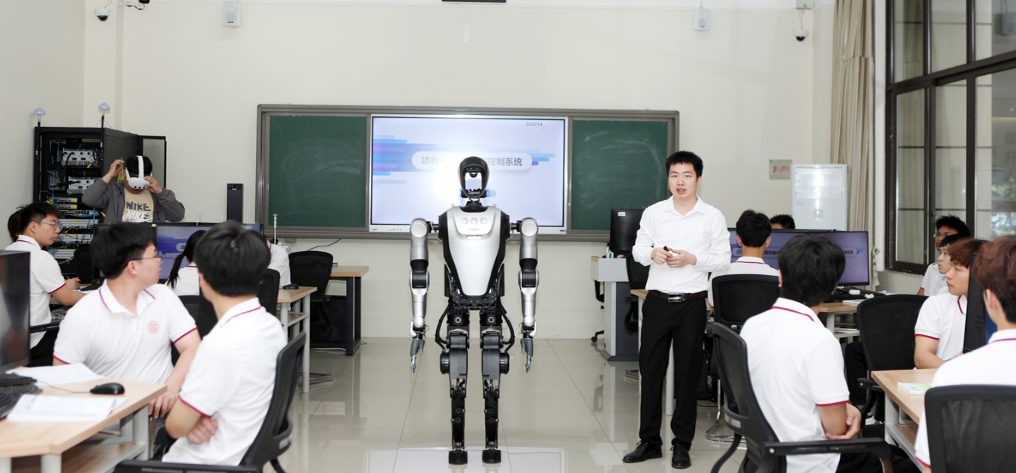
An AI intelligent robot gives lessons to students at a school in Southwest China's Chongqing Municipality on April 16, 2025. Photo: VCG
Building an AI-literate generation
The students who took center stage at the forum are not isolated prodigies. Behind their projects lies a rapidly expanding, nationwide effort to introduce AI literacy into China's basic education system, with the goal of making AI education accessible not only to exceptional students but to every child.
"AI education requires two complementary approaches," the Global Times learned from Lu Yu, deputy dean of the School of Educational Technology at Beijing Normal University and secretary-general of Beijing's expert committee on AI education for primary and secondary schools. "We need programs that identify and cultivate top talent. While, at the same time, we need universal AI education so that many more students have the opportunity to encounter AI, develop an interest in it and eventually allow truly creative minds to emerge."
In reality, AI education in Chinese schools did not begin overnight. Guangzhou in South China's Guangdong Province introduced citywide AI literacy education as early as 2022, followed by Shenzhen in Guangdong in 2023 and Shanghai in 2024. Beijing was set to roll out universal AI education across all primary and secondary schools beginning in September 2025, requiring every student to receive no fewer than eight class hours of AI instruction each academic year, according to media reports.
Scaling such a program, however, has proved to be a challenge. "AI literacy is not yet a nationally standardized subject like mathematics or physics," Lu said. "The biggest question was how to make sure every school, not just a handful of model schools, could actually teach it."
Rather than asking individual schools to design courses from scratch, Beijing developed a centralized support system. According to Lu, the city has produced more than 160 sets of teaching resources, including presentation slides, lesson plans, programming examples and AI tools, all freely available to teachers. It has also organized large-scale teacher training programs and established a dedicated expert committee to provide ongoing academic support.
Beijing's education authorities announced that AI literacy courses now cover more than 1,400 primary and secondary schools, reaching approximately 1.83 million students across the municipality, according to the Beijing Daily on July 2.
"The term 'AI agent' has arguably become even more familiar in primary and secondary schools than it is on many university campuses," Lu said.
China's systematic approach has drawn growing international attention.
"Beijing can kind of set out the agenda for what tools are going to be used, what curricula are going to be established. We don't really have an equivalent of that here, besides funding priorities or maybe some executive orders that kind of establish the importance of something," Priten Soundar-Shah, a Harvard-trained educator, was quoted by the Newsweek in May as saying.
In January, the Financial Times also highlighted the message that science as the key to national progress continues to echo through classrooms and homes in China.
According to the People's Daily in December 2025, China has a talent pool of 220 million skilled professionals, including more than 72 million highly skilled workers. The country is home to nearly 20 million scientists and engineers and sees more than five million students graduate in science, technology, engineering and mathematics (STEM) disciplines every year - the largest annual STEM talent output in the world.
Beyond technology
While the achievements are encouraging and policy support continues to grow, AI education remains a work in progress. Behind the success stories lie challenges that cannot be overlooked.
"In many classrooms today, AI is simply replacing existing teaching tools," Lu said. "Teachers use it to answer questions, explain difficult concepts or prepare teaching materials. That's useful, but fundamentally it's still doing traditional tasks with more advanced technology."
True AI education, he argued, should go much further.
Rather than focusing solely on improving classroom efficiency, AI should help cultivate students' creativity, critical thinking and problem-solving abilities while encouraging them to explore how the technology works and how it can be applied responsibly.
To achieve that goal, Lu has proposed a three-dimensional framework for generative AI education.
The first dimension is generation: understanding how generative AI creates content and the principles behind it. The second is application: learning to use AI creatively and appropriately across different scenarios. The third, and in his view the most important, is responsibility.
Ultimately, Lu believes a well-designed AI curriculum should serve two purposes simultaneously: introducing students to AI, while also addressing long-standing challenges in traditional classroom teaching.
"China has made remarkable progress in expanding AI education nationwide," Lu said. "But achieving genuinely high-quality teaching and learning remains a long-term task."
Chu Zhaohui, a research fellow at the National Institute of Education Sciences, told the Global Times that if education becomes excessively digitized - or relies on AI in one-directional ways - students may gradually lose opportunities for independent exploration, develop greater dependence on digital systems and become increasingly passive in the learning process.
While AI promises personalized learning, Chu cautioned that it may also reduce students' opportunities to make choices, solve problems independently and cultivate resilience through trial and error.
"Also, if educators rely on AI too rigidly, they may gradually become spokespersons for AI models rather than independent educators capable of exercising their own professional judgment and creativity," Chu said.
"No external tool, however advanced or efficient, can replace the development of human intelligence and character," Chu emphasized. "Whether to use AI, how much to use it and in what ways it should be used ought to remain decisions made by educators and learners themselves."
That perspective resonates strongly with Mi Qi, principal of the High School Affiliated to Renmin University of China.
Mi acknowledged that the emergence of large language models and increasingly capable AI agents can make it seem as though every student now has access to an all-knowing tutor.
"But cognitive development doesn't happen because someone simply receives the correct answer," he said. "Children's brains develop through exploration. It is during the process of thinking, making mistakes and discovering solutions that the brain's internal structures continue to evolve."
"We hope children will continue to explore, invent and innovate," he said. "But their work should always look toward the future, contribute to our country's development and benefit the shared future of humanity. Schools and teachers must remain committed to nurturing people, regardless of how technology changes."
Encouragingly, the children growing up with AI are proving to be far from passive recipients of the technology.
After an AI-led failure, You Xiaopeng learned not to blame himself or trust AI blindly. "AI can't make me understand or make decisions," he said, "what it can do is make it easier to turn my ideas into reality."
RELATED ARTICLES