Illustration: Tang Tengfei/GT
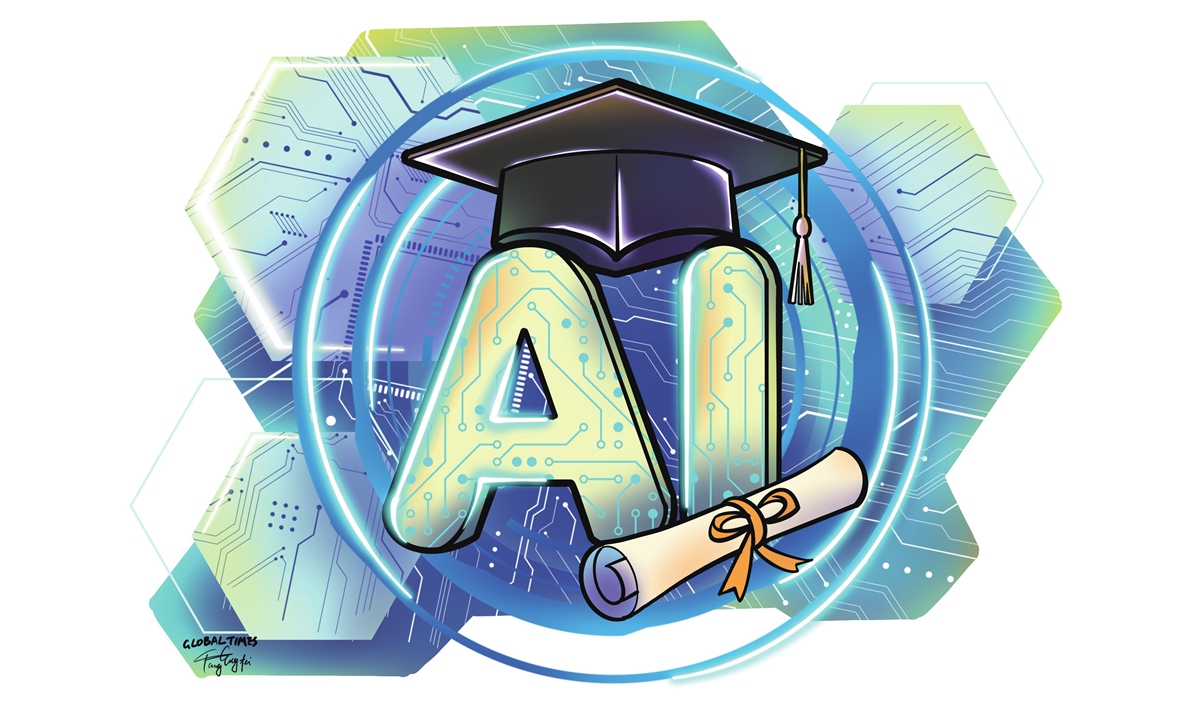
Everyone watches closely each year as students taking China's gaokao, the national college entrance exam, make their university choices, a decision with weighty implications for their longer-term education and career outcomes. Several provinces have released this year's application timetable. According to CCTV News, a number of universities plan to expand enrolment, while artificial intelligence (AI)-related programs are being introduced or expanded at many institutions.This trend may offer a useful lens through which to view a broader evolution in China's education system, in which exposure to AI is extending beyond universities to students across different age groups. From primary school pupils to undergraduates and older learners, engagement with AI-related tools and concepts is becoming more embedded in formal education. Over time, this widening exposure could help deepen familiarity with AI and adjacent technologies, including humanoid robotics, while also contributing to a larger pipeline of talent.
For instance, according to a report in the Guangming Daily in May 2025, China's Ministry of Education issued national guidelines for AI literacy education in primary and middle schools. The framework adopts a stage-based approach, which is in line with students' cognitive development.
At the primary level, the emphasis is on sparking curiosity through hands-on and engaging activities that help children experience how AI technologies are used in everyday life. Middle school education focuses on developing problem-solving skills, encouraging students to use AI tools to carry out simple real-world tasks. At the high school level, instruction shifts toward understanding the underlying principles of AI, enabling students to gain an initial grasp of cutting-edge technologies and their logic.
A visible trend is the integration of AI into China's broader education system. This process is widening the base of AI-related talent and extending AI literacy across different levels of schooling.
Beyond breadth, a further dimension is depth. Media reports offer some illustrative examples. At a primary school in Hangzhou, East China's Zhejiang Province, students take on the role of "AI trainers" during practical lessons. They feed different styles of traditional Chinese opera mask images into AI models and repeatedly adjust parameters to help the systems accurately recognize the features of the images and perform voice narration, gaining firsthand experience of how AI works.
Such forms of hands-on interaction in schools sit alongside frontier courses at leading universities and research conducted in cutting-edge laboratories, forming different layers of engagement with AI across the education system, and contributing to the emergence of higher-level talent in an era increasingly shaped by intelligent technologies.
This trend sits within China's "engineer dividend." In recent years, the country's pool of engineering and scientific talent has continued to expand in both scale and quality. The Xinhua News Agency reported in April 2025 that after years of development, China had maintained the world's largest full-time equivalent research and development (R&D) workforce for several consecutive years.
It had also built the world's most comprehensive disciplinary system and largest talent pool, with the number of engineers ranking among the highest globally.
With AI becoming more deeply embedded in China's education system, it is likely that it will increasingly intersect with the country's engineer dividend, contributing to the gradual evolution of its talent base.
China's evolving talent dividend, together with its rapid adaptation to the era of AI, is likely to generate sustained opportunities for the development of AI and related industries. These opportunities are not confined to domestic firms.
As China continues to push for high-standard opening-up, its talent dividend is becoming increasingly international in character. Foreign-invested enterprises can tap into this resource through a range of channels, including direct investment and the establishment of local R&D centers. In doing so, they are able to participate in, and benefit from, China's expanding pool of AI-related talent and capabilities.
This trend is already visible. Official figures show that foreign direct investment in China's high-tech industries rose by 20.3 percent year-on-year in the first four months of this year.
Viewed in the context of this year's gaokao, the broader picture comes into focus. From education through to the labor market, China's talent dividend continues to take shape and evolve. Investment in China - and in its talent base - will retain long-term potential, even as the technology landscape continues to shift.
The author is a reporter with the Global Times. bizopinion@globaltimes.com.cn
RELATED ARTICLES