SPORT / FOOTBALL
FIFA risks losing faith in fair play for red card probation on US player
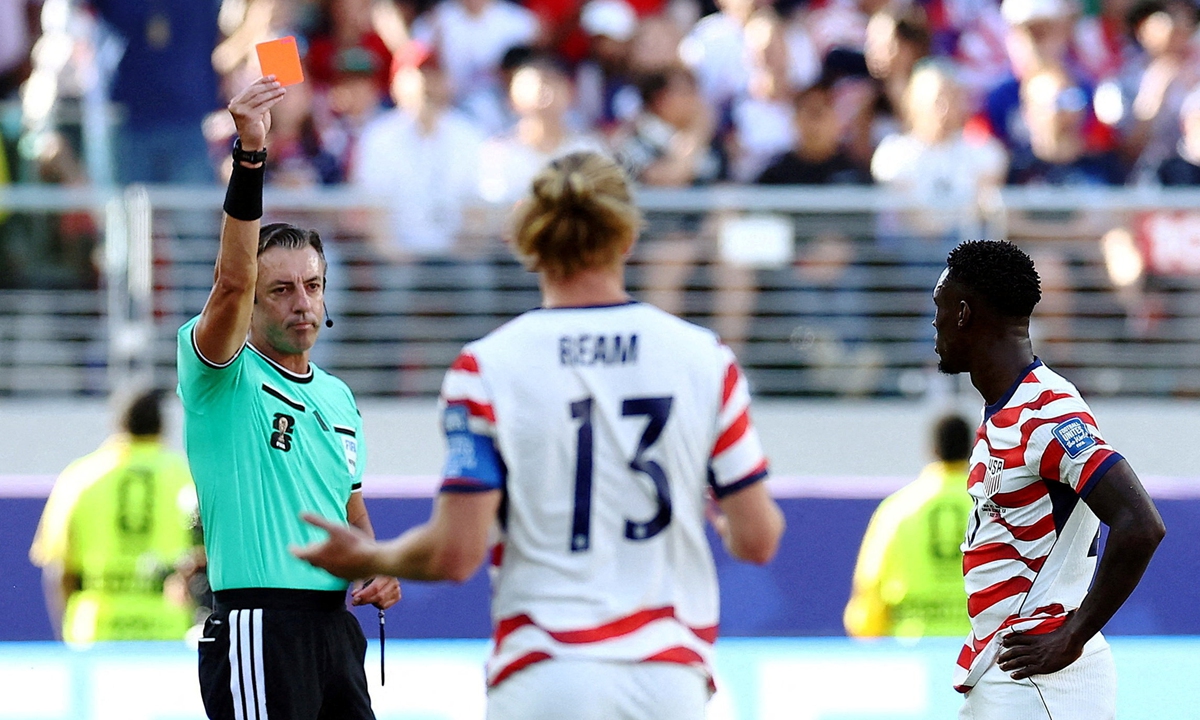
US forward Folarin Balogun (right) receives a straight red card from referee Raphael Klaus during their 2026 World Cup Round of 32 clash against Bosnia and Herzegovina. Photo: IC
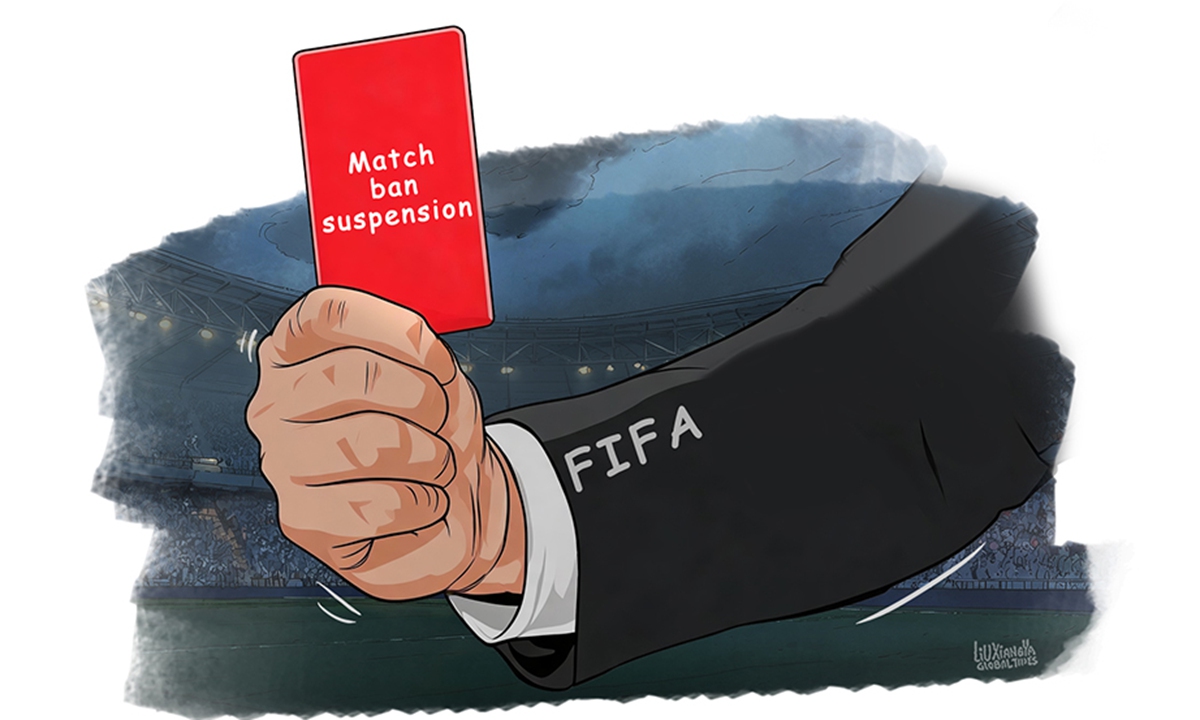
Illustration: Liu Xiangya/GT
Football fans have spent decades learning one of the sport's simplest rules: Receive a straight red card, miss the next game. Apparently, at the 2026 FIFA World Cup, there is now an exception.
FIFA's decision to suspend the implementation of US striker Folarin Balogun's automatic one-match ban, making him eligible for the Round of 16 clash against Belgium, has produced one of the most extraordinary governance controversies in recent World Cup history.
Rather than overturning the red card itself, FIFA placed the suspension on probation for one year under Article 27 of its Disciplinary Code, meaning Balogun may continue playing unless he commits another similar offence during that period.
The decision has delighted the US supporters and understandably frustrated Belgium. Yet the biggest loser may ultimately be FIFA itself.
This is no longer about whether Balogun deserved a red card. It is about whether football's rules still mean the same thing for everyone.
To be fair, Balogun's dismissal was controversial from the moment it happened. The US forward scored his third goal of the tournament before being sent off after VAR upgraded what initially appeared to be an accidental challenge on Bosnia and Herzegovina defender Tarik Muharemovic.
US head coach Mauricio Pochettino argued after the match that the tackle never warranted a red card, while many football analysts and former referees questioned whether the punishment fit the offence.
Reasonable people can disagree over whether the referee made the correct decision.
Football has survived controversial refereeing decisions for well over a century. What football struggles to survive is uncertainty over the rules themselves.
For days after Balogun's dismissal, the expectation appeared straightforward. Under the World Cup regulations, a player shown a direct red card is automatically suspended for the team's next match.
Then everything changed.
The world football governing body did not erase the red card. It simply postponed the punishment, effectively allowing Balogun to play in the quarterfinal match against Belgium while placing him on a one-year probationary period.
Legally, FIFA may well be within its rights. But legality and legitimacy are not always the same thing. Sport depends on something more than legal interpretation. It depends on procedural consistency.
The principle of fair play extends beyond players obeying the Laws of the Game. It also requires governing bodies to apply disciplinary rules consistently, transparently and predictably.
Otherwise, fans begin asking uncomfortable questions.
If the Article 27 could be used here, why has it not been applied in previous World Cups under similar circumstances?
What threshold must a case meet before an automatic suspension becomes optional?
And perhaps most importantly, how are teams supposed to know what "automatic" actually means?
Belgium's football federation wasted little time expressing its dissatisfaction. It said it was "astonished" by FIFA's decision and argued that the ruling appeared to contradict both FIFA's own disciplinary provisions and the tournament regulations, while confirming the federation was examining all possible legal options.
Belgium head coach Rudi Garcia delivered perhaps the sharpest line of the day when he joked that he did not realize "July 5 had become April 1," comparing the announcement to an April Fool's joke.
Even in China, where fans show no particular interest in Belgium, football enthusiasts found themselves scratching their heads.
On Chinese social media platforms, football fans reacted with a mixture of disbelief and humour over the unprecedented scenario at the World Cup. Some joked that FIFA had introduced the concept of a "suspended sentence" into football, while others wondered whether they had misunderstood the sport's disciplinary rules all along.
The political backdrop has only intensified the scrutiny as several US media reported that US President Donald Trump personally contacted FIFA President Gianni Infantino to request a review of Balogun's sending-off. Trump later publicly welcomed FIFA's decision.
Even if FIFA's legal reasoning proves entirely sound, the decision has left many observers unconvinced.
For years, FIFA has promoted video review technology as a tool to strengthen competitive fairness. VAR performed its role. But technology did not create this debate, the governance of FIFA did.
Supporters of FIFA's decision argue that correcting an obviously harsh punishment ultimately serves justice. That argument deserves consideration. No governing body should blindly enforce an unjust outcome merely for the sake of consistency.
But if exceptional remedies exist, they should themselves follow exceptional procedures that are transparent, predictable and clearly explained.
Otherwise, every future disciplinary controversy risks becoming a negotiation rather than the application of established rules.
Football's greatest strength has never been perfection. Referees and players make mistakes on the pitch, and even governing bodies occasionally make mistakes. But what keeps supporters believing in the game is the confidence that everyone competes under the same framework.
When fans begin wondering whether identical rules produce different outcomes depending on circumstances that are invisible to them, trust begins to erode.
A single red card will not damage the World Cup. A single controversial decision will not destroy FIFA. But if football's governing body leaves supporters uncertain whether "automatic" suspensions are truly automatic, then the real casualty will not be Belgium, the US or even Balogun. It will be the credibility of fair play itself. And when credibility is placed on probation, restoring it is far more difficult than overturning a red card.
The author is a reporter with the Global Times. life@globaltimes.com.cn
RELATED ARTICLES