Can AI-driven services devt open new space for China-S.Korea digital economic cooperation?
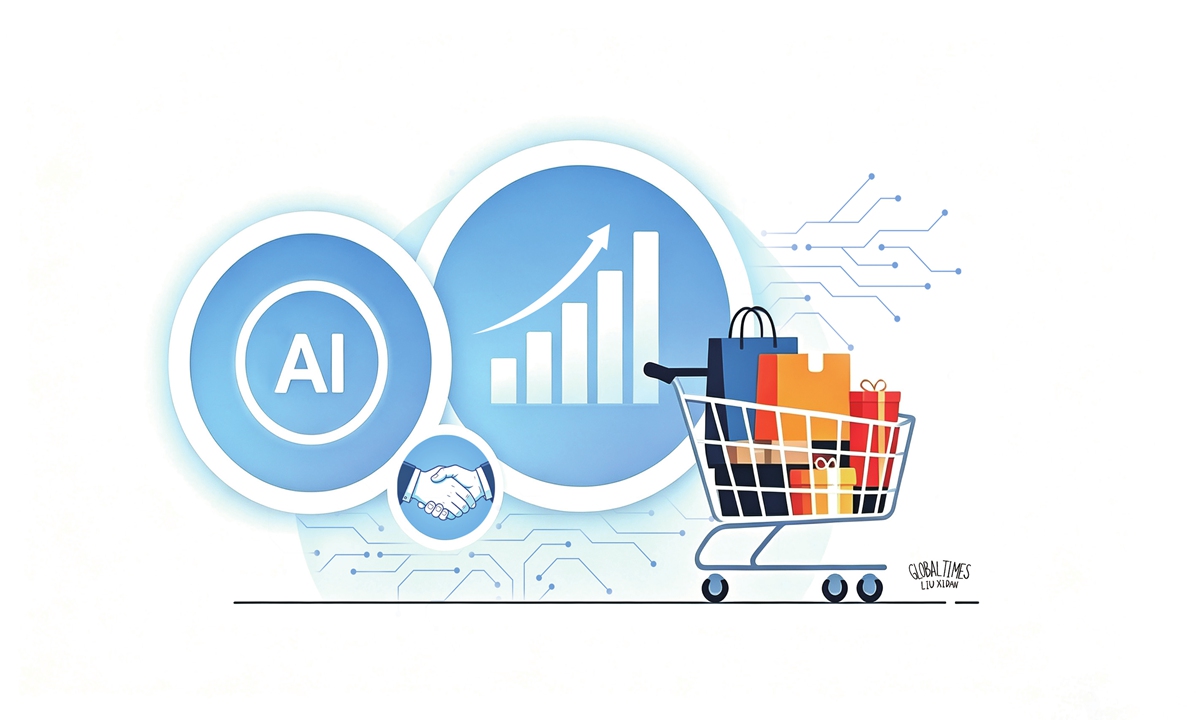
Illustration: Liu Xidan/GT
South Korea will make efforts to revamp regulations and accelerate the adoption of artificial intelligence (AI) technologies in the services sector, which accounts for 60 percent of its GDP, the South Korean Ministry of Finance and Economy said Monday, the Yonhap News Agency reported."Currently, the services industry is facing a major transformation driven by AI, leading to convergence with the manufacturing sector, innovation in public services and major changes in daily life," South Korean Finance Minister Koo Yun-cheol said. South Korean finance ministry said such changes can be observed in online shopping, where AI agents can recommend and compare products while placing orders and making payments.
As South Korea accelerates the AI-driven transformation of its services sector, China has made rapid progress in AI applications, digital payments and e-commerce platforms in recent years. Leveraging a vast range of service-sector use cases and a massive consumer market, China has rapidly deployed AI across industries including tourism, elderly care and logistics. According to the Xinhua News Agency, China's AI industry maintained strong momentum in 2025, with more than 6,200 AI enterprises and a core industry exceeding 1.2 trillion yuan ($176.75 billion) in value.
At present, AI has been integrated into virtually every stage of China's e-commerce industry chain. According to a recent CCTV News report on the performance of China's e-commerce sector in the first half of the year, as many as 90 percent of merchants on one major e-commerce platform in China have adopted AI tools. The use of AI has become a core source of competitiveness in the e-commerce sector.
For example, in the major small commodity trading hub of Yiwu, East China's Zhejiang Province, AI-powered cross-border e-commerce tools are being used to support product design and rapidly generate multilingual short videos for product promotion, significantly reducing the cost of cross-border transactions. AI-powered "virtual sales assistants" with real-time voice interaction capabilities communicate directly with overseas buyers, becoming practical digital assistants in merchants' daily operations, according to media outlet people.cn.
In addition, media reports show that China's digital payment platforms are accelerating the deployment of AI-enabled payment applications. One leading digital payment platform now supports up to 95 percent of mainstream intelligent agent frameworks, including general-purpose AI agents, smart devices such as AI glasses and earbuds, as well as intelligent cockpit systems in electric vehicles.
Both China and South Korea regard AI as an important driver of service-sector development, with broad cooperation potential in areas such as online retail, intelligent recommendation systems and digital payments. China benefits from a vast consumer market and rich application scenarios, while South Korea is accelerating the deployment of AI in services such as e-commerce and payments. The two sides are highly complementary and are well positioned to jointly foster new growth drivers in digital services trade.
At present, South Korea demonstrates strong capabilities in advanced manufacturing, semiconductors and smart devices, while China maintains a leading position in digital infrastructure, e-commerce and platform innovation. By leveraging their comparative advantages, the two countries can strengthen cooperation in AI applications and digital trade, further unlocking the growth potential of bilateral economic and trade relations.
As service-sector digitalization and the application of AI continue to deepen, China and South Korea have broad cooperation potential in areas such as technological innovation, cross-border e-commerce and digital payments. If such cooperation makes substantive progress, it will facilitate the efficient flow of technology, capital and services resources between the two sides, driving the upgrading of the digital economy and services trade, boosting growth of new business models, injecting fresh momentum into consumption expansion, industrial upgrading and the internationalization of enterprises.
For South Korea, China's vast consumer market and rich application scenarios provide substantial room for growth in AI technology and digital services trade cooperation. According to the Report on China's Development of Digital Trade 2025 issued by the Ministry of Commerce, China's imports of digitally deliverable services reached $174 billion in 2024, up 4.3 percent year-on-year, reflecting continued expansion in demand for digital services. Deepening cooperation in this area between China and South Korea would open significant market opportunities for South Korean enterprises.
China is South Korea's largest trading partner, while South Korea is China's second-largest trading partner. In the digital and services sectors, the two countries are actively advancing the upgrading of the China-ROK Free Trade Agreement (FTA) and promoting alignment of rules and standards. Efforts to facilitate digital trade and improve the convenience of digital services are also being accelerated.
As AI becomes more deeply integrated with the services sector, if China and South Korea can make substantive progress in digital trade, services trade cooperation and related regulatory coordination, it will not only open up new growth space for bilateral cooperation, but also provide a replicable and referential model for the Asia-Pacific region, thereby contributing to the further development of regional digital economy and services trade cooperation.
The author is a reporter with the Global Times. bizopinion@globaltimes.com.cn
RELATED ARTICLES