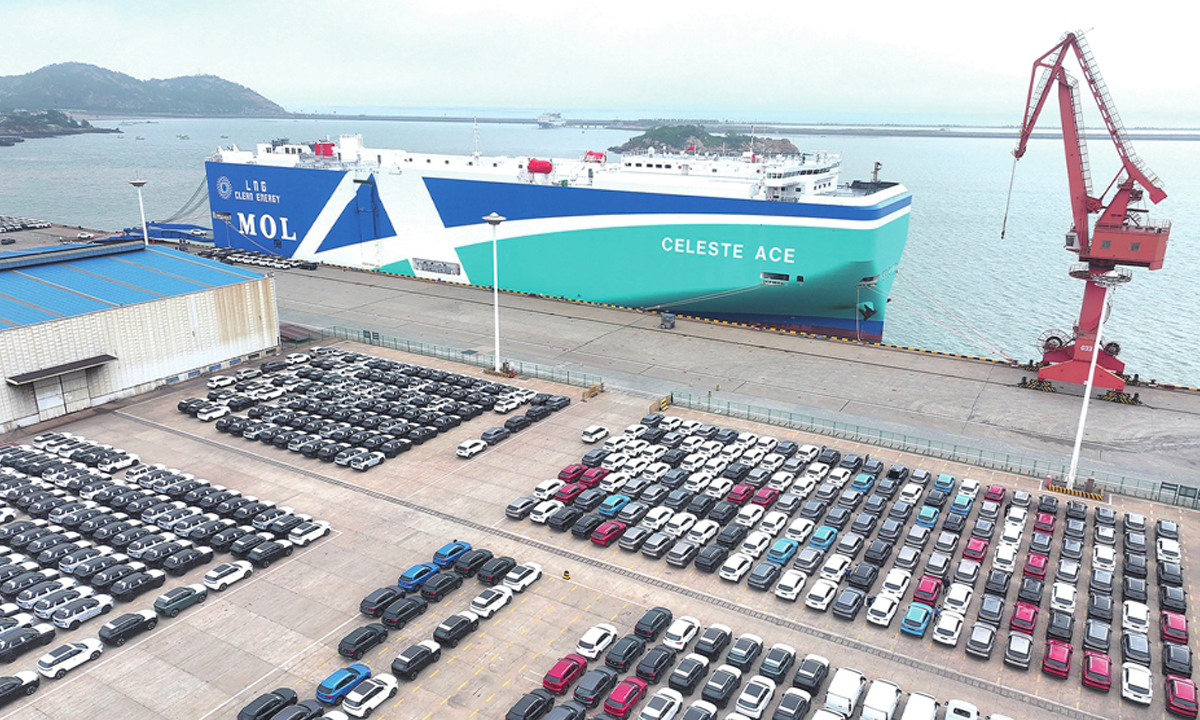
A ro-ro vessel loads electric vehicles for export at a berth of Lianyungang Port's Dongfang Port Branch in Lianyungang, East China's Jiangsu Province, on May 15, 2026. Photo: VCG
Chinese new-energy vehicle (NEV) companies are expanding into the South Korean market, with electric vehicle (EV) manufacturer Zeekr becoming the latest example, as the brand reportedly saw its 7X series exceed 1,000 orders in the first month of pre-sales. A Chinese expert said that Chinese NEVs, which combine strong price competitiveness with advanced software-defined features, have become high cost-performance products for overseas markets and promoted the green development of the global auto industry.
According to the Yonhap News Agency on Monday, starting June 5, Zeekr opened pre-sales for the 7X at its nine stores in South Korea, including locations in Seoul, Gyeonggi-do, Daejeon, and Busan. Pre-orders have already exceeded 1,000 units, Yonhap reported.
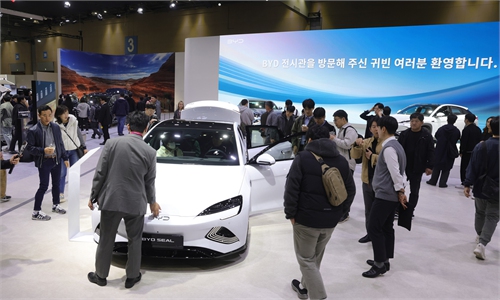
Zeekr is the second Chinese automaker to enter the South Korean market after BYD. The company plans to expand its store network to 14 locations and increase its service centers to 11 within the year, according to Yonhap.
Zeekr's performance comes as a number of Chinese NEV brands are ramping up their push into South Korea. The Dong-A Ilbo reported that XPeng, Chery, and Xiaomi also plan to enter the South Korean market in the second half of this year.
The report noted that just 11 months after entering the country, BYD achieved sales of 10,000 units, the fastest such milestone ever for an import car manufacturer.
Lü Chao, a research fellow at the Liaoning Academy of Social Sciences, told the Global Times on Monday that the main reason Chinese NEVs are popular in South Korea is their continuously improving cost-effectiveness and practicality.
"The Chinese automotive industry has significantly increased its investment in technology, with high-tech applications such as AI being widely adopted in the sector, delivering a better user experience for consumers than other brands," Lü said.
Citing an analyst, The Korea Times reported on June 30 that Chinese EV makers are increasingly competing on technology rather than price alone. Features such as intelligent driving assistance, digital cockpits and battery technology have helped Chinese brands attract consumers seeking alternatives to traditional internal combustion vehicles.
Cui Dongshu, secretary-general of the China Passenger Car Association, told the Global Times on Monday that with electricity, in-car smart cockpit functions can be greatly enriched, while chip performance is significantly improved. This markedly enhances the vehicle's intelligence level, allowing the advanced driver-assistance system to become smarter and more effective through powerful computing power and algorithms.
"For South Korean consumers, electrification has significantly improved their daily driving experience. Therefore, China's push toward electrification has enabled Chinese cars to gain a clear leading advantage over traditional fuel vehicles at a higher technological level," Cui noted.
Chinese automakers are striving to break the long-standing perception of "high cost-performance but low performance," and are committed to providing the world with smarter and greener automotive products, Cui added.
According to Yonhap, Chinese-made vehicles overtook Japanese brands in South Korea's import market for the first time in April, driven largely by BYD, whose April registrations alone exceeded the combined sales of major Japanese brands including Toyota, Lexus and Honda.
"It is not surprising that China has surpassed Japan in single-month auto import volume in South Korea. Amid rising oil prices driving increased demand for electric vehicles, Chinese-made EVs — which combine strong price competitiveness with advanced software-defined features — have become highly popular among overseas consumers," Cui said.
Cui noted that the future direction of automotive development lies in sustainability and energy transformation, while consumers also demand more intelligent products. Electrification itself not only meets the needs of green transformation but also lays a solid foundation for intelligence. This is why China's electrification transition is pointing the world toward a new direction of development, the expert added.
RELATED ARTICLES