IN-DEPTH / IN-DEPTH
China's four major global initiatives inject balanced multilateral vision into fragmented global AI governance: UN resident coordinator in China
Steering AI for Humanity

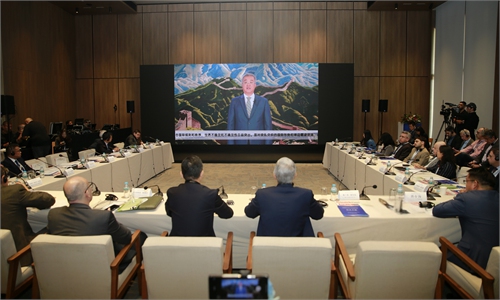
Officials from the UN system in China, domestic AI industry leaders, and experts visit the Zhongguancun Exhibition Center in Beijing on July 2, 2026. Photo: Lin Xiaoyi/GT
Editor's Note:In an era marked by unprecedented global transformations, the world stands at a critical crossroads, grappling with deepening deficits in peace, development, security and governance. As humanity faces unparalleled challenges during this tumultuous period, Xi Jinping, general secretary of the Communist Party of China (CPC) Central Committee and Chinese president, has put forth a solemn call to action through the Global Development Initiative (GDI), the Global Security Initiative (GSI), the Global Civilization Initiative (GCI) and the Global Governance Initiative (GGI). The four pivotal initiatives address the pressing issues of our time, offering viable pathways and robust support for building a community with a shared future for humanity.
Rooted in the rich historical experiences of the CPC's century-long struggle and infused with the wisdom of China's traditional culture, these initiatives are expected to unite the world in the pursuit of common progress and stability. To offer a deeper understanding of the four major global initiatives and elaborate on their global significance, the Global Times is launching a series of articles.
In this installment, Global Times reporters Lin Xiaoyi and Chen Zishuai (GT) sat down with Stephen Jackson (Jackson), the United Nations resident coordinator in China at the Zhongguancun Dialogue on AI Cooperation, recently held in Beijing, to discuss how China leverages multilateral cooperation platforms to carry out extensive international collaboration on artificial intelligence, supports Global South countries in scaling up their technological capacity-building and contributes to bridging the global AI divide.
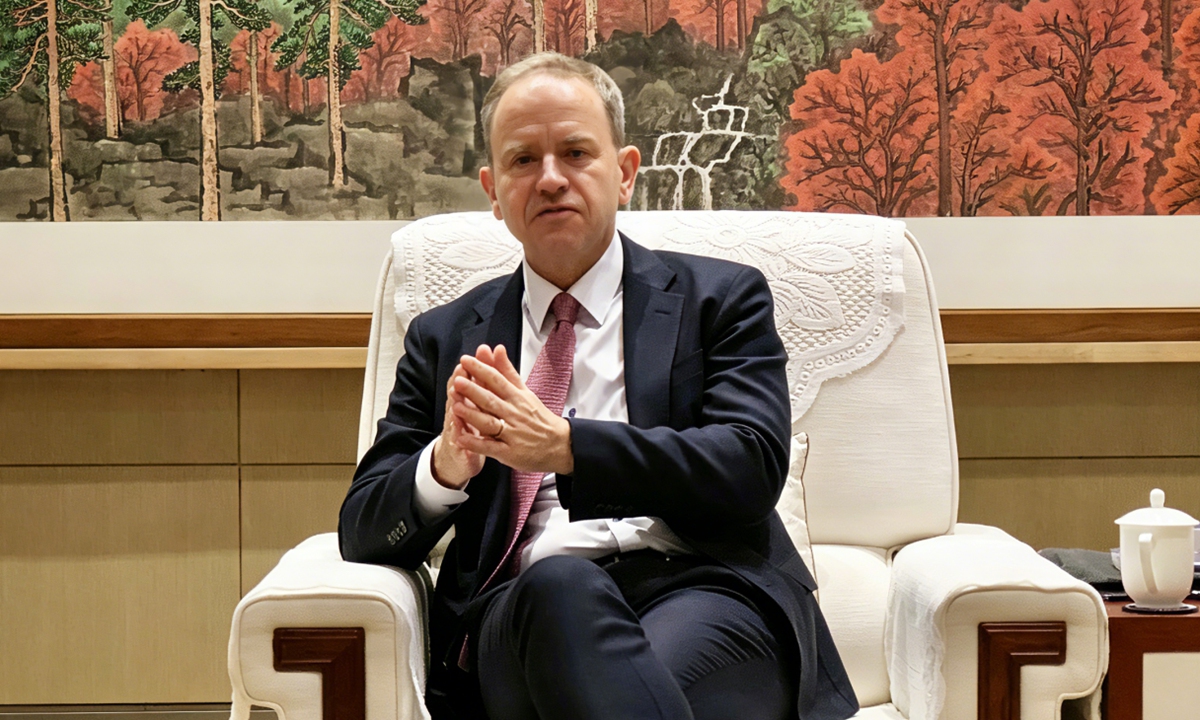
Stephen Jackson, the United Nations resident coordinator in China, during an exclusive interview with the Global Times in Beijing on July 2, 2026 Photo: Lin Xiaoyi/GT
GT: After three months in office in China, what is your overall impression of China's sci-tech innovation and digital industry?Jackson: Before arriving, I followed media coverage and had a distant appreciation of the unparalleled scale, speed and breadth of China's technological advances, particularly in artificial intelligence. Yet nothing compares to witnessing and experiencing these breakthroughs in person - as our UN team did during our visit to Zhongguancun. Even with mental preparation for the extraordinary, we were all completely in awe.
We saw rotating 3D displays reconstructing ancient Chinese cultural relics, precision surgical robots capable of highly complicated bone reconstruction and real-time video generation tools that instantly turn a speaker's words into imagery of dragons, astronauts or aliens. The technological leaps are staggering, yet they also raise a critical question: can the global community keep pace with such rapid change? That is precisely where the UN steps in.
While the progress is remarkable, it immediately underscores an urgent agenda: we must build comprehensive guardrails, safety nets, ethical guidelines and legal frameworks to govern these technologies. Unchecked embodied intelligence carries unprecedented risks that current global governance systems are not yet fully equipped to address.
GT: AI has become a core arena for global technological competition and industrial transformation, while also bringing new challenges to global governance. What is your perspective on the UN's role in leading global AI governance? What are its core mandates and top priorities?
Jackson: AI can drive us toward sustainable development, but it can also widen divides. First, there is the cross-country digital gap: technology front-runners monopolize AI capabilities, while developing nations struggle to gain access. Second, domestic inequality persists: billions across Africa, including roughly 20 percent of Kenya's population, lack even smartphones and internet connectivity, effectively excluding them from AI's benefits. Third, we face environmental costs: AI computing power multiplies four to 10 times annually, driving soaring electricity consumption that will exacerbate climate harm unless we simultaneously accelerate the green energy transition.
The UN holds a unique position as the only platform uniting all 193 member states to tackle shared challenges. Our global mandate falls into two pillars. The first is to help think through questions of governance, ethics and international regulatory frameworks - providing the necessary protections while also enabling the advances we need and facilitating their sharing. The second is to act as a matchmaker for the dissemination of those advances.
In this regard, we see enormous opportunities to engage with Chinese innovation to accelerate progress toward ending hunger, promoting quality healthcare, ensuring quality education and advancing gender equality in developing countries. China, I believe, is giving serious thought to the most effective way to share the technologies it is developing with the Global South and with other developing nations.
GT: China's GDI, GSI, GCI and GGI have provided important impetus for reforming global governance and upgrading international cooperation, while offering valuable guidance for promoting responsible tech development and inclusive AI innovation. How do you assess China's role in advancing inclusive AI and upgrading global AI governance systems?
Jackson: I start from the premise that all pressing challenges - climate change, conflict, pandemics, inequality - require countries and peoples to come together to find common solutions, because these problems do not respect borders. We are also at a moment in history when not every country is as enthusiastic about cooperation as it used to be. Fortunately, China remains very committed to that cooperation. I see the four initiatives China has proposed as holding significant potential to contribute to renewed multilateralism and to the pursuit of sustainable development.
In the field of science and technology, China's commitment extends beyond its own domestic sector: it is actively helping countries and the private sector around the world find the right balance between innovation and development, inclusion, sustainability and safety.
Currently, global AI governance debates remain fragmented - split between market-led innovation models and rights-focused regulatory systems. China's governance philosophy, with its emphasis on balance - supporting innovation while mitigating risks and bridging global gaps - is deeply rooted in Confucian and Taoist traditions of harmony. This balanced framework is a valuable contribution to global rule-setting. China is, therefore, an extremely important actor in the global discussions that are already underway.
GT: From your perspective, where does the greatest synergy between China's technological capacity and the UN's Sustainable Development Goals (SDGs) lie?
Jackson: Today, there is not a single SDG that cannot be assisted by AI - from eradicating poverty and hunger to combating climate change, promoting gender equality or fostering international partnerships. The recent earthquake response in Venezuela offers a perfect illustration. Humanitarian crises are often hampered by a lack of timely damage data, delaying rescue operations. Chinese satellites, combined with real-time AI analysis, produced detailed disaster maps within 48 hours, which were then freely shared with UN humanitarian teams to guide relief efforts.
China's AI and space technologies deliver scalable and affordable solutions to tackle climate disasters, food insecurity and public health crises - all core SDG challenges that disproportionately burden the Global South. What sets this apart from purely commercial technology is China's willingness to provide critical data and tools free of charge, setting a benchmark for inclusive technological cooperation.
GT: Several countries have imposed restrictions on the export of AI technologies and advanced chips on so-called "national security" grounds. What impact does this have on developing countries?
Jackson: We are at a moment when the tide of openness that prevailed for the previous 30 years has started to go backwards. I think that is very unhealthy. We need a world of cooperation, collaboration, commerce and trade. I am concerned that the imposition of barriers can hinder the journey toward sustainable development. It is a challenge for every country to balance their legitimate interests in security, intellectual property and their own economic development with the needs of the planet. But I fervently hope we will find solutions that achieve the right balance. The UN is the right platform through which to do that.
GT: The UN System in China has enthusiastically embraced the Zhongguancun Dialogue on AI Cooperation with the China-SCO Countries AI Application Cooperation Center. What unique value does this kind of partnership bring to the Global South?
Jackson: This dialogue delivered surprisingly rich and actionable collaboration ideas, bridging two seemingly disconnected communities: tech developers discussing large language models and embodied intelligence, and UN practitioners focused on SDG implementation. It was indeed a very substantive dialogue that generated concrete and practical proposals for cooperation.
One standout proposal was the concept of global AI literacy campaigns. At present, most populations in the Global South lack a basic understanding of how AI can be applied to agriculture, disaster relief and public services. Jointly launching national and cross-border AI literacy programs would equip ordinary citizens and policymakers in developing countries to harness AI opportunities, thereby translating China's industrial technological advantages into tangible improvements in livelihoods across the Global South.
GT: You first visited China in 1993. What societal transformations beyond technological advancement have you witnessed over these 33 years?
Jackson: I remember vividly my first visit to China in 1993. At that time, Beijing's broad avenues were filled with black bicycles; today they are lined with BYD electric vehicles and other new energy vehicles - a visible marker of the country's comprehensive transformation. What remains unchanged is the Chinese people's relentless drive, determination and inherent warmth. This enduring human spirit, combined with technological progress, fuels not only China's domestic development but also its willingness to share its solutions with the rest of the world.
Current global discourse tends to focus on technical governance priorities - data privacy, cybersecurity and ethical AI deployment. However, we have yet to have sufficiently wide-ranging conversations about AI's more profound humanistic impacts. AI is reshaping the essence of humanity: it redefines creative culture - poems and films that once took weeks of human labor can now be generated in an instant; it transforms labor markets and human cognition. In the coming months, senior UN leadership will hold high-level exchanges with China to explore these deeper philosophical, cultural and societal shifts brought about by AI and embodied intelligence.
RELATED ARTICLES