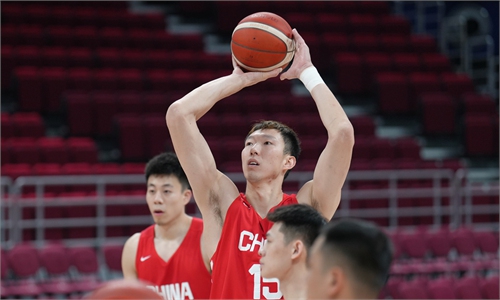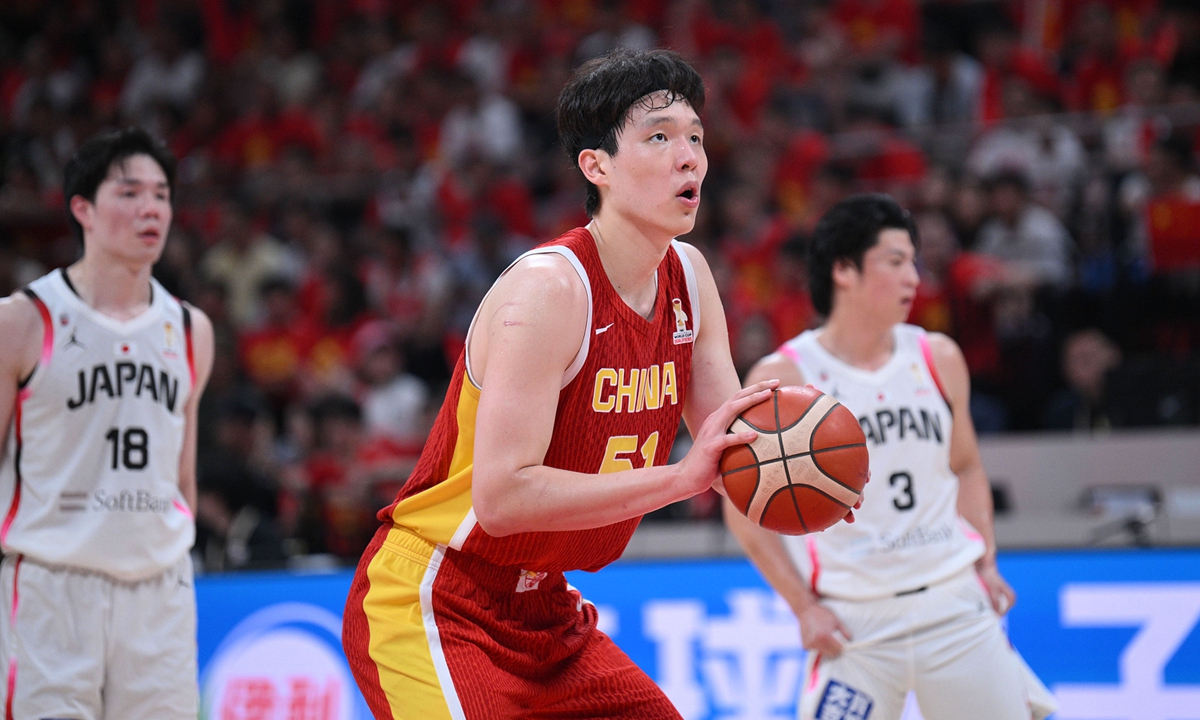
Center Yang Hansen prepares to shoot during the match between China and Japan. Photo: VCG
While China's men's national basketball team has achieved its minimum target of reaching the second round of the FIBA World Cup Asian Qualifiers, the next stage will provide stern challenges as they are set to face three West Asian opponents.
After having defeated Chinese Taipei on Monday, China advanced to the second round of the qualifiers with a 3-3 record, marked by agonizing defeats to archrivals South Korea and Japan.
The second round of the qualifiers will see 12 teams drawn in two groups and tip off in August. China faces home and away matches against Lebanon, Qatar and Saudi Arabia. The top three teams from each group, along with the best-performing fourth-placed team across the two groups, will qualify directly for the World Cup to be held in Qatar from August 27 to September 12.
The first round of qualifiers has offered a realistic assessment of where the team currently stands. China remains competitive in Asia, but it is still searching for the consistency, offensive creativity and leadership required to return to the continent's top tier, Liu Yu, a Beijing-based sports commentator, told the Global Times.
China opened its first round of qualifiers with two defeats to South Korea before rallying from behind to beat Japan and Chinese Taipei. On July 3, China suffered its first home defeat to Japan in a FIBA competition in 88 years, and only secured a narrow qualification after beating Chinese Taipei in the final round.
Liu noted that offensive problems remain the biggest concern for China.
Against Asian powerhouses that play at a fast pace with consistent three-point shooters and excel in pick-and-roll execution, China has lacked reliable ways to break down defenses. The team has struggled to mount comebacks when trailing, while turnovers have increased sharply in tight moments, he said.
Facing stronger opponents, the team often struggled to generate efficient scoring opportunities. Ball movement became predictable, perimeter shooting lacked consistency, and the team frequently relied on individual solutions when games entered critical moments.
Center Yang Hansen, who currently plays for the Portland Trail Blazers in the NBA, struggled to meet expectations when facing high-intensity physical play, with his low-post scoring, free-throw efficiency and rim protection all areas of concern.
Yet, young players such as Pang Zhenglin and Li Hongquan have emerged as the bright spots of the first round, injecting offensive energy into the team.
Pang, who made his official debut for the national team, chipped in 11 points in 13 minutes during the last group game against Chinese Taipei. Head coach of the national team Guo Shiqiang recognized his contribution and described him as the team's X factor.
Looking to the following matches against the three West Asian teams, Zhou He, a Beijing-based basketball commentator, told the Global Times on Tuesday that the priority is to make targeted improvements in three areas: roster, tactical modernization and opponent-specific preparation.
The current squad was not China's strongest lineup, and the team needs to evaluate which players can contribute most effectively moving forward. Adding experienced players such as Zhao Rui and Zhou Qi could make a difference, Zhou He said.
Tactically, China must move away from a slow and predictable style and embrace a more modern approach. Meanwhile, against the three West Asian opponents, detailed defensive plans will be essential, especially when dealing with the three West Asian opponents' influential naturalized players, he said.
For China, the margin for error will be even smaller in the second round.
The author is a reporter with the Global Times. life@globaltimes.com.cn