China completes world's largest fusion magnet, clearing key hurdle for 'artificial sun'
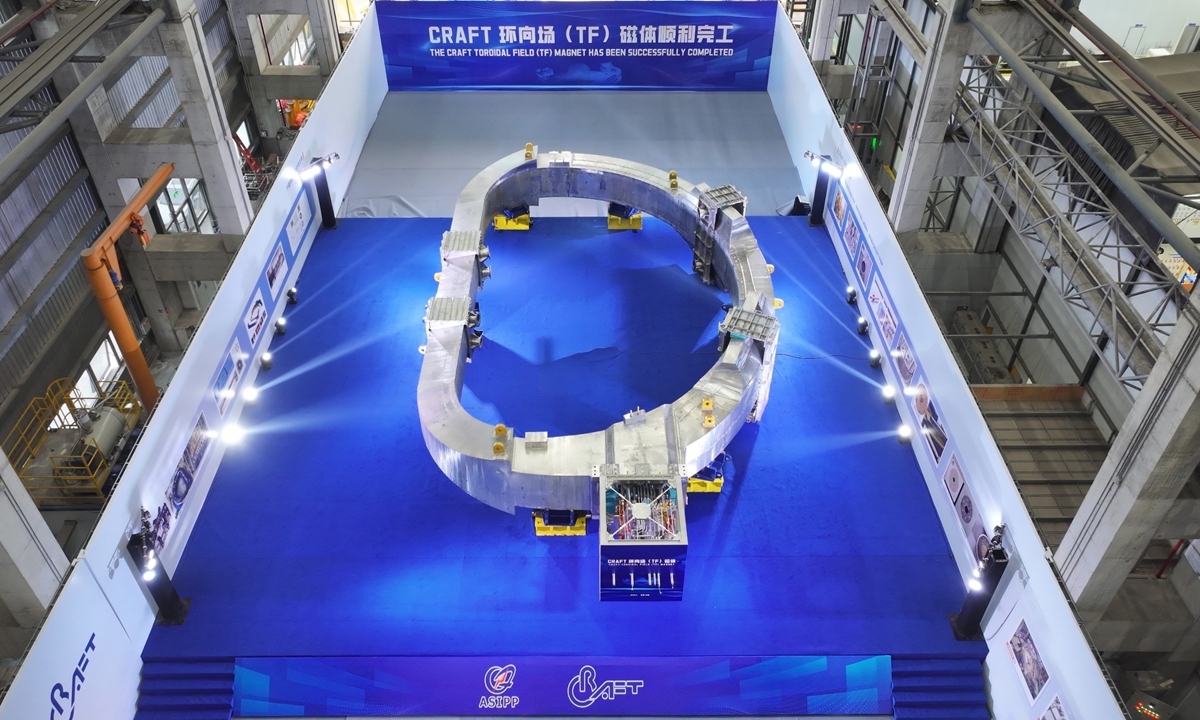
Toroidal field superconducting magnet Photo: Courtesy of the Institute of Plasma Physics, Chinese Academy of Sciences
China's "artificial sun" program has cleared one of its toughest engineering hurdles, with two fully domestically developed superconducting magnets, which are the core components of a fusion reactor, passing expert acceptance and full-parameter testing at the Institute of Plasma Physics, Chinese Academy of Sciences (ASIPP). This marks a major step in the country's push to turn controlled nuclear fusion from laboratory science into a working energy source.
The newly accepted toroidal field superconducting magnet, a D-shaped structure measuring 21 meters long, 12 meters wide and weighing 582 tons, is the largest fusion reactor superconducting magnet ever built, with 1.3 times the volume and three times the stored energy of comparable magnets in the International Thermonuclear Experimental Reactor. Sixteen such coils will eventually form a ring generating a 6.5-tesla magnetic field at the plasma center.
"Its job is to use a powerful magnetic field to confine the plasma to keep that 100-million-degree 'fireball' suspended inside the vacuum chamber without touching the walls," Wu Yu, a researcher at ASIPP, told the Global Times. "It works like an invisible, extremely sturdy magnetic cage."
Passing full-parameter tests the same day was a high-temperature superconducting central solenoid coil, which ASIPP researcher Qin Jinggang likened to "the spark plug of a car engine."
Test data showed the coil carried a stable current, with key indicators such as stored energy, maximum field ramp rate and joint resistance all reaching internationally leading levels. As the "power heart" of China's compact fusion energy experimental device, the coil induces and drives the plasma current, directly determining whether a fusion reactor can ignite and run stably.
Song Yuntao, director of ASIPP, said the core value of the twin breakthroughs lies in full-chain self-reliance. "From core raw materials such as superconducting tapes, high-strength cryogenic stainless steel and special insulation materials, to the complete set of processes including structural design, precision winding, ultra-low-resistance joint fabrication and quench protection, we have completely broken foreign technological monopolies and achieved 100 percent localization, eliminating the risk of core components being subject to chokepoints," he said. The six-year project has yielded 47 authorized patents and 25 industry standards.
Behind the massive hardware lies extreme precision. Wu noted that fusion reactor magnets must operate reliably for a full 60 years at minus 268.95 C under high current, intense radiation and heavy mechanical stress, pushing the limits of materials science.
During heat treatment of niobium-tin superconductors, a temperature deviation of just a few degrees can cause performance to collapse, and keeping temperatures uniform across a furnace holding coils more than 10 meters in size is itself a cutting-edge engineering feat.
The team also drove internal joint resistance down to 0.04 nano-ohms, effectively zero loss at currents in the 100-kiloampere range, with conductor samples surviving over a thousand electromagnetic and thermal cycles at 4.2 Kelvin while still outperforming design values. "It's not about passing a single run, it's about staying reliable after being put through the wringer again and again. We are building equipment that must serve for 60 years, and the thoroughness of verification is itself the greatest credibility," Wu said.
The central solenoid coil team, tasked six years ago with the twin demands of raising performance and cutting costs, overcame more than 10 key technologies, including high-current high-temperature superconducting conductors and quench protection, slashing the cost of once-prohibitive high-temperature superconducting tape from 400 yuan ($56) per meter to 100 yuan, clearing a key obstacle to the economic viability of future devices.
The breakthroughs have galvanized a complete domestic fusion industry chain, with multiple leading enterprises taking on superconducting materials, special structural components, system integration and precision manufacturing, an upgrade from "supplying international projects" to independently developing complete sets of core equipment.
The magnet breakthroughs build on decades of accumulation. China's Experimental Advanced Superconducting Tokamak set a world record by sustaining plasma at 100 million C for 1,066 seconds in steady-state high-confinement mode, the fruit of 22 rounds of physics experiments and 160,000 rounds of testing. As a key ITER member, China has undertaken more than 9 percent of the project's core component development, with all delivered products passing international assessment.
Under China's three-step fusion roadmap, the Burning Plasma Experimental Superconducting Tokamak is slated for completion by the end of 2027, with fusion power generation targeted around 2030, to be followed by the China Fusion Engineering Demonstration Reactor aiming at becoming the world's first fusion demonstration power station.
Qin cautioned that the successful magnet tests represent about 80 percent of the task, with full machine assembly and long-term service testing under extreme conditions still ahead. "The road to commercializing fusion energy remains long, but every core technological breakthrough shortens the distance between humanity and the ultimate clean energy," he said.
RELATED ARTICLES