China's Atomic Energy Law, taking effect Thursday, is set to boost high-quality development of nuclear power: expert
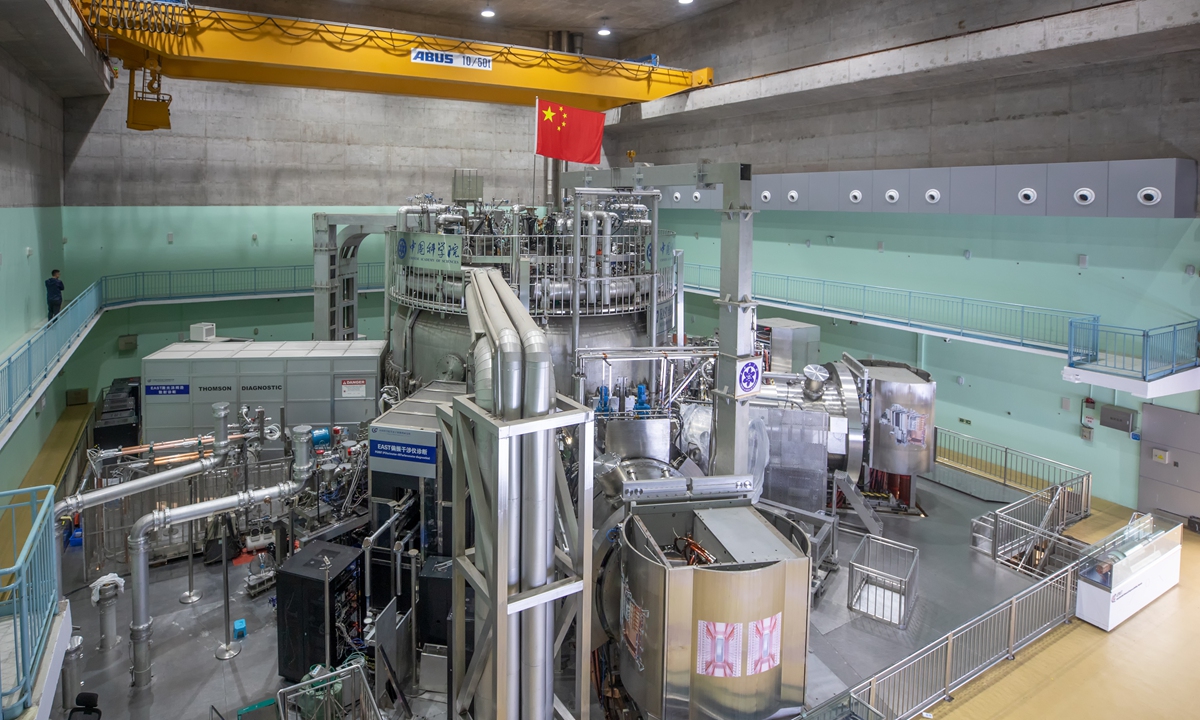
A view of the Experimental Advanced Superconducting Tokamak (EAST), dubbed China's "artificial sun," in Hefei, East China's Anhui Province Photo: VCG
China's Atomic Energy Law, adopted last September to ensure the research, development and peaceful utilization of atomic energy, took effect Thursday. By laying a legal foundation for industrial development, the law is expected to drive high-quality development of nuclear sector and create more green energy, an expert said.
The law encourages and supports scientific research and technological development in controlled thermonuclear fusion, according to the law. The law also stipulates the establishment of a supervisory mechanism aligned with the characteristics of controlled thermonuclear fusion and aimed at promoting its application, while implementing graded and classified management of fusion fuels and fusion facilities.
Controlled nuclear fusion, long confined to research laboratories, is emerging as a future industry. In China, the Experimental Advanced Superconducting Tokamak (EAST), also known as the "artificial sun," is a representative project in the field.
"By involving 'nuclear fusion' in a law for the first time, the Atomic Energy Law regulates the industry from the perspective of both security and industrial development. It will provide the legal basis for China's high-quality development of nuclear sector and drive the creation of more green energy," Lin Boqiang, director of the China Center for Energy Economics Research at Xiamen University, told the Global Times on Thursday.
Nuclear power is among the cleanest and most cost-effective energy sources with stable output compared with other forms of new energy such as solar and wind, Lin said, noting that China holds a leading position globally in this field.
According to the Recommendations of the Central Committee of the Communist Party of China for Formulating the 15th Five-Year Plan for National Economic and Social Development, nuclear fusion is listed as one of the industries of the future.
The implementation of the Atomic Energy Law, together with multiple government policies to promote the industrial development of nuclear fusion power as well as scaled investment in the sector, reflects the dual safeguarding role of policy and legislation, Chen Jing, vice-president of the Technology and Strategy Research Institute, told the Global Times on Thursday.
In recent years, China has continued to make breakthroughs in this field. For example, researchers have identified a method to surpass the plasma density limit in experiments with the EAST, providing a crucial physical basis for high-density operation in magnetic confinement fusion devices, the Xinhua News Agency reported on January 2.
With continuous breakthroughs in controlled nuclear fusion technology, the sector is emerging as a new frontier for China's venture capitalists.
According to a projection made by the research institute of Huaxi Securities Co, China's controlled nuclear fusion sector is projected to maintain approximately 95 billion yuan ($13.63 billion) in capital expenditure between 2026 and 2030, corresponding to an annual investment volume exceeding 10 billion yuan.
Domestic enterprises, whether in the upstream raw material segment or the midstream equipment manufacturing segment, have already formed strong domestic independent supply capabilities and achieved breakthroughs in domestic substitution in some key segments, according to a note published on the institute's official WeChat account recently.
Notably, a day after the Atomic Energy Law took effect, a conference on fusion energy technology and industry will be held in Hefei, East China's Anhui Province from Friday to Saturday, attracting the participation of enterprises, academia, government agencies, and financial institutions to discuss development opportunities for the fusion energy and boost cooperation between capital and technologies in the industry, domestic news site the Securities Times reported.
"China has an advantage in execution capability, and it's anticipated that there will be intensive technical breakthroughs before 2030, with equipment construction accelerating," Chen said.
RELATED ARTICLES