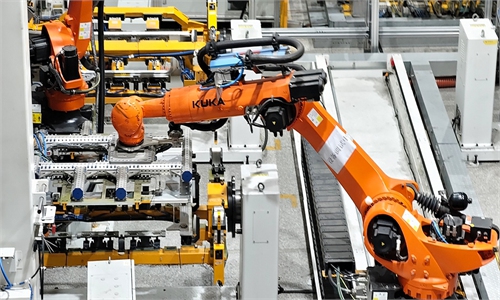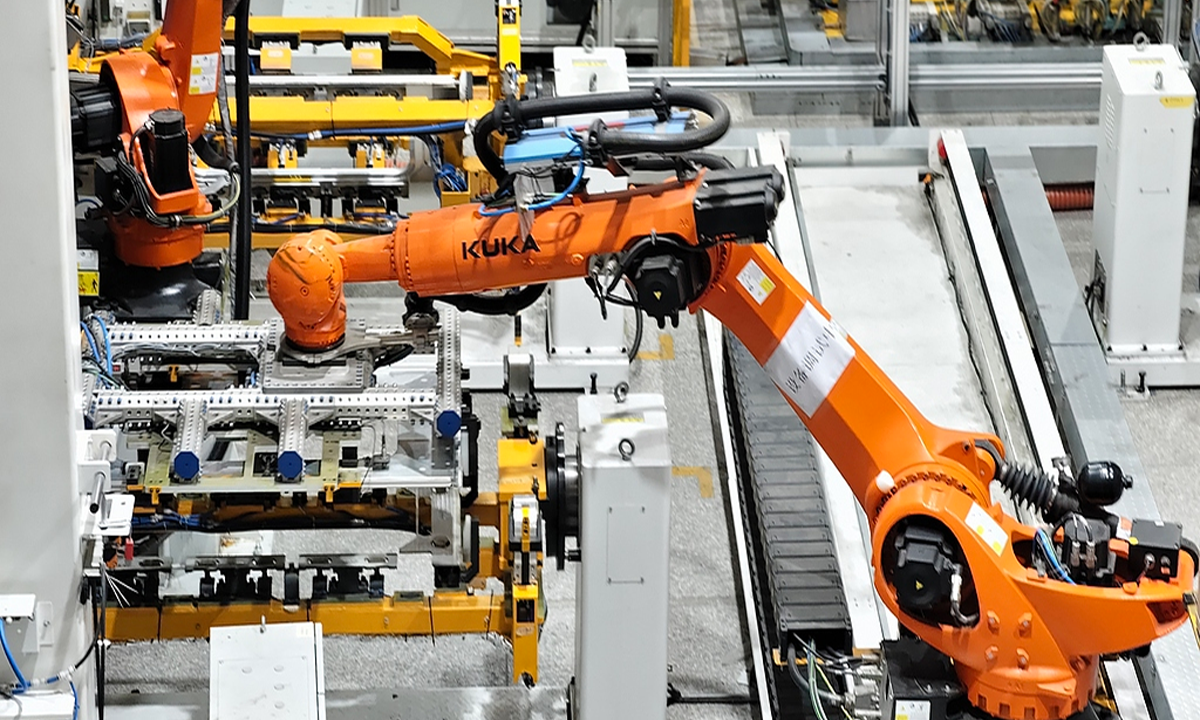
Robotic arms perform precision operations at an intelligent factory in Nanjing, East China's Jiangsu Province, on September 20, 2025. Photo: VCG
Editor's Note:
Currently, China's economy is steadily advancing along the path of high-quality development, even as domestic and international circumstances become increasingly complex. Some Western media, due to misunderstanding or bias, have repeatedly questioned or even distorted China's economic development. Accordingly, the Global Times launches the "Q&A on China's Economy" column to publish opinion pieces to present facts and clarify perceptions.
For some time, certain Western politicians, media outlets and think tanks have persistently hyped the narrative of China's "massive industrial subsidies." They claimed that China uses enormous government subsidies to artificially lower product prices, distort global markets and create what they describe as an "unfair competitive advantage." Some in the EU have even sought to use this claim as justification for advancing a "European Section 301" mechanism to pressure China. The underlying logic points to a central question: Is China's strong international industrial competitiveness something that has been built - or "subsidized" - with money?
The widespread popularity of Chinese products is the result of enterprises' own competitive efforts, not government subsidies. China's industrial subsidy policies are primarily guidance-oriented; they strictly adhere to WTO rules and consistently uphold the principles of fairness, transparency, and non-discrimination, involving no prohibited subsidies as defined by WTO regulations.
Take the photovoltaic (PV) industry, which is often held up by the US and Europe as evidence of their claims, as an example. China's support for the PV sector has gone through a complete cycle - from initial investment subsidies to generation-based subsidies and, finally to their full phase-out.
During the industry's initial development phase (2009-12), subsidies primarily targeted the first batch of demonstration power plants in desert regions, aiming to validate technical pathways. From 2013 to 2018, the industry entered a phase of feed-in tariff subsidies; however, subsidy rates were reduced by 10 to 20 percent annually. This "phase-out" mechanism was designed to compel enterprises to accelerate technological upgrades and drive down costs, as relying solely on subsidies made profitability impossible. By 2021, central government subsidies for new PV projects were completely eliminated. It is particularly worth noting that the overseas production capacity and orders of Chinese photovoltaic companies do not benefit from domestic subsidies; instead, these companies compete internationally relying entirely on their own cost-control capabilities and technological advantages.
If competitiveness could simply be created through subsidies, then companies in the US and Europe that invested heavily in industrial subsidies should have achieved considerable success, but this has not been the case. It was reported that the US Inflation Reduction Act authorized a total of $430 billion over 10 years. However, in its first year of implementation, nearly 40 percent of major investment projects that cost more than $100 million experienced delays of more than two months or were even suspended indefinitely. Massive fiscal spending did not translate into the expected leap in industrial competitiveness. Similarly, the Critical Raw Materials Act and Net-Zero Industry Act established tens of billions of euros in dedicated funds to support domestic solar, wind power and battery manufacturers while introducing carbon tariffs and import quotas to protect local industries. Yet these measures still failed to "subsidize" industrial competitiveness into existence.
In fact, as a means of addressing market failures and supporting technological R&D and early-stage deployment, industrial subsidies are a common practice among major global economies. According to research by the International Monetary Fund, the world's 75 major economies introduced more than 2,500 industrial policy interventions in 2023, with developed economies serving as the primary drivers. In August 2025, the US government used the remaining $5.7 billion authorized but not yet disbursed under the CHIPS and Science Act, together with additional funding, to reach an $8.9 billion investment agreement to acquire a 9.9 percent stake in Intel. As a result, US semiconductor companies became the world's largest recipients of government subsidies in absolute terms. The EU provides substantial subsidies to battery manufacturers while simultaneously implementing protective measures - such as countervailing duties - against Chinese electric vehicle imports. It is a classic case of double standards for the US and the EU to heavily subsidize their own industries while accusing China of engaging in "unfair competition."
The "subsidy dividend" is a label that some Western institutions and media have pinned on China. They have expanded the definition of "subsidies" to include government appropriations, tax incentives, below-market-interest loans and even normal commercial financing. Such allegations are based on inconsistent standards, extensive estimates and subjective assumptions, and are highly questionable in terms of rigor and objectivity, making their conclusions unconvincing.
What truly matters is sustained technological innovation, complete industrial and supply chains, a vast domestic market, and vigorous market competition. Together, these factors create the internal momentum that enables Chinese companies to continuously evolve and achieve breakthroughs. It is precisely this hard strength that has made Chinese manufacturing widely recognized in international markets.
Take new energy vehicles (NEVs) as an example. In 2025, both China's production and sales of NEVs exceeded 16 million units, with exports reaching 2.615 million. Notably, due to tariff policies in some countries, Chinese NEVs generally sell at higher prices overseas than in China, with price differences for the same models typically ranging from 30 to 50 percent. If Chinese products relied, as some have alleged, on subsidized low-price dumping to capture market share, why would overseas consumers be willing to pay higher prices than Chinese consumers for the very same products? Clearly, what they are paying for is advanced technology, reliable quality and comprehensive services - not any "subsidy dividend."
Simply attributing China's industrial success to "subsidies" does nothing to address the real problems facing global industrial development, and furthermore it seriously undermines the multilateral trading system and hinder global economic recovery and the green transition. Only by optimizing the international division of labor through openness and cooperation, expanding markets, improving rules, and sharing innovation can countries continue to expand industrial capacity, steadily improve product quality and ultimately enable consumers around the world to enjoy safer, smarter and greener products and services at more reasonable prices.
RELATED ARTICLES