ARTS / CULTURE & LEISURE
Foreign visitors retrace the Long March, rekindling its spirit
‘Pinnacle of human survival’

People gather at the memorial park marking the starting point of the Central Red Army's Long March in Yudu county, Jiangxi Province, in April 2025. Photo: VCG
Zhavier Harris, a manager from a US non-profit social service organization, recently tried his hand at making traditional straw sandals, twisting hemp fibers, tying knots, weaving the strands and shaping the finished footwear in Yudu county, East China's Jiangxi Province. He noted that the process, while painstaking, has deepened his understanding of the extraordinary hardships endured during the Long March (1934-36).
This year marks the 90th anniversary of the victory of the Long March, which was a military maneuver by the Chinese Red Army that later became a defining episode in modern Chinese history.
The Red Army marched across raging rivers, snowy mountains and arid grasslands to break the Kuomintang regime's grip on the country and continue the fight against Japanese invaders. Some of the soldiers marched as far as 12,500 kilometers, enduring hunger, thirst and cold along the way. The maneuver laid the foundation for the eventual victory of the Communist Party of China.
To mark the anniversary of the Long March, provinces along the route of the epic journey are holding experiential activities that allow participants to retrace the historic trek. Participants visited memorial halls, museums and revolutionary sites, learning about the history behind the Long March to gain a deeper understanding of the enduring spirit of perseverance, courage and faith that it embodies.
Harris, the marketing and communications manager at the Springfield Urban League in the US, is among a group of foreign scholars, journalists and experts invited by the China International Communications Group to retrace the historic trek. The journey, which began on June 15 and spans over 40 days, takes them from Jiangxi, Guangxi, Guizhou, and Sichuan to Gansu and Shaanxi provinces.
Currently in Southwest China's Sichuan Province, Harris told the Global Times that at every stop along the route, they have sensed the weight of the sacrifices made by the tens of thousands of Red Army soldiers who had given their lives in pursuit of a stronger and better China.
"Their legacy is not confined to history books, it lives on in the resilience, determination, and collective spirit that still echoes throughout the country," he noted.
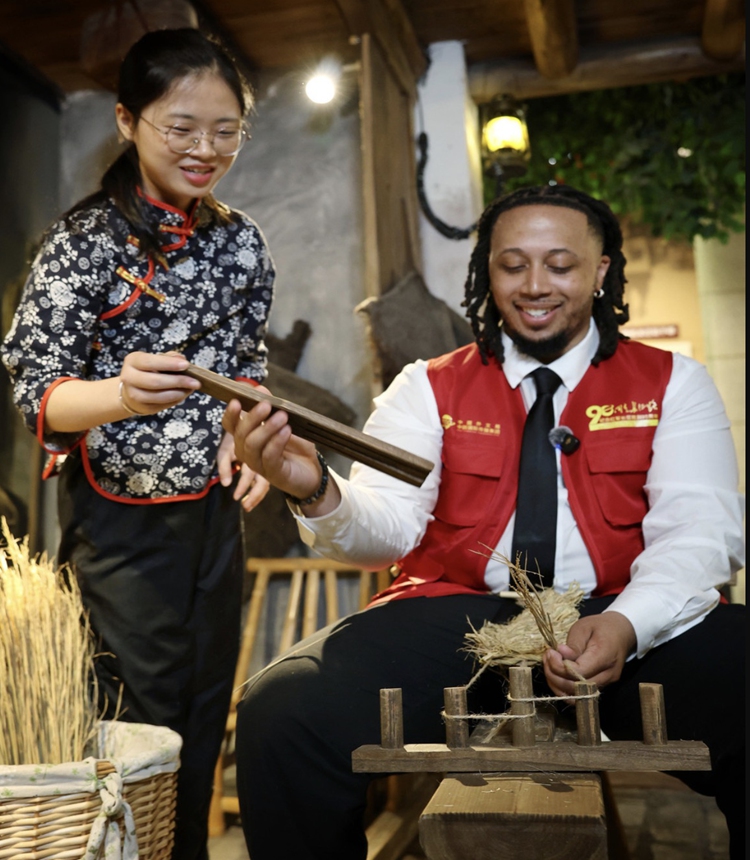
Zhavier Harris (right) makes straw sandals during a visit to East China's Jiangxi Province in June 2026. Photo: Courtesy of Zhavier Harris
Profound sacrificesThe Long March stands as a testament to the unbreakable bond between the Red Army and the people. Nowhere is that more evident than in Yudu, where more than 80,000 Red Army soldiers embarked on the journey that would become a legend.
Before the departure from Yudu, residents made some 200,000 pairs of straw sandals for the soldiers. They also dismantled doors, tables and even coffin planks to build makeshift bridges for the crossing, the Xinhua News Agency reported.
Harris noted that the moments that move him most were the countless sacrifices made by local communities to support the Red Army, sacrifices that ultimately paved the way to victory.
Harris first walked the Long March in 2016 as an intern journalist. Returning to the route again 10 years later, he said that his understanding of the Long March spirit has grown deeper with time. "I've come to better understand the profound sacrifices that were made, the extraordinary sense of unity and community that carried people forward, and the enduring spirit that continues to shape China's people, culture, and development today," he said.
When visiting a memorial dedicated to the Battle of the Xiangjiang River in South China's Guangxi Zhuang Autonomous Region, Harris and other group members laid flowers in tribute to the revolutionary martyrs of the Red Army.
The Battle of Xiangjiang River was a fierce one in which the Red Army suffered heavy casualties. The number of Red Army soldiers, aged under 20 on average, fell to just over 30,000 after the battle from some 86,000 when they set off, Xinhua reported.
"More than anything, I have been deeply moved by the sacrifices that made this journey possible and by the enduring kindness, resilience, and generosity of the people whose spirit continues to define China today," said Harris.
Living legacy
William N. Brown, a US professor at Xiamen University in East China's Fujian Province, was recently involved in the production of a documentary about the Long March. He is also among the group following the historic route.
Brown told the Global Times that this journey is not merely a retrospective look back at history, but also a rediscovery of the fighting spirit of contemporary China.
More than a milestone in history, the Long March has left behind enduring and tangible legacies that continue to shape local communities and people's lives.
In Qinggangpo village, Southwest China's Guizhou Province, participants visited the site of the Qinggangpo Battle and learned how the village has transformed its revolutionary heritage and ecological advantages into a revolutionary-themed tourist attraction and a flourishing pomelo industry.
The pomelo orchard traces its origins to Song Jiatong, a wounded Red Army soldier who settled in the village to recuperate and later planted a pomelo tree. Decades later, the tree has grown into a 1,900-mu (126.7-hectare) orchard, which has generated an output value of 1.2 million yuan ($176,600) so far this year.
In Harris' view, the Long March's spirit is the essence of perseverance and determination, as well as the pinnacle of human survival. It holds the profound memory of the sacrifices that led a country to a better future.
"The spirit of the Long March reminds us that differences in socioeconomic standards between the classes should not negate the value of human life and the quality of life that they have. It also serves as a reminder that regardless of your circumstances, you can make a difference in this world," Harris added.
RELATED ARTICLES