ARTS / CULTURE & LEISURE
Film on Red Army’s Chishui crossings premieres in Guiyang
Movie shows ‘heavy weight of history’: producer
By Published: Jun 10, 2026 11:01 PM

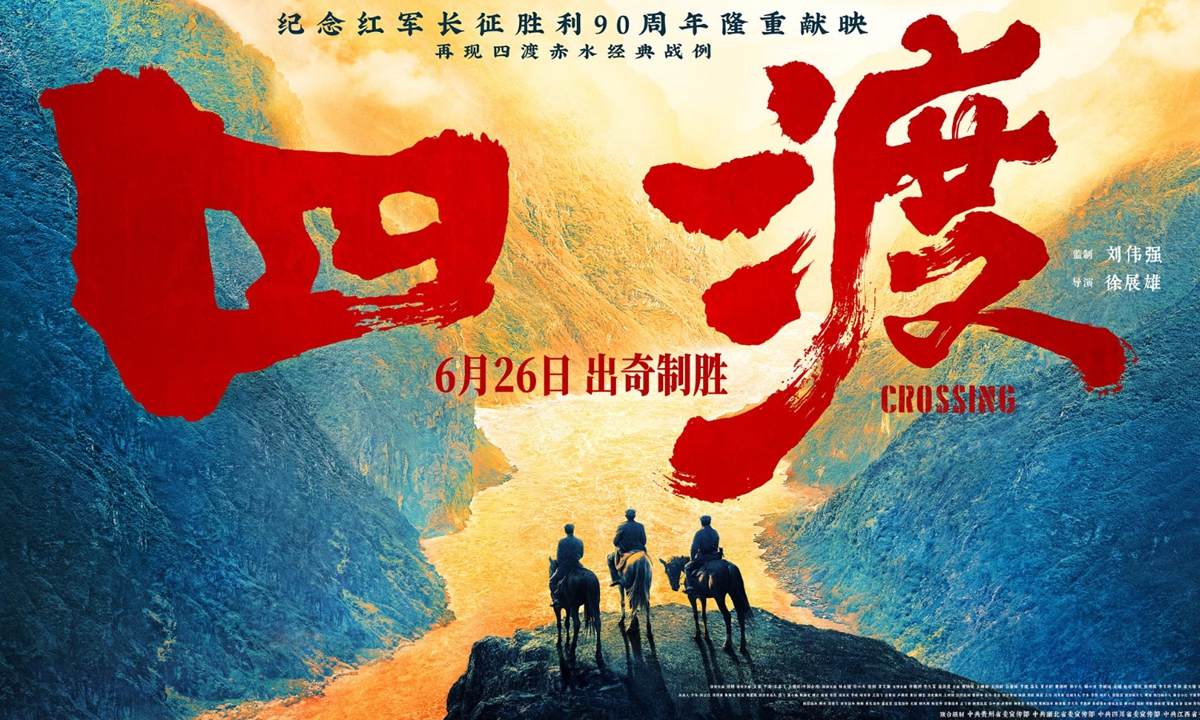
Crossing Photo: Courtesy of Douban
When the lights came up after the pre-screening of the upcoming movie Crossing at Guiyang's Yuejie Cinema in Southwest China's Guizhou Province, many people in the audience had tears in their eyes.
One woman, He Li, granddaughter of Red Army soldier He Mulin, spoke with a shaky voice. "My grandfather fell in that kind of fighting," she said, the Guizhou-based Eyes News reported on Wednesday.
"He was hurt at Qinggangpo and left unconscious on the battlefield. Local people carried him to a cave to heal." Her tears were for the heroes of 90 years ago and for the film that brought their story alive.
The new major revolutionary history film Crossing had its premiere in Guiyang on Tuesday. The movie tells the story of the Red Army's famous Four Crossings of the Chishui River during the Long March. It shows how the Red Army used smart tactics to turn the tide of battle against the Kuomintang forces and prevail. The film honors the 90th anniversary of the victory of the Long March. More than 80,000 Red Army soldiers began the Long March in October 1934, the roughly 12,500-kilometer trek later described by US journalist Harrison Salisbury as "a great human epic." After two years of hardship, the troops marched across raging rivers, frigid mountains, and arid grasslands to reach northern China, completing a strategic shift that would help shape China's modern history.
Guizhou played a very important role in the Long March. The Central Red Army spent more than four months there, moving through over 40 counties. The Four Crossings of the Chishui River was a key part of the campaign.
About 30,000 Red Army soldiers faced 400,000 enemy troops. They crossed the river back and forth four times in a clever way, creating a military miracle of achieving victory over a much larger force.
How do you make such a complex and fast-changing battle easy to understand and exciting on screen? Producer Andrew Lau explained at the premiere on Tuesday that the film adopted a fast pace. "With 30,000 facing 400,000, one slow step could mean the whole army was lost," he said. "We wanted to show that real pressure and the heavy weight of history."
The film pays special attention to the Battle of Loushan Pass. This was a very important fight that helped decide the Red Army's future. It includes big attacks, surprise climbs on cliffs, intelligence work, and quick decisions. It was the first major victory for the Red Army during the Long March.
To depict the Loushan Pass battle, the crew visited the real historic site to study the land. Director Xu Zhanxiong said, "A good script is written with your feet. You must go to the places where the Red Army fought to truly understand and film their story."
The team drove more than 1,800 kilometers. They visited many places the Red Army passed: Zunyi, Tongzi, Renhuai, Maotai, Xishui, Chishui, and others. They went to about 30 memorial sites and museums.
Lau recalled his first stop in Guizhou was the Four Crossings Memorial. "The guide explained everything very clearly from the first crossing to the fourth. We needed to learn this well," he said. He also visited the Red Ribbon exhibition - China's first comprehensive immersive digital experience hall themed around the Long March - and learned a lot about how the Red Army fought and climbed mountains.
When Lau first stood on the steep cliffs of Loushan Pass, he was shocked by how difficult the terrain was. Actor Yu Shi, who plays a Red Army soldier named Zhao Defa, went on the research trip too. "The east side is almost straight cliffs, and the west has high mountains," he recalled. "It is hard to imagine how the Red Army broke through in such dangerous places."
To show this truthfully, the crew built a huge set: a cliff 24 meters high and 30 meters wide, almost 90 degrees straight up. Actors Yu Shi and Wang Tianchen did the climbing and fight scenes themselves. Wang said it was the most memorable part. "It was at night and raining. While climbing, my arms felt weak. I thought about how the real Red Army soldiers were not professional climbers. They did it for the mission to take back Zunyi. It was really moving."
After the victory at Loushan Pass, Mao Zedong wrote the poem Remembering Qin'e: Loushan Pass. The director made a brave choice to shoot the real scene described in the poem: "The green mountains lie like a sea, the setting sun blazes like blood."
Director Xu Zhanxiong said, "We must thank Guizhou's beautiful mountains and rivers for giving us such a romantic view." The team of hundreds waited for sunset and quickly filmed the scene.
When actors playing Mao Zedong, Zhou Enlai, and Zhu De rode horses to the mountain top and looked at the red sunset, everyone felt it was very beautiful. "When you see it with your own eyes, you know all the waiting and hard work was worth it," Xu said.
Audience members at the premiere were deeply touched by the film's historical details and heroic spirit. Many said the movie makes the great Long March feel real and close. After watching the film, they understood better that the revolutionary victory came with great sacrifice, reported China's Central TV. Others praised the exciting battle scenes and the fearless spirit of the Red Army soldiers. They called it a good film that has deep thoughts, artistic value, and is enjoyable to watch.
Sun Jiashan, an associate research fellow at the China National Academy of Arts, told the Global Times that the Four Crossings is a classic campaign in the Long March. Such red classic stories tell audiences: "No victory comes easily. Behind every success are sacrifice and hard effort."
The movie Crossing will be released across China on June 26 as an important part of the country's upcoming summer box-office season.
RELATED ARTICLES