ARTS / CULTURE & LEISURE
Various events announced for 90th anniversary of Long March
Cultural heritage resources to be fully assessed
By and Wu Jie Published: Mar 25, 2026 11:03 PM

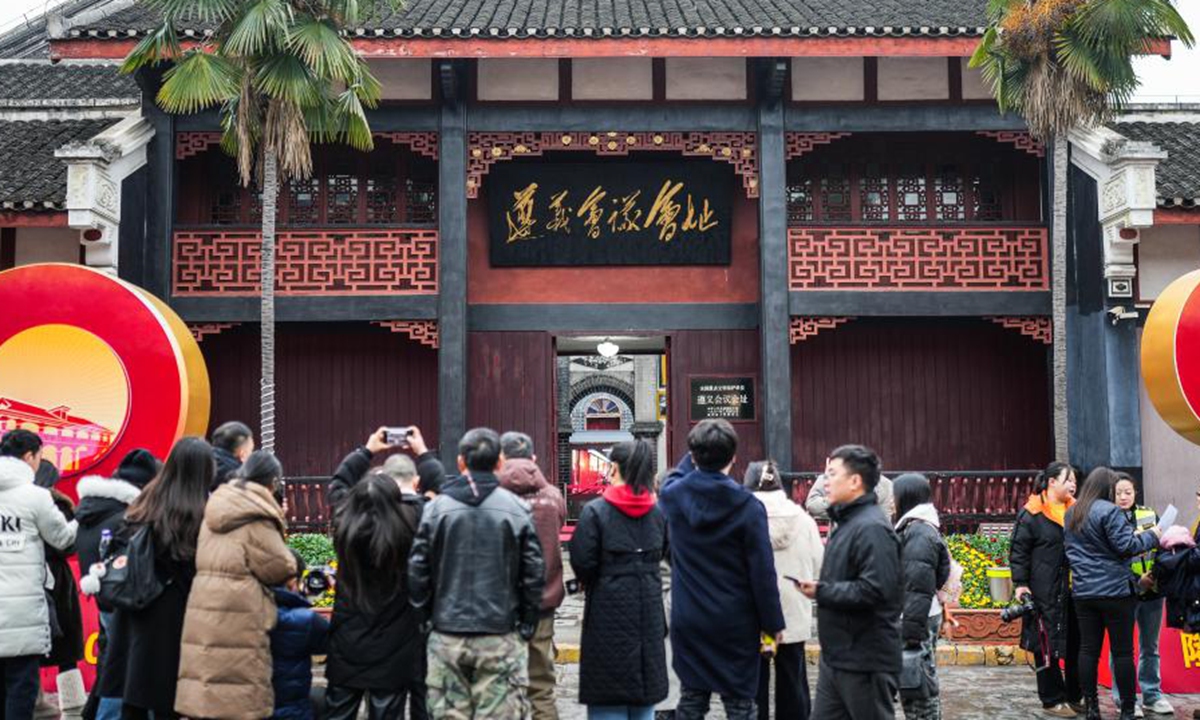
Tourists visit the venue of the Zunyi Meeting in Zunyi, Southwest China's Guizhou Province. Photo: Xinhua
On the 90th anniversary of the victory of the Long March of the Chinese Workers' and Peasants' Red Army in 2026, the National Cultural Heritage Administration (NCHA) will jointly launch a host of themed activities on the protection and exhibition of Long March cultural relics, the NCHA announced at a press conference on Wednesday.Efforts will be made to comprehensively assess Long March cultural heritage resources, compile a list of Long March heritage sites and a directory of memorial halls, and conduct a thorough survey of the preservation status of these sites, Peng Yuehui, an official with the NCHA, told the Global Times.
The Long March was a military maneuver carried out by the Red Army (forerunner of the People's Liberation Army) from 1934 to 1936. During this period, the army left their bases and marched through raging rivers, frigid mountains, and arid grasslands to break the siege of Kuomintang forces and continued to fight Japanese aggressors. Some of them marched as far as 12,500 kilometers, enduring hunger, thirst and cold.
Ninety years on, the legacy of the Long March continues to influence and inspire the Chinese people with its message of perseverance, unity and dedication.
The Long March is a magnificent epic and a towering monument in the course of the Chinese nation's great rejuvenation. Long March cultural relics bore witness to its history and carry forward its spirit, serving as valuable assets for advancing a new Long March in the new era and forging ahead on a new journey, said Peng.
The Zunyi Meeting site in Southwest China's Guizhou Province will be fully opened to the public later this year, and over 10 Long March-themed exhibitions will be held nationwide this year to present a panoramic picture of the great significance of the Long March in the history of the Communist Party of China (CPC), the country, and the military, Peng noted.
The renowned Zunyi Meeting was held between January 15 and 17, 1935, during the Long March. It was a landmark event in the history of the CPC as it largely determined the fate of the Party at a critical juncture for its survival.
To protect and make good use of revolutionary cultural relics, the Zunyi Meeting site is closed for restoration till June 30, according to a notice released by the site on March 6.
Meanwhile, technological advancement has brought the Long March legacy to life. At the Guizhou Long March Culture Digital Art Museum, visitors can experience the hardships of crossing snow-capped mountains and arid grasslands in simulated "freezing winds," and feel the thrill of the crossings of the Chishui River through the motion of rising and falling seats. As of early March, the museum had staged more than 21,000 performances and received over 2.1 million visitors, according to Eyesnews.cn, a news app operated by the Guizhou Daily.
The cultural heritage authorities of the 15 provincial-level regions along the Long March route will conduct a comprehensive inspection of the preservation status of Long March sites in their respective areas, with the aim of eliminating major risks and safety hazards at these sites, said Peng.
A special plan for the protection and inheritance of Long March cultural relics and cultural resources will be released in July, alongside support for the implementation of a number of key conservation projects, according to the press conference.
A "Retracing the Long March Route" heritage-themed travel route will be developed, and storytelling events on Long March history will be held. High-quality resources integrating revolutionary cultural relics will be promoted, while efforts will be made to enhance the quality and efficiency of public services at Long March sites and related venues.
RELATED ARTICLES