Photo: CCTV News
Beijing Zoo's newly built giant panda complex has been completed and five giant pandas have already moved into their upgraded home to begin adapting to the new environment, according to a press release the zoo sent to the Global Times on Wednesday.
Many netizens have taken to Chinese social media platforms to voice their anticipation for the newly renovated venue, expressing eagerness to visit the beloved giant pandas as soon as possible.
An employee surnamed Song told the Global Times that the five pandas, including Menglan, Fujiang, Fuxing and Baitian, are all long-term residents of the Beijing Zoo and that no new pandas will be introduced to the new compound. The public opening of the new pavilion will be scheduled after the five pandas have fully adapted to their new home.
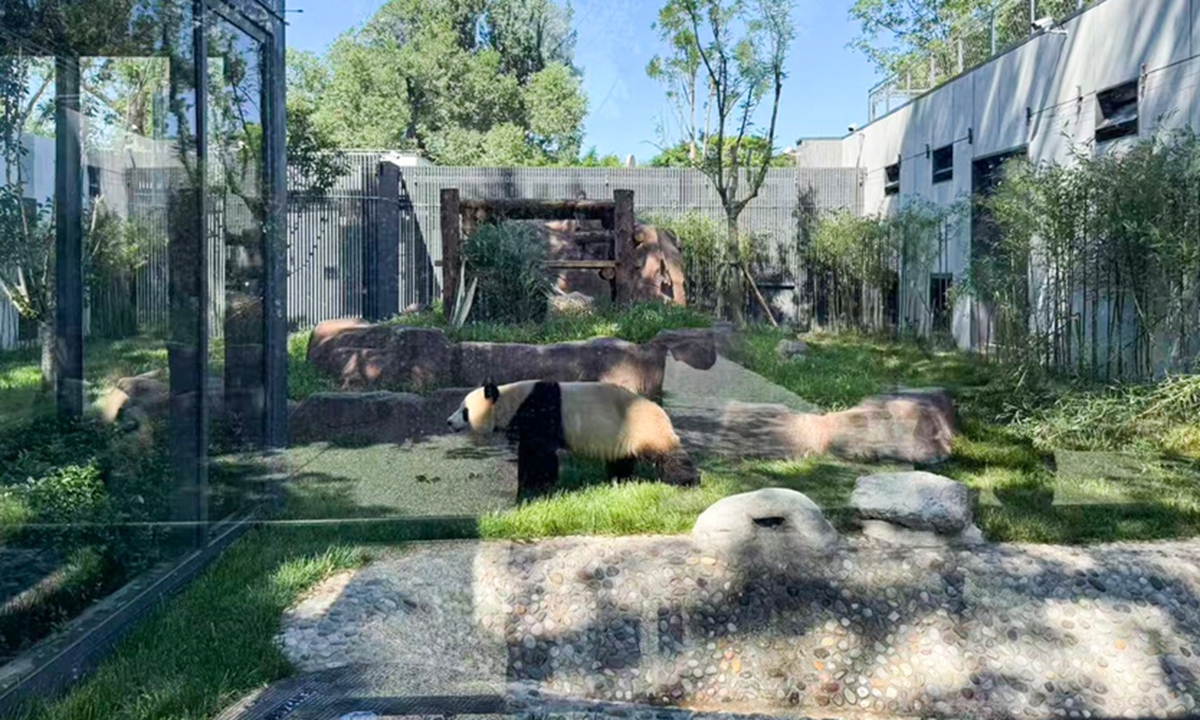
The expansion, which broke ground in December 2023, sits east of the zoo's existing panda facilities and links the original Asian Games Panda House from 1990 and the Olympic Panda House from 2008 to form a unified exhibition zone. With a footprint of 13,000 square meters and a total floor area of 2,483.91 square meters, the complex adds four indoor exhibition halls, five dens and five outdoor exercise yards, all built to current husbandry standards for the species, according to the press release.
The Beijing Zoo, one of the oldest zoological parks in China, has long carried a reputation as a guardian of the city's cultural memory, urban ecology and public education, and its giant pandas have consistently been one of its biggest draws.
The design of the new facility adopted what the zoo described as a "light intervention, micro-renewal" approach that weaves new functions into existing buildings and gardens. Movement routes between old and new sections were opened up, forming a continuous loop with the Asian Games house to enliven the whole precinct. Construction combined demolition, preservation, renovation and construction: original courtyards and landscaping were repaired and retained, while the outdoor visitor walkway of a former pheasant enclosure was converted into a panda activity area. Its indoor animal spaces were turned into a semi-outdoor rest areas for visitors, essentially flipping the interior and exterior areas for animals and humans within the confined site, the press release noted.
In addition, the mature trees, ancient specimens and venerable wisteria vines were kept intact, giving the panda yards a layered, plant-rich environment that preserves a sense of time.
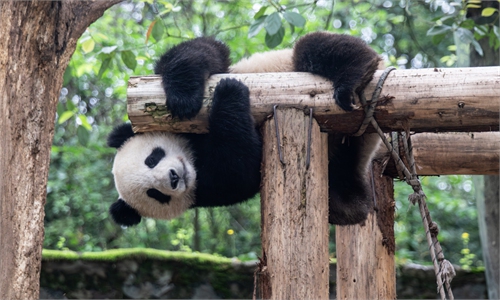
The habitats themselves have been dramatically upgraded. Climbing frames have been installed in both indoor and outdoor areas to cater to the animals' tree-climbing instincts, while splash pools and mist-spraying equipment are designed to keep them cool during Beijing's hot summers.
For visitors, the landscape design leans heavily into classical Chinese gardens, with covered corridors linking different sections to offer shaded paths. The sequence of verandas, courtyards, bamboo groves, gentle hillocks and rain gardens creates a meandering, layered experience that the zoo says is intended to deepen the sense of immersion.
On the construction side, the project was built to China's three-star green building standards, with a focus on low-carbon materials and a circular approach. The external walls use recycled bamboo-textured pressed concrete panels, repurposing waste materials from the site while echoing the textures of older structures. The entire design and construction were supported by building information modeling, or BIM, allowing a full digital record to be preserved for future smart operations and maintenance, the Zoo noted in the press.