IN-DEPTH / IN-DEPTH
In Central China's wheat fields, farmers and CPC members battle extreme weather to secure the people's rice bowl
A 'rescue' won against rain
By and Lin Xiaoyi Published: Jul 08, 2026 10:29 PM

Editor's Note:
This year marks the 105th anniversary of the founding of the Communist Party of China (CPC). Over the past century, the Party has led China through profound transformations: from national peril to national rejuvenation, from bare subsistence to moderate prosperity, from technological catch-up to independent innovation and from isolation and underdevelopment to greater educational equity. Generation after generation of CPC members, through their unwavering commitment, have written an epic of uplifting the destiny of the Chinese nation, the well-being of its people and the course of national development.
July 1 marks the CPC's founding anniversary. On this occasion, the Global Times is launching a special series, "105 Years of Uplift," to explore the deeper answer to the question of why the CPC has succeeded. The second installment looks at how, in the face of extreme weather, the Party supported farmers to save a wheat harvest and, in doing so, upheld the fundamental promise of food security for hundreds of millions.
The sky had turned overcast again. Wang Yongzhong looked up at the gathering mass of gray clouds. A wind blew in from the fields, carrying the scent of ripening wheat - and with it, a trace of anxiety.
More than 66.7 hectares of Wang's wheat were still standing in the fields, while the weather forecast warned that a new round of torrential rain was heading toward his home in Xiangyang, Central China's Hubei Province.
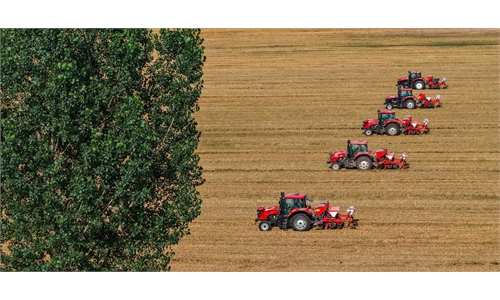
Since mid-May, more than 300,000 hectares of wheat in Xiangyang had ripened all at once, only to be met by a rare spell of consecutive rainy days. According to local media reports, if the crop was not harvested urgently, a year's worth of farmers' hard work could go to waste - affecting the livelihoods of countless farming families involved, and, more fundamentally, posing a threat to the nation's food security.
But Wang, like many other farmers in Xiangyang, did not have to worry for long. Before the wheat harvest began, meeting rooms in many grassroots CPC organizations across the city were brightly lit as the Party members and officials discussed how to better help farmers bring in the crop. Local power utility workers also inventoried lighting equipment and prepared to head into the wheat fields through the night. Also, hundreds of kilometers away, combine harvester operators from across the country started their engines as they received calls for help from Xiangyang.
In the end, the race against the downpour - a "battle" to save the grain - was won through the efforts of all sides. Local farmers' anxiety gave way to the steady reassurance of a bumper harvest.
In Wang's eyes, it was numerous hands, lights and roaring machines that together uplifted the bowls of rice in Xiangyang safely out of the rain.
"If it hadn't been for the support of the Party and the government, and the help that came from all directions, my wheat might still be stuck in the mud right now," Wang told the Global Times.
A three-day and two-night 'battle'
Wang is a grain farmer in Nanzhang County of Xiangyang. Nestled in the rolling hills of northwestern Xiangyang, Nanzhang depends heavily on wheat, which is one of the key sources of annual income for local farm households.
In Xiangyang, the wheat crop had been looking exceptionally strong this year, raising hopes for a bumper harvest. But in mid-May, several days of continuous rain arrived. Mature wheat ears were soaked in the downpour, and the risks of lodging, sprouting and mildew rose by the day. Wang paced back and forth at the edge of his fields, anxious and restless. He knew all too well that, if the harvest were delayed any longer, a season's worth of hard work could come to nothing.
He was not alone in his worry. Across Xiangyang, a total of 357,000 hectares of wheat might face the same fate.
"We could see the golden heads of wheat in the fields, but we couldn't harvest them. That made us anxious," recalled Liu Fan. As Party secretary of Huanglong Town in Xiangyang, he felt the pressure immediately: if the town's more than 8,000 hectares of wheat could not be harvested on time, yields would fall, and the price of sprouted wheat would also drop sharply.
Everyone was waiting for the rain to stop. Finally, the local meteorological department identified a precious window: from May 21 to 23, a stretch of three days and two nights with no rain, possibly the only chance to rush the wheat harvest.
"At that point, we decided to make the most of those three days and two nights," Liu told the Global Times.
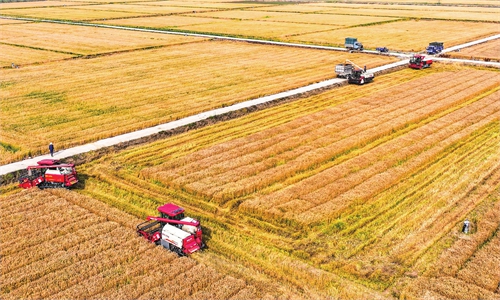
A 72-hour wheat-harvest "battle" unfolded across Xiangyang's briefly clear skies.
In Huanglong Town, grassroots Party members and officials worked together to clear field roads and dredge drainage ditches, ensuring farm machinery could get into the fields. The town also opened many public facilities, providing a place for the more than 170 combine harvesters that arrived from outside the region to rest, as well as hot and cold showers and free daily necessity kits.
"During those days, there was no such thing as clocking in or out. Wherever there was a need, that was where we went," Liu said. For them, during those days, it was normal to still be tallying unharvested wheat plots after midnight and then be back in the fields at dawn.
In Nanzhang, Wang was working just as hard. In addition to being a major grain grower, Wang also heads an agricultural cooperative that pools and markets grain from local farmers. Drawing on a network he had built up over the years, Wang urgently contacted dozens of combine harvesters and their operators from nearby provinces.
The scene in the wheat fields moved many people. Late at night, the lights of harvesters traced shifting ribbons across the farmland, while the roar of machinery cut through the damp air. Farmers stood on the field ridges, watching combine harvesters with out-of-province license plates drive into their fields one after another. The shift in their expressions, from anxiety to relief, did not go unnoticed by local Party and government officials.
Over the course of three days and two nights, more than 90 percent of Huanglong Town's wheat was harvested and safely brought in. Liu said he could finally breathe a sigh of relief. "It was the result of coordinated efforts by the Party and government, harvester operators, farmers and all the support teams working together," he told the Global Times.
'Invisible' backbones
In just three days and two nights, 90 percent of the wheat harvest was saved, effectively compressing a typical 10- to 15-day harvesting cycle into that brief window, Liu explained. This was not only a victory of coordination among all parties involved, but also a vivid example of how grassroots ingenuity and technology are coming together to empower China's agriculture, he said.
Nonetheless, getting the wheat in was only half the battle. What to do with the wet grain was just as critical in determining whether the harvest could truly be secured.
This year, the wheat collected in Xiangyang generally reached 50-percent moisture - the highest level in recent years. "If it wasn't dried or properly stored in time, the combination of high moisture and early-summer heat would cause the grain to heat up and ferment within hours, leading to sprouting and mold," Wang told the Global Times.
In response, Wang came up with an inventive solution: "ground cage" cooling. He laid large "cages" with perforated ventilation channels across the warehouse floor, stacked the wet grain on the "cages," and used blowers to continuously send in cool air, keeping the temperature of the grain pile below the fermentation threshold.
"As long as the temperature doesn't rise, the wheat won't mildew," Wang said. The method extended the preservation window for wet grain from the usual 48 hours to more than 72 hours, buying precious time for drying.
Behind the scenes, power supply is also an invisible backbone of this grain-rescue campaign.
In Zaoyang City of Xiangyang, 15 Party-member service teams with more than 160 frontline members from Zaoyang Power Supply Company under State Grid Corporation of China were on standby around the clock. Over those three days and two nights, 263 grain-drying enterprises in Zaoyang received one-to-one electricity support.
Power cuts were strictly ruled out; if a fault occurred, mobile generators were immediately deployed as a backup, said Chen Guohua, deputy director of the operations and maintenance department at the company.
Nighttime harvesting depended even more on lighting support. Since 2023, the company has made drone-mounted lighting systems part of its regular emergency response equipment. "Local farmers come to us for lights, because we once used drone lighting during midnight maintenance jobs. They had seen it, and they trust us," Chen told the Global Times.
That trust has been built on reliable power supply in everyday life.
According to Zhao Hong from the company's Party building department, the average outage duration for users in the city fell by 65 percent compared with 2024. Power cuts are gradually ceasing to be a source of worry for residents there.
"Only by maintaining a state of routine emergency preparedness can we stand firm in extreme weather and be truly dependable," Zhao told the Global Times.
Rooted resilience
On the evening of May 23, a new round of rain returned to Xiangyang. Raindrops tapped against the stubble of wheat fields that had already been harvested, making a soft, steady sound.
But for local farmers, the skies had already begun to clear up: the cut wheat had been sent to drying towers, and most of it was now safely in storage.
Those days, Xiangyang's CPC members were almost constantly on the move. Some stayed at highway exits until after midnight, holding signs to guide harvesting machines arriving from other provinces; some were still counting unharvested plots at midnight, drawing up work plans for the next day. "For grassroots Party officials like us, I believe bringing benefits to the people is the greatest achievement," Liu told the Global Times. "Protecting every hectare of farmland means safeguarding national food security and the people's well-being. That is the responsibility our Party members must shoulder, and it is also the most direct expression of the Party uplifting the lives of hundreds of millions of people."
This "battle" for rescuing grain was not confined to Xiangyang. In Nanyang, Central China's Henan Province, for instance, local agricultural authorities quickly coordinated tracked combine harvesters during breaks in the rain, giving priority to harvesting waterlogged low-lying fields. In some major grain-producing counties of Fuyang, East China's Anhui Province, machinery teams from other provinces also arrived, passing swiftly through the "green channel" on expressways and heading immediately to the front line.
Behind this seamless chain of support lay a nationwide coordination mechanism, orchestrated by the CPC.
At Wang's farmland, the more than 66 hectares of wheat he grows were not the first to be harvested. "When the machines arrived, I let them help the smaller farmers first. They were more anxious," he said.
Over the days of the urgent wheat harvest, Wang's cooperative bought nearly all the wet wheat brought in by local farmers. He said that while purchasing grain straight from the fields means taking a loss, he believes it is worth it. "I came up through hardship myself, so I also want to help others who are going through hard times," he said. When Wang was 17, he developed ankylosing spondylitis and was left bedridden. In his darkest days, it was the care of the local CPC organizations and the help of fellow villagers that gave him the courage and hope to keep going. From seeking treatment to starting his cooperative, Wang said he has received a great deal of care and support from the Party and the government. Having once been lifted up, he now wants to lift other people up.
As both a grain grower and a grain purchaser, Wang has closely watched China's Party-led efforts to support grain production. "The Party is holding up our steady rice bowl," he told the Global Times. "With the Party here, our people's good life has the strongest backing."
This year marks the 105th anniversary of the founding of the Communist Party of China (CPC). Over the past century, the Party has led China through profound transformations: from national peril to national rejuvenation, from bare subsistence to moderate prosperity, from technological catch-up to independent innovation and from isolation and underdevelopment to greater educational equity. Generation after generation of CPC members, through their unwavering commitment, have written an epic of uplifting the destiny of the Chinese nation, the well-being of its people and the course of national development.
July 1 marks the CPC's founding anniversary. On this occasion, the Global Times is launching a special series, "105 Years of Uplift," to explore the deeper answer to the question of why the CPC has succeeded. The second installment looks at how, in the face of extreme weather, the Party supported farmers to save a wheat harvest and, in doing so, upheld the fundamental promise of food security for hundreds of millions.
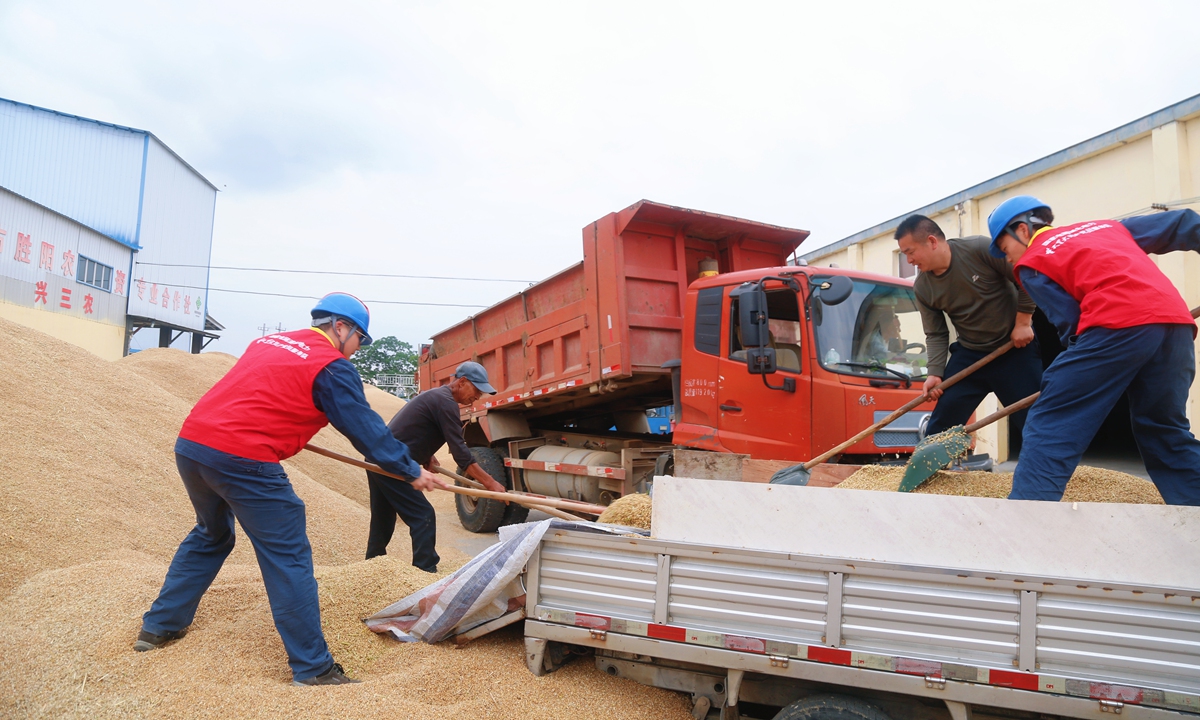
Staffers of Zaoyang Power Supply Company under State Grid Corporation of China help local farmers dry wheat in Zaoyang, Central China's Hubei Province, on May 21, 2026. Photo: Courtesy of Yang Junchao
The sky had turned overcast again. Wang Yongzhong looked up at the gathering mass of gray clouds. A wind blew in from the fields, carrying the scent of ripening wheat - and with it, a trace of anxiety.
More than 66.7 hectares of Wang's wheat were still standing in the fields, while the weather forecast warned that a new round of torrential rain was heading toward his home in Xiangyang, Central China's Hubei Province.
Since mid-May, more than 300,000 hectares of wheat in Xiangyang had ripened all at once, only to be met by a rare spell of consecutive rainy days. According to local media reports, if the crop was not harvested urgently, a year's worth of farmers' hard work could go to waste - affecting the livelihoods of countless farming families involved, and, more fundamentally, posing a threat to the nation's food security.
But Wang, like many other farmers in Xiangyang, did not have to worry for long. Before the wheat harvest began, meeting rooms in many grassroots CPC organizations across the city were brightly lit as the Party members and officials discussed how to better help farmers bring in the crop. Local power utility workers also inventoried lighting equipment and prepared to head into the wheat fields through the night. Also, hundreds of kilometers away, combine harvester operators from across the country started their engines as they received calls for help from Xiangyang.
In the end, the race against the downpour - a "battle" to save the grain - was won through the efforts of all sides. Local farmers' anxiety gave way to the steady reassurance of a bumper harvest.
In Wang's eyes, it was numerous hands, lights and roaring machines that together uplifted the bowls of rice in Xiangyang safely out of the rain.
"If it hadn't been for the support of the Party and the government, and the help that came from all directions, my wheat might still be stuck in the mud right now," Wang told the Global Times.
A three-day and two-night 'battle'
Wang is a grain farmer in Nanzhang County of Xiangyang. Nestled in the rolling hills of northwestern Xiangyang, Nanzhang depends heavily on wheat, which is one of the key sources of annual income for local farm households.
In Xiangyang, the wheat crop had been looking exceptionally strong this year, raising hopes for a bumper harvest. But in mid-May, several days of continuous rain arrived. Mature wheat ears were soaked in the downpour, and the risks of lodging, sprouting and mildew rose by the day. Wang paced back and forth at the edge of his fields, anxious and restless. He knew all too well that, if the harvest were delayed any longer, a season's worth of hard work could come to nothing.
He was not alone in his worry. Across Xiangyang, a total of 357,000 hectares of wheat might face the same fate.
"We could see the golden heads of wheat in the fields, but we couldn't harvest them. That made us anxious," recalled Liu Fan. As Party secretary of Huanglong Town in Xiangyang, he felt the pressure immediately: if the town's more than 8,000 hectares of wheat could not be harvested on time, yields would fall, and the price of sprouted wheat would also drop sharply.
Everyone was waiting for the rain to stop. Finally, the local meteorological department identified a precious window: from May 21 to 23, a stretch of three days and two nights with no rain, possibly the only chance to rush the wheat harvest.
"At that point, we decided to make the most of those three days and two nights," Liu told the Global Times.
A 72-hour wheat-harvest "battle" unfolded across Xiangyang's briefly clear skies.
In Huanglong Town, grassroots Party members and officials worked together to clear field roads and dredge drainage ditches, ensuring farm machinery could get into the fields. The town also opened many public facilities, providing a place for the more than 170 combine harvesters that arrived from outside the region to rest, as well as hot and cold showers and free daily necessity kits.
"During those days, there was no such thing as clocking in or out. Wherever there was a need, that was where we went," Liu said. For them, during those days, it was normal to still be tallying unharvested wheat plots after midnight and then be back in the fields at dawn.
In Nanzhang, Wang was working just as hard. In addition to being a major grain grower, Wang also heads an agricultural cooperative that pools and markets grain from local farmers. Drawing on a network he had built up over the years, Wang urgently contacted dozens of combine harvesters and their operators from nearby provinces.
The scene in the wheat fields moved many people. Late at night, the lights of harvesters traced shifting ribbons across the farmland, while the roar of machinery cut through the damp air. Farmers stood on the field ridges, watching combine harvesters with out-of-province license plates drive into their fields one after another. The shift in their expressions, from anxiety to relief, did not go unnoticed by local Party and government officials.
Over the course of three days and two nights, more than 90 percent of Huanglong Town's wheat was harvested and safely brought in. Liu said he could finally breathe a sigh of relief. "It was the result of coordinated efforts by the Party and government, harvester operators, farmers and all the support teams working together," he told the Global Times.
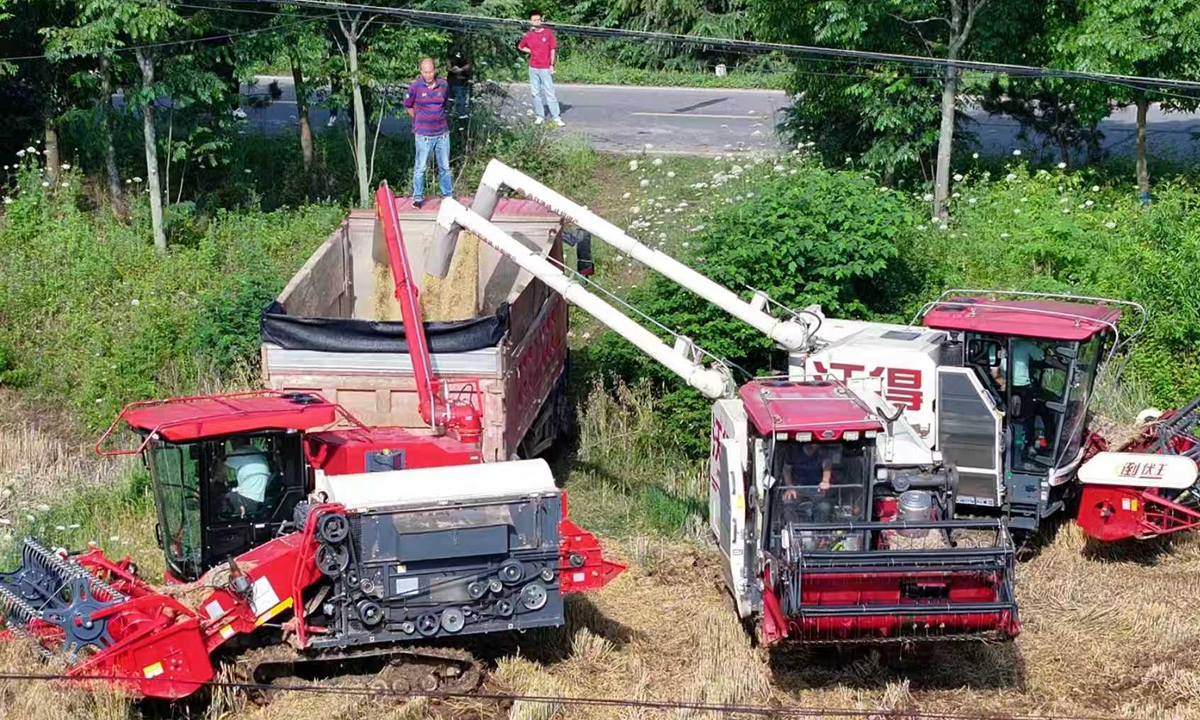
Combine harvesters are busy getting wheat in a village of Huanglong Town, Hubei Province, on May 21, 2026. Photo: Courtesy of Yang Tao
'Invisible' backbones
In just three days and two nights, 90 percent of the wheat harvest was saved, effectively compressing a typical 10- to 15-day harvesting cycle into that brief window, Liu explained. This was not only a victory of coordination among all parties involved, but also a vivid example of how grassroots ingenuity and technology are coming together to empower China's agriculture, he said.
Nonetheless, getting the wheat in was only half the battle. What to do with the wet grain was just as critical in determining whether the harvest could truly be secured.
This year, the wheat collected in Xiangyang generally reached 50-percent moisture - the highest level in recent years. "If it wasn't dried or properly stored in time, the combination of high moisture and early-summer heat would cause the grain to heat up and ferment within hours, leading to sprouting and mold," Wang told the Global Times.
In response, Wang came up with an inventive solution: "ground cage" cooling. He laid large "cages" with perforated ventilation channels across the warehouse floor, stacked the wet grain on the "cages," and used blowers to continuously send in cool air, keeping the temperature of the grain pile below the fermentation threshold.
"As long as the temperature doesn't rise, the wheat won't mildew," Wang said. The method extended the preservation window for wet grain from the usual 48 hours to more than 72 hours, buying precious time for drying.
Behind the scenes, power supply is also an invisible backbone of this grain-rescue campaign.
In Zaoyang City of Xiangyang, 15 Party-member service teams with more than 160 frontline members from Zaoyang Power Supply Company under State Grid Corporation of China were on standby around the clock. Over those three days and two nights, 263 grain-drying enterprises in Zaoyang received one-to-one electricity support.
Power cuts were strictly ruled out; if a fault occurred, mobile generators were immediately deployed as a backup, said Chen Guohua, deputy director of the operations and maintenance department at the company.
Nighttime harvesting depended even more on lighting support. Since 2023, the company has made drone-mounted lighting systems part of its regular emergency response equipment. "Local farmers come to us for lights, because we once used drone lighting during midnight maintenance jobs. They had seen it, and they trust us," Chen told the Global Times.
That trust has been built on reliable power supply in everyday life.
According to Zhao Hong from the company's Party building department, the average outage duration for users in the city fell by 65 percent compared with 2024. Power cuts are gradually ceasing to be a source of worry for residents there.
"Only by maintaining a state of routine emergency preparedness can we stand firm in extreme weather and be truly dependable," Zhao told the Global Times.
Rooted resilience
On the evening of May 23, a new round of rain returned to Xiangyang. Raindrops tapped against the stubble of wheat fields that had already been harvested, making a soft, steady sound.
But for local farmers, the skies had already begun to clear up: the cut wheat had been sent to drying towers, and most of it was now safely in storage.
Those days, Xiangyang's CPC members were almost constantly on the move. Some stayed at highway exits until after midnight, holding signs to guide harvesting machines arriving from other provinces; some were still counting unharvested plots at midnight, drawing up work plans for the next day. "For grassroots Party officials like us, I believe bringing benefits to the people is the greatest achievement," Liu told the Global Times. "Protecting every hectare of farmland means safeguarding national food security and the people's well-being. That is the responsibility our Party members must shoulder, and it is also the most direct expression of the Party uplifting the lives of hundreds of millions of people."
This "battle" for rescuing grain was not confined to Xiangyang. In Nanyang, Central China's Henan Province, for instance, local agricultural authorities quickly coordinated tracked combine harvesters during breaks in the rain, giving priority to harvesting waterlogged low-lying fields. In some major grain-producing counties of Fuyang, East China's Anhui Province, machinery teams from other provinces also arrived, passing swiftly through the "green channel" on expressways and heading immediately to the front line.
Behind this seamless chain of support lay a nationwide coordination mechanism, orchestrated by the CPC.
At Wang's farmland, the more than 66 hectares of wheat he grows were not the first to be harvested. "When the machines arrived, I let them help the smaller farmers first. They were more anxious," he said.
Over the days of the urgent wheat harvest, Wang's cooperative bought nearly all the wet wheat brought in by local farmers. He said that while purchasing grain straight from the fields means taking a loss, he believes it is worth it. "I came up through hardship myself, so I also want to help others who are going through hard times," he said. When Wang was 17, he developed ankylosing spondylitis and was left bedridden. In his darkest days, it was the care of the local CPC organizations and the help of fellow villagers that gave him the courage and hope to keep going. From seeking treatment to starting his cooperative, Wang said he has received a great deal of care and support from the Party and the government. Having once been lifted up, he now wants to lift other people up.
As both a grain grower and a grain purchaser, Wang has closely watched China's Party-led efforts to support grain production. "The Party is holding up our steady rice bowl," he told the Global Times. "With the Party here, our people's good life has the strongest backing."
RELATED ARTICLES