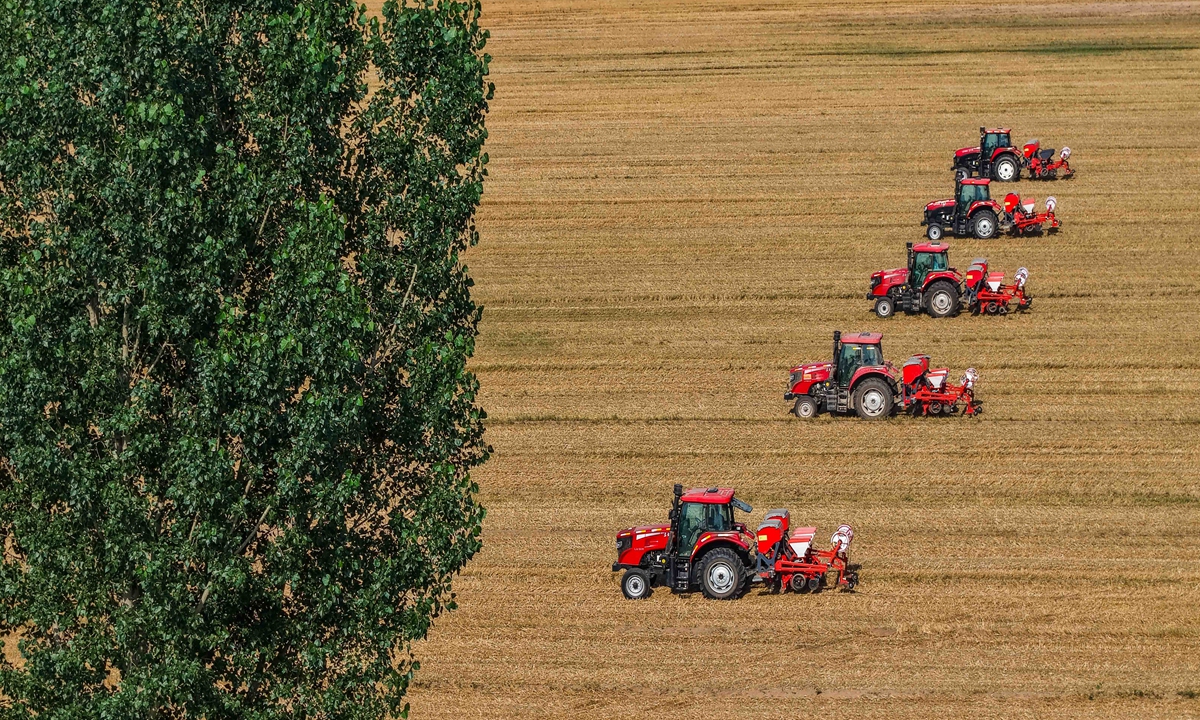
Farmers are busy working in the fields during the summer sowing season in Dongyujia village, Dezhou, East China's Shandong Province, on June 24, 2026. Photo: VCG
Editor's Note:
Since 2012, China has witnessed an extraordinary economic transition, with historic achievements in all aspects of the economy. Such an unparalleled feat does not just happen by accident, especially during a tumultuous period in the global geo-economic landscape and a tough phase in China's economic transformation and upgrading process. It was Xi Jinping Thought on Socialism with Chinese Characteristics for a New Era that guided the country in overcoming various risks and challenges, and in keeping the China economic miracle alive.
As China embarked on the quest to become a great modern socialist country amid global changes unseen in a century, Xi's economic thought has been and will continue to be the guiding principle for development in China for years to come. Furthermore, China's development carries immense significance for the world at large. What is Xi's economic thought? What does it mean for China and the world?
To answer these questions, the Global Times has launched this special coverage on Xi's major economic speeches and policies, and how they are put into practice to boost development in China and around the world.
Having just completed his 29th summer harvest season, 50-year-old Song Zhijie has spent nearly three decades working in agricultural machinery operations. Looking back on a dust-covered and sweat-soaked summer harvest in 1997, he paused for a moment, reflecting on how far things have come.
"Back then, we were still using tractors without cabins, and we often ended up covered in mud after a day's work," Song, an agricultural machinery operator from Dongyujia village in Bianlin township, Dezhou, East China's Shandong Province, told the Global Times. "Now, we are operating modern machines equipped with air-conditioned cabins. The performance has also improved dramatically, and the work has become much easier and more comfortable."
Recalling the rainy weather during this year's summer harvest in June, Song smiled, appearing visibly relieved while describing the efficiency of the rapid harvesting operations. "In the past, we could only harvest around 50 to 60 mu (3.3-4.0 hectares) of wheat per day with older machinery," Song told the Global Times, adding excitedly that with upgraded equipment, daily harvesting efficiency has now risen significantly to about 140 to 150 mu, nearly tripling the previous capacity.
In late June, farmers run corn seeders through fields freshly cleared of wheat across Shandong Province, carving furrows into the soil as they race to finish summer sowing.
It was into this rhythm of relentless motion that President Xi Jinping visited Dezhou, a major provincial breadbasket, on June 24. It was a trip he made specifically to see how summer farm work was going, check out the fields, and spend time with the villagers, the Xinhua News Agency reported.
Walking into the farmlands at Dongyujia, Xi, also general secretary of the Communist Party of China Central Committee and chairman of the Central Military Commission, stopped to speak with grain growers, machine operators, and agricultural technicians.
When told that wheat yields had risen again this year and that corn planting was proceeding briskly, well within the seasonal window, Xi voiced his approval. "Ensuring a stable supply of grain and other agricultural products is the top priority in agricultural production," he said.
The Chinese leader also called for solid measures to advance the modernization of agriculture and rural areas.
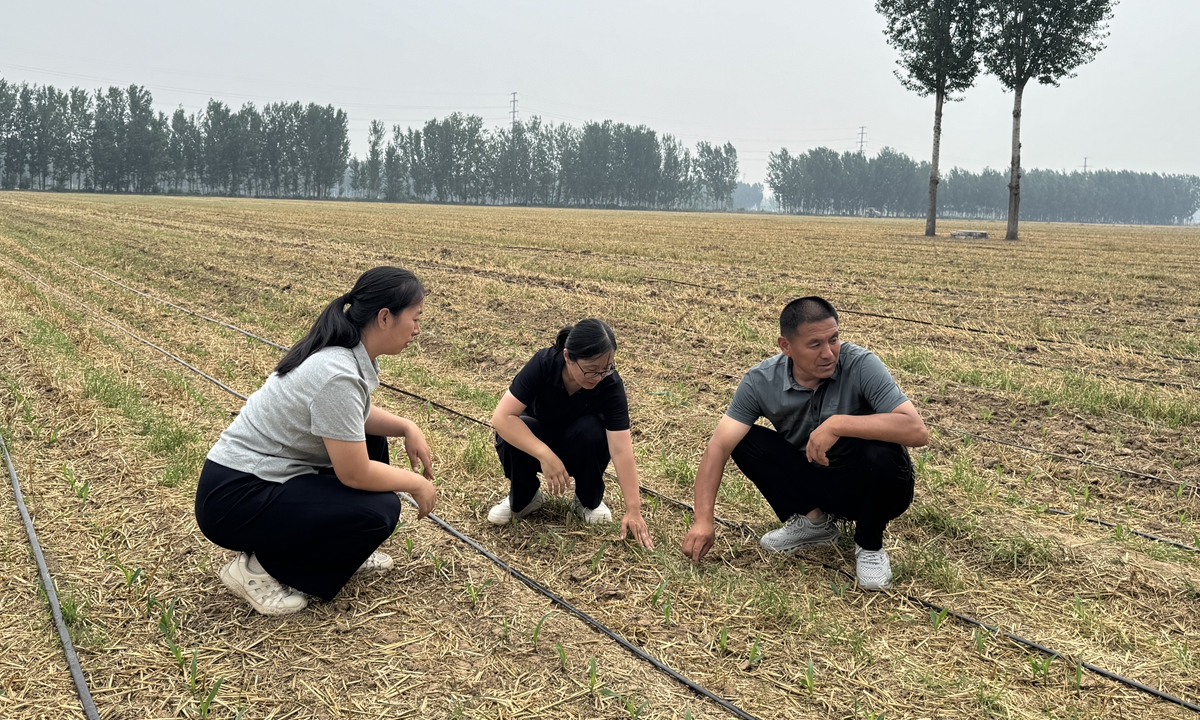
Cui Xinyan and Gao Jianmei, agricultural technicians responsible for Dongyujia village, inspect the integrated water and fertilizer irrigation pipelines and the growth of corn seedlings on June 30, 2026. Photo: Chen Qingrui/GT
New equipment empowers food security
With nearly 20 percent of the world's population but only about 9 percent of its arable land, China has achieved absolute security in staple food and basic self-sufficiency in grain through sustained efforts to protect farmland and improve agricultural productivity.
Dezhou, a major grain-producing city in Shandong, is just a microcosm of the countless cities across China that are vigorously advancing green, high-tech driven and high-yield grain production initiatives.
The city produces more than 7.5 billion kilograms of grain annually, accounting for about 1.1 percent of China's total and nearly 14 percent of Shandong's output, according to Xinhua.
With thousands of years of agricultural history, Dezhou's farming practices have evolved from stone tools to modern machinery. Today, a new generation of agricultural equipment is helping local villagers move toward a more intelligent and technology-driven era of farming.
"After the wheat harvest in June, we planted corn seedlings. During the corn planting period, we used high-performance precision seeders to raise planting density from roughly 4,500 to 5,500 plants per mu," Cui Xinyan, a technician at the local agricultural technology promotion center, told the Global Times, adding that the optimized density of an additional 1,000 plants per mu is expected to improve yield potential while maintaining healthy crop growth.
The tractors used in Dongyujia village, widely favored by users in Shandong, are equipped with the Beidou satellite-based intelligent monitoring system, enabling real-time tracking of more than 20 operational indicators, including tillage depth and seeding accuracy, according to the YTO Group, a leading domestic agricultural machinery manufacturer.
After all the corn seedlings had been planted, Dongyujia officially entered the summer field management phase. As farming moves into this stage, the integrated water and fertilizer irrigation system introduced earlier this year is playing a key role.
In the past, irrigation and fertilization in rural villages were highly complex and labor-intensive to manage at an ideal level. Today, however, farmers told the Global Times that they can complete the tasks efficiently through instruments and controls in a centralized control room.
The system can reduce water and fertilizer use by more than 30 percent while significantly cutting labor costs, Gao Jianmei, a technician at the local agricultural technology promotion center, told the Global Times. "In the past, irrigating 400 to 500 mu of farmland would require five people working for five days, but now two people can finish the job in two days." She added that the technology can also increase yields by more than 15 percent and raise fertilizer utilization efficiency by over 15 percent.
The Global Times also learned that local agricultural authorities regularly organize professional technical teams to work in the fields, providing continuous guidance and support to farmers to ensure that relevant agricultural technologies are effectively delivered to the front line of production.
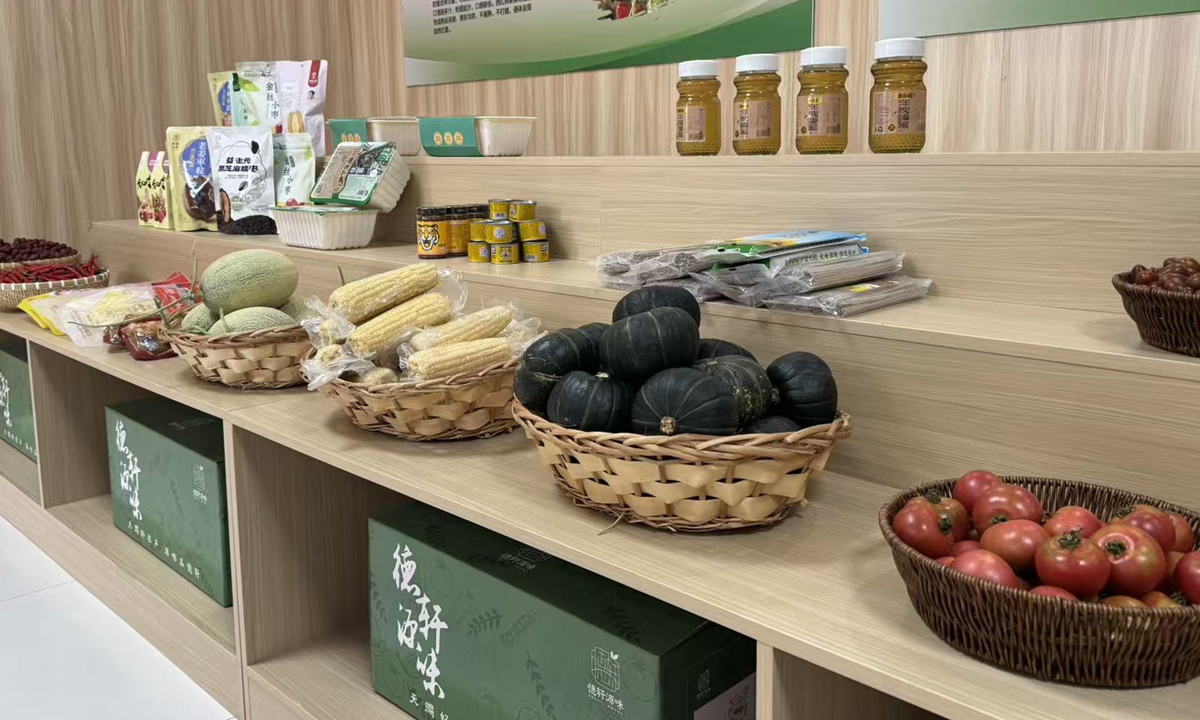
Agricultural products grown and produced are displayed in Dongyujia village on June 30, 2026. Photo: Chen Qingrui/GT
Modern agriculture improves rural livelihoods
In villages that are increasingly aligned with modern agriculture, more vivid and diversified farming practices are emerging on the ground. Dongyujia, rich in local produce, together with the Dexuan Cluster - an agricultural zone covering Dongyujia, Xiyujia and Guozhuang villages - is adopting new approaches to improving farmers' livelihoods and rural development.
A village official in Dongyujia village told the Global Times that the area has already worked well in vibrant agricultural livestreaming.
"Daily shipments now reach about 1,500 orders, mainly including tomatoes, cucumbers, corn, black wheat, as well as local specialties such as shepherd's purse dumplings and mung bean jelly," the official said.
Notably, the village authorities have also prepared a wide range of popular science reading materials for farmers, covering e-commerce livestreaming skills, video editing techniques and even how to use emerging AI tools such as DeepSeek.
According to Cui, local agricultural authorities also regularly organize e-commerce training sessions for villagers, targeting groups such as stay-at-home mothers, and returning college graduates who are interested in entrepreneurship.
"In recent years, the scale of greenhouse vegetable production has expanded, while new business formats such as fruit picking, educational field trips, livestream e-commerce and rural tourism have also developed. Last year, per capita disposable income in the village reached 40,000 yuan," Huang Yunzhou, Party secretary of Xiyujia village, which is close to Dongyujia, told the Global Times.
Huang said that he would continue to push for industrial upgrading in the village, relying on a newly planned agricultural product processing plant in the area to raise value added and help farmers earn better prices, while also encouraging surrounding villages to develop together so that rural livelihoods can continue to improve.
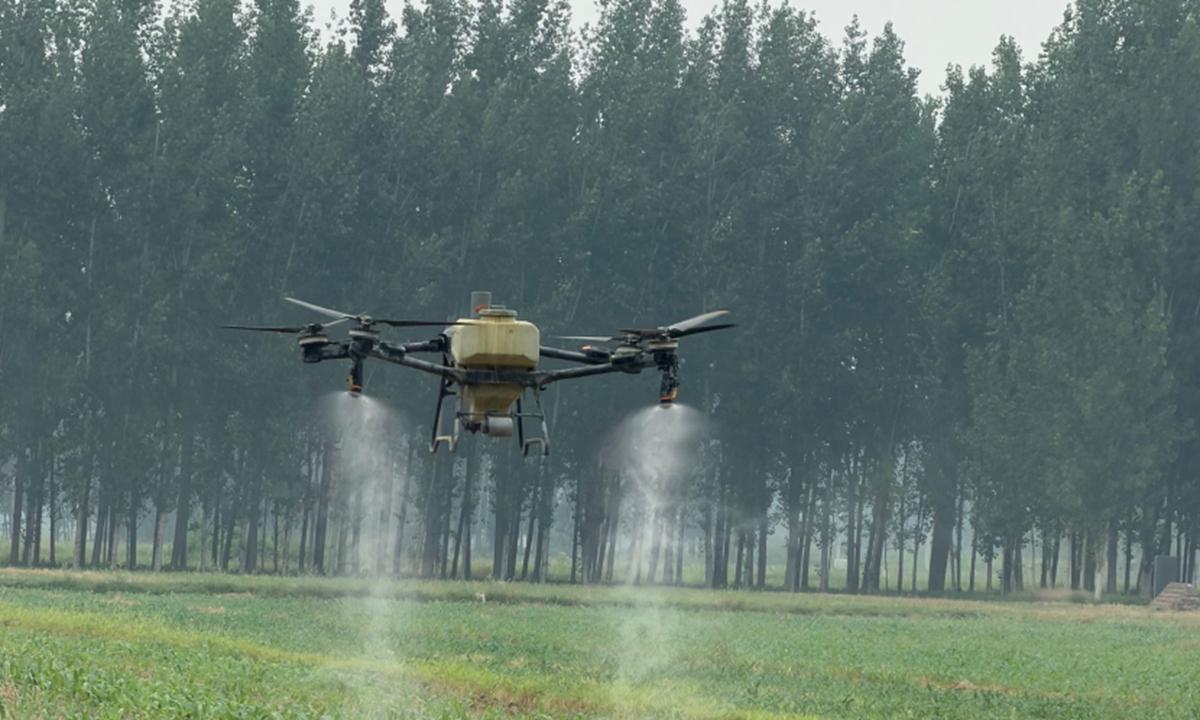
Agricultural drones spray wheat seedlings in Dongyujia village, Shandong, on April 2, 2026. The mixed solution includes insecticides, fungicides, and plant growth regulators to support healthy crop growth. Photo: Courtesy of Dongyujia village
Steady policy efforts, strong harvest confidence
This year, China's central policy documents have placed a strong emphasis on advancing agricultural modernization while ensuring national food security. Supported by both policy guidance and the application of modern technologies, farmers in Xiyujia village are increasingly confident about this year's harvest.
The State Council, China's cabinet, has issued a plan to accelerate agricultural and rural modernization during the 15th Five-Year Plan (2026-2030) period. The plan seeks to accelerate the modernization of agriculture and rural areas to drive Chinese modernization, and has identified key tasks and policy measures for this purpose during the period, Xinhua reported.
Meanwhile, the nation's "No. 1 central document" for 2026 released early this year also outlined plans to advance agricultural and rural modernization and to promote all-around rural revitalization.
Agricultural modernization is essentially about applying practical technologies in real farming, combining better seeds, machinery and farming methods, Li Guoxiang, a research fellow at the Rural Development Institute of the Chinese Academy of Social Sciences, told the Global Times. He noted that in recent years, China has been accelerating the transfer of agricultural research into field use, so that mature technologies can be applied at scale in production.
"China's grain production has maintained steady growth over the long term and has clearly moved beyond the cyclical fluctuations seen in the past," Li said. "This is largely due to the elevation of food security to a national strategic priority, supported by continuous policy guidance, institutional safeguards and technological advancement that together have strengthened overall agricultural capacity." Broader adoption of modern agricultural technologies has continued to drive gains in farming productivity in China in recent years.
In 2025, China's grain production reached about 714.9 million tons, marking the second straight year grain output had stayed above 700 million tons. Notably, the nation's contribution rate of agricultural scientific and technological progress last year exceeded 64 percent, while the comprehensive mechanization rate of crop cultivation and harvesting reached 76.7 percent, according to Xinhua.
To achieve this year's grain output target of around 1.4 trillion jin, every village, every region, every plot of farmland, and every farming household carries a sense of mission.
For example, in response to the adverse impact of rainfall this year, China's distinctive cross-regional harvesting teams have played an important role, while the introduction of more advanced harvesting equipment has further boosted the efficiency of the rush harvest, providing a solid safeguard for food security.
The wider use of advanced equipment, including heavy-duty crawler harvesters, has made rush harvesting more efficient. These harvesters can be quickly moved across regions via expressways and are better suited to muddy fields, helping reduce harvesting losses and grain scattering. Their use has greatly strengthened China's ability to carry out emergency harvesting under extreme weather and in complex farmland conditions.
"Cross-provincial and cross-regional harvesting operations test not only a country's level of agricultural mechanization, but also society's sense of responsibility for food security," expert Li said.
Given precisely targeted policy support, agricultural technology is also bolstering harvest confidence in rural areas.
Back in Dezhou, major grain growers its Licheng district told the Global Times that they were confident about this year's harvest.
"This year's wheat harvest is better than last year's. Yields are up by several dozen jin per mu, exceeding 1,300 jin (650 kilograms), and grain prices have remained relatively stable," Yu Shulei, a large-scale grain farmer from Dongyujia village, told the Global Times. Yu said the integrated water and fertilizer irrigation system has been instrumental in boosting yields, increasing corn production by about 200 jin per mu and wheat output by around 100 jin per mu.
"I'm confident about this year's harvest," he said, adding that he is aiming for a corn yield of 1,700 jin per mu this year, and will work hard to achieve that goal.
For Li Lianjun, another large-scale grain farmer from Biansan village in Dezhou, confidence also comes from the precise support provided by agricultural technicians.
"I think increasing yields by more than 200 jin per mu compared with previous years is well within reach, because agricultural technicians have introduced new scientific farming methods that have helped us improve production," Li told the Global Times.
This summer in Dezhou, from sowing to harvesting and then back to sowing again, different figures can be seen busy across the fields. Each of them carries a firm sense of responsibility on their shoulders, quietly contributing to every stage of the agricultural cycle.
"We grow the grain ourselves, and at the same time, we are providing the most basic guarantee for food security at the regional and even national level. Helping safeguard the country's food supply is both an honor and a source of pride," Yu told the Global Times firmly.
Latest model of agricultural modernization