IN-DEPTH / IN-DEPTH
China-Kyrgyzstan archaeological collaboration awakens legendary Suyab city, continuing civilization dialogue along Silk Road
Threads through time
By Lin Xiaoyi, and Xia Wenxin in Bishkek Published: Jun 08, 2026 10:18 PM

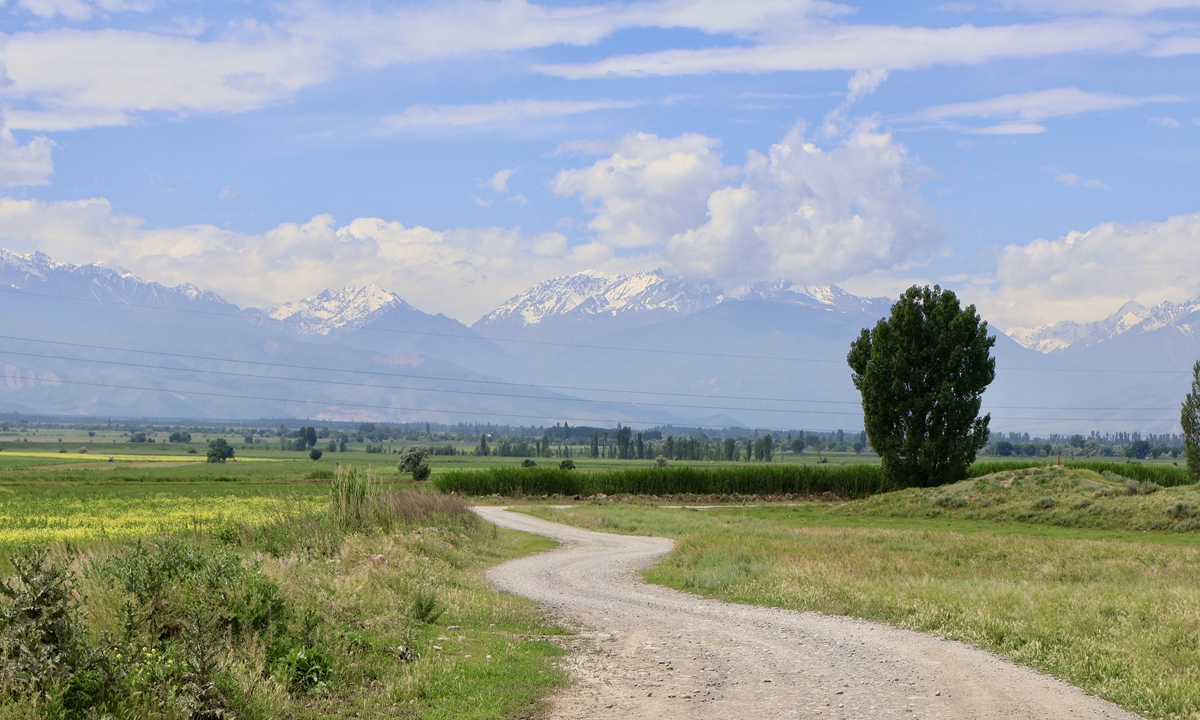
A view of the area where the Suyab ruins are located in Tokmok, Kyrgyzstan Photo: Lin Xiaoyi/GT
Editor's Note:As global challenges grow increasingly interconnected, technological solutions are rarely confined to a single country. Through research collaboration, open sharing of expertise and partnerships with international institutions, Chinese scientists, engineers and enterprises are engaging more deeply with the world, contributing tools and experience to problems that demand collective answers.
The Global Times launches a series of "Tech Seeds, Global Bloom," spotlighting China's achievements in advancing technology for good both domestically and internationally. By following these trajectories, the series invites readers to consider a different measure of progress: Not how advanced technology becomes, but whom it ultimately serves, and how widely its benefits can spread.
This article is the fourth installment. Global Times reporters visited the ancient city of Suyab in Kyrgyzstan on the spot, exploring how China's refined archaeological expertise tackles persistent hurdles in conserving earthen historic sites and showcasing the tangible outcomes of cultural and technology exchange between China and Kyrgyzstan along the Silk Road.
Beneath the full summer heat, the snow-capped peaks of the Tianshan Mountains stretch endlessly across the Chuy Valley in Kyrgyzstan. Outside Tokmok town, the ruins of the ancient city of Suyab lay quietly embedded in the green expanse.
A group of figures appeared beside the site's earthen ramparts, conversing in Chinese, Russian, Kyrgyz and other tongues. Despite speaking different languages, they share one common goal: figuring out how to keep this over 1000-year-old ancient city alive for generations to come.
Experts from the Dunhuang Academy introduced the environmental and structural health monitoring systems deployed on-site to the gathered international scholars. These devices continuously collect data, including temperature, humidity, soil moisture, rainfall and surface movement, providing the evidence needed to analyze the progression of deterioration in earthen sites and to guide conservation interventions.
Archaeologists, architects, conservation specialists and interdisciplinary scholars from Kyrgyzstan, Kazakhstan, Uzbekistan, Tajikistan, Russia watched closely and asked detailed questions. Some pulled out their phones to take photos, while others jotted down notes on their devices.
This is the scene on May 26, during a field survey as part of an international academic and practical seminar on earthen sites in Central Asia. Drawing on their years of experience in protecting earthen sites along the Silk Road in northwestern China, the Chinese scholars introduced the Suyab site monitoring platform to their international colleagues, explained the mechanisms behind earthen site deterioration, and demonstrated technical solutions for visual monitoring and digital conservation.
"How deep do these sensors need to be buried underground?"
"What is the outdoor service lifespan of sensor batteries?"
Their detailed, highly technical discussions forge a solid friendship stretching from Dunhuang in Northwest China's Gansu Province across the Tianshan Mountains all the way to Bishkek, Kyrgyzstan's capital.
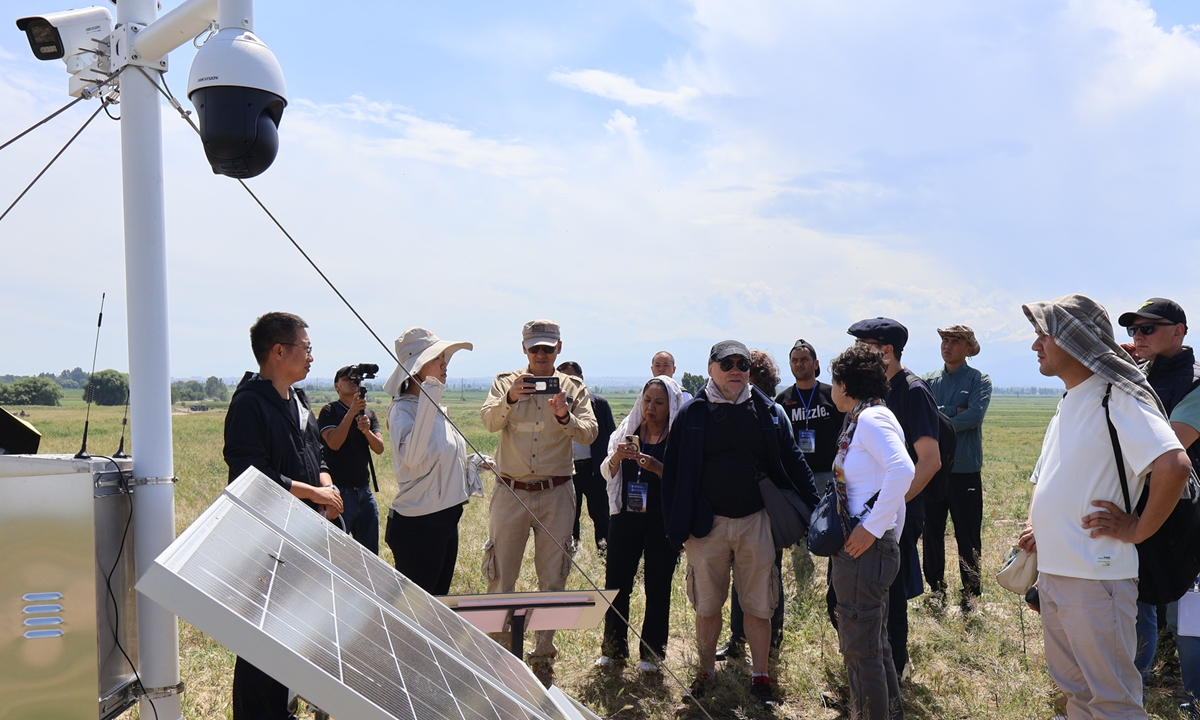
Experts from the Dunhuang Academy introduce the monitoring systems deployed at the Suyab ruins to international scholars on May 26, 2026. Photo: Lin Xiaoyi/GT
On September 30, 2025, the China-Kyrgyzstan Belt and Road Joint Laboratory on Cultural Heritage Conservation (CKJLCHC) was officially approved for construction, with the Dunhuang Academy serving as the lead institution on the Chinese side.The roots of China-Kyrgyzstan cooperation on cultural heritage protection go back further than the laboratory. In 2014, a joint application by China, Kazakhstan and Kyrgyzstan led to the recognition of "the Silk Roads: the Routes Network of Chang'an-Tianshan Corridor" as a UNESCO World Heritage Site. This pioneering success marked a breakthrough in transnational heritage nominations and remains a landmark case study in the field.
The area where Suyab city is located is precisely an important historical node in this corridor that spans the Tianshan Mountains and connects Eastern and Western civilizations.
On both sides of the Tianshan Mountains, the story of the Silk Road has continued from ancient times to the present.
Where civilizations met along Chang'an-Tianshan Corridor
Many people first hear of Suyab because of the long-running speculation that it might be the birthplace of Li Bai, the legendary Chinese poet who lived over 1,000 years ago. This literary connection has brought Suyab into the cultural spotlight for many. But the historical significance of Suyab goes far beyond any single poet's legend.
Located just 50 kilometers from modern-day Bishkek, the site sits at a strategic bottleneck: the Tianshan Mountains to the south and the open steppe to the north. For centuries, it served as a critical link between China's heartland, the Hexi Corridor - once a bustling artery of the ancient Silk Road - and the interior of Central Asia on both sides of the Tianshan Mountains. Merchants, monks, and artisans converged, exchanging goods, technologies, beliefs, and art. It was not merely a fortress, but a living stage where cultures met and merged.
Today, however, the city is silent. No longer are there ornate palace buildings, only weathered earthen ruins peek out from tall grass.
For a long time, Suyab existed mainly in history books, archaeological reports, and local lore, remaining largely invisible to the wider public. The conservation, display and utilization of its ruins also need further improvement. Yet Suyab stands as one of the most significant medieval urban sites across Central Asia. How to make the Silk Road civilization embodied in the ruins tangible, visible and inheritable through scientific conservation, has become a shared mission for heritage professionals in both China and Kyrgyzstan.
Pei Qiangqiang, director of the Maiji Mountain Grottoes Art Research Institute at the Dunhuang Academy, told the Global Times that the team has set up a monitoring system focused on environmental data collection and visual display around Suyab's core area. Sensors at the site continuously collect information on temperature, humidity, rainfall, soil moisture, vegetation growth and surface changes. The data is sent to the CKJLCHC platform in Bishkek, helping researchers analyze how environmental factors affect the deterioration of earthen sites.
The Global Times has learned from China Electronic Technology Group Corporation (CETC) that the company signed an environmental monitoring equipment project with the Dunhuang Academy for the central road zone of the Suyab ruins. For this site project, CETC rolled out tailor-made sensors exclusively developed for cultural relic conservation. Many sensors feature compact size, low power consumption, and waterproof and dustproof casings, allowing two full years of maintenance-free field operation. Every monitoring station is fitted with a solar power storage system. Its built-in power controller automatically regulates battery charging and discharging to cope with Kyrgyzstan's cold, low-sunlight winters and keep all devices running steadily around the clock.
One of the biggest challenges in remote archaeology is losing signal. CETC solved this with a "self-healing" wireless network. If the internet connection drops, the sensors store the data locally until the signal returns, ensuring no information is ever lost.
In line with international standards for cultural heritage monitoring, this set of sensors features miniaturized probes and a hole-free anchoring design. The installation causes no damage to cultural relics, fully protecting the original ruins.
Zhang Bo, associate researcher at the Dunhuang Academy, told the Global Times that with the remote monitoring platform of the CKJLCHC, experts can track environmental changes and the physical condition of Suyab in real time. The data will support risk assessment, protection decisions and future public presentation, moving site conservation from experience based judgment toward science based decision making.
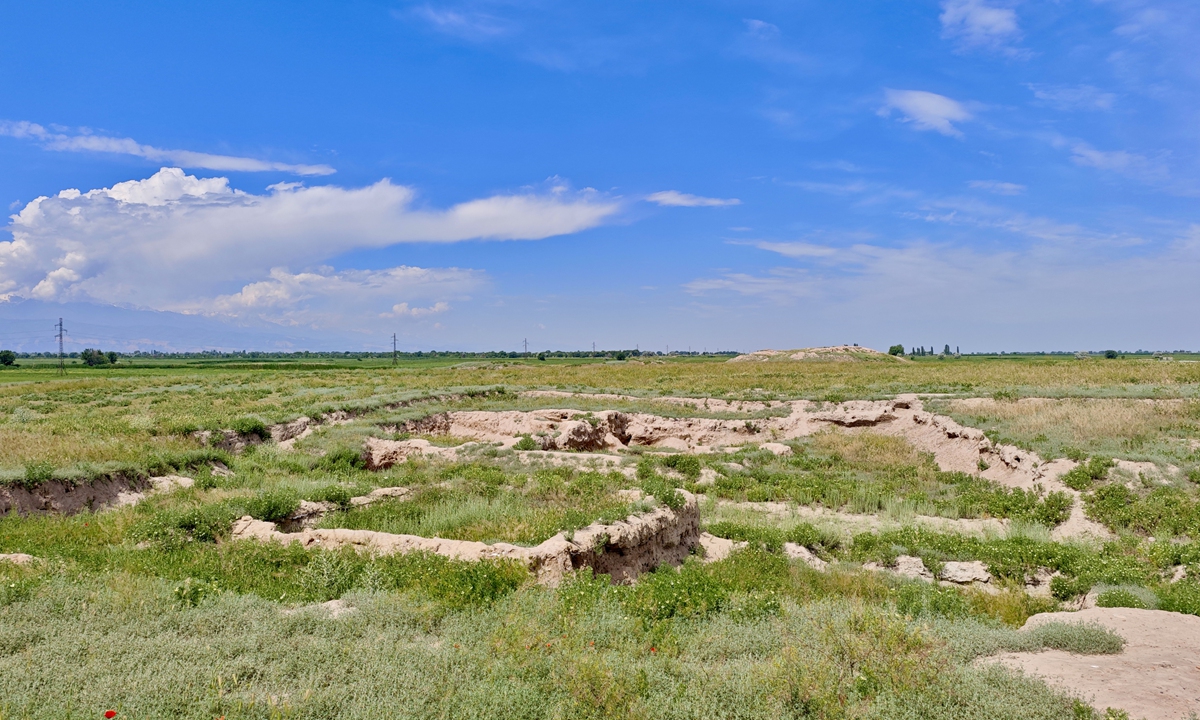
A view of the area where the Suyab ruins are located in Tokmok, Kyrgyzstan Photo: Xia Wenxin/GT
'Our work is stable and continuous'
Since 2024, Wood Aisuluu, a young Kyrgyz woman who speaks fluent Chinese, has become a key interpreter and coordinator for the Dunhuang Academy team during their local fieldwork and exchanges. She has accompanied Chinese experts on multiple missions to heritage sites across Kyrgyzstan.
"The Chinese experts are very professional and meticulous," Aisuluu told the Global Times. She recalls that in the past, local conservation ideas were simple: if something collapsed, patch it; if something broke, fix it; or simply put a large shelter over it. "There were no truly detailed, laboratory-level measures."
What the Dunhuang Academy brings is a systematic approach rooted in survey research, monitoring and assessment, technology evaluation, and demonstration projects.
Pei noted that the CKJLCHC is systematically advancing research and conservation planning around Suyab's needs. A technical pathway, from basic research and monitoring to demonstration and application, is gradually taking shape.
Aisin Duishanalieva, director of the Republican Inspectorate for the Protection of Historical and Cultural Monuments of the Ministry of Culture of the Kyrgyz Republic, told the Global Times that "the establishment of the joint laboratory is extremely significant for us. It is not just a research platform, but also a base that allows us to carry out concrete joint projects on cultural heritage protection, restoration, research and monitoring."
During the interview, Aisin stressed one word: continuity. "Our work is stable and continuous," she said.
"The laboratory, approved under the Belt and Road Initiative, has created systematic potential that will be further developed in the future," Aisin said.
On May 21, 2026, the CKJLCHC held its second cooperation promotion meeting in Bishkek, during which appointments for Kyrgyz personnel were formalized. The session further refined the lab's organizational structure and operational mechanisms. Plans for advanced talent cultivation, demonstration training programs, joint postgraduate supervision, and student exchange initiatives were incorporated into the follow-up cooperation agenda.
According to the Dunhuang Academy, since 2017, China and Kyrgyzstan have signed multiple cooperation agreements, conducted eight special joint surveys, held two academic conferences on cultural heritage protection, and exchanged more than 200 visits. These cumulative efforts have laid the groundwork for the sustained development of the CKJLCHC.
New echoes
Aisuluu has recently noticed a change: More and more visitors, both local and international, are coming to Suyab. "As archaeological findings are published and protection projects are implemented, more and more Kyrgyz people are learning about this place. The local tourism association is also actively promoting Suyab's cultural and travel resources."
At the 2026 China-Kyrgyzstan Media Cooperation Forum held in Bishkek on May 27, Eduard Kubatov, director of the State Agency for Tourism Development of Kyrgyzstan, told the Global Times that the Tianshan Mountains are a natural bond linking China and Kyrgyzstan. He pointed out that the two countries have shared cultural ties for a thousand years, and that both sides will continue to deepen collaboration in heritage protection, tourism development, and cultural communication, bringing new life to Silk Road civilizations.
This cultural revival resonates strongly among young locals. At the ruins, Global Times reporters met 28-year-old Kyrgyz tour guide Mitrofanov Leonid Dmitrievich, who is widely known among Chinese visitors by his adopted Chinese name: Li Bai.
He recounted how the name came about during a 2024 visit by a delegation from East China's Fujian Province, during which he served as their translator. "They teased me about my love for writing poems and suggested I go by Li Bai to make it easier for Chinese guests to remember me."
Today, Leonid runs a Xiaohongshu (RedNote) account, posting short videos, travel photos and on-site commentary introducing Suyab's history, Central Asian landscapes and China-Kyrgyzstan cooperation stories. "Social media serves as the perfect cross-cultural bridge in the digital age," he told the Global Times, noting that he hopes his content helps global audiences to see the fruits of China-Central Asia cultural exchange.
At the site, Global Times reporters also noticed another detail: Scholars from many countries enthusiastically invited experts from the Dunhuang Academy to visit their own countries for further research.
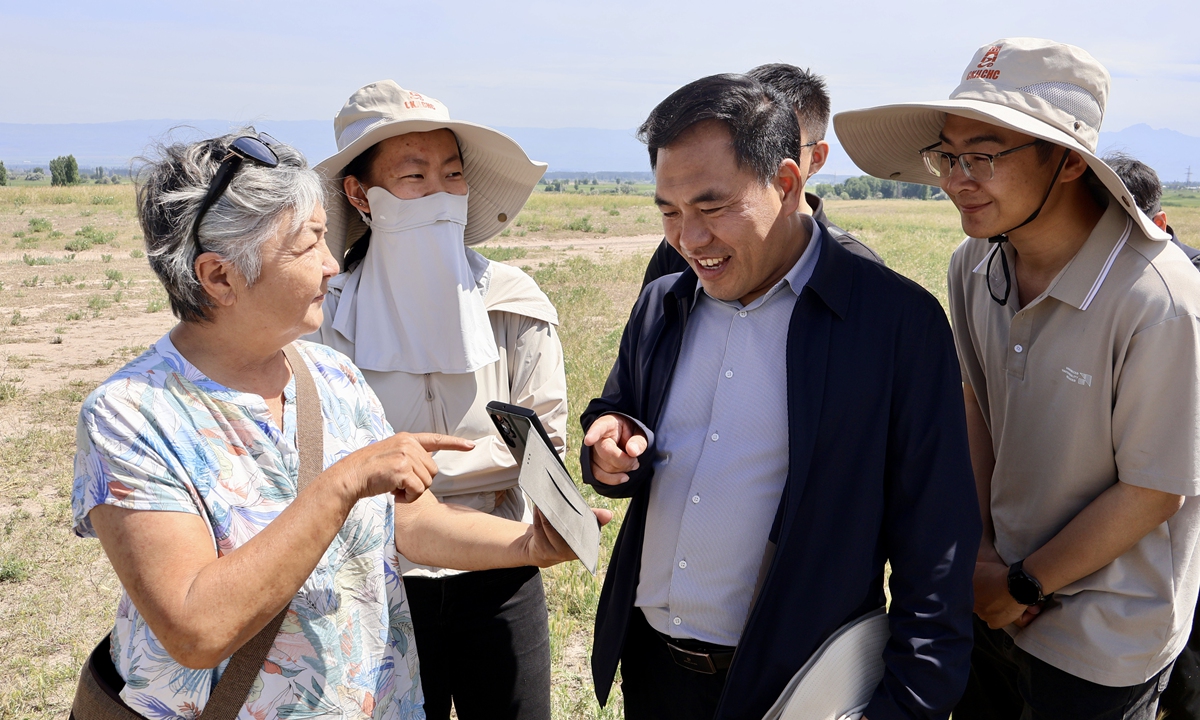
A scholar (left) from Central Asia and experts of the Dunhuang Academy exchange technical ideas on earthen site conservation during the field survey at the Suyab ruins on May 26, 2026. Photo: Lin Xiaoyi/GT
After the translation work was done, Aisuluu explained the meaning of her Chinese name to Global Times reporters, "Ai Silu" - meaning "Love the Silk Road" in Chinese. It sounds close to her original name, and she explained that it fits as she is someone who guides travelers walking along the Silk Road.Aisuluu introduced that her name means "beautiful moon" in the Kyrgyz language. This is also fitting as the moonlight of the Silk Road has shone across the northern and southern slopes of the Tianshan Mountains, and also upon the friendship between the two peoples, she said.
RELATED ARTICLES