China commissions mega semi-submersible crane vessel, boosts offshore engineering capabilities
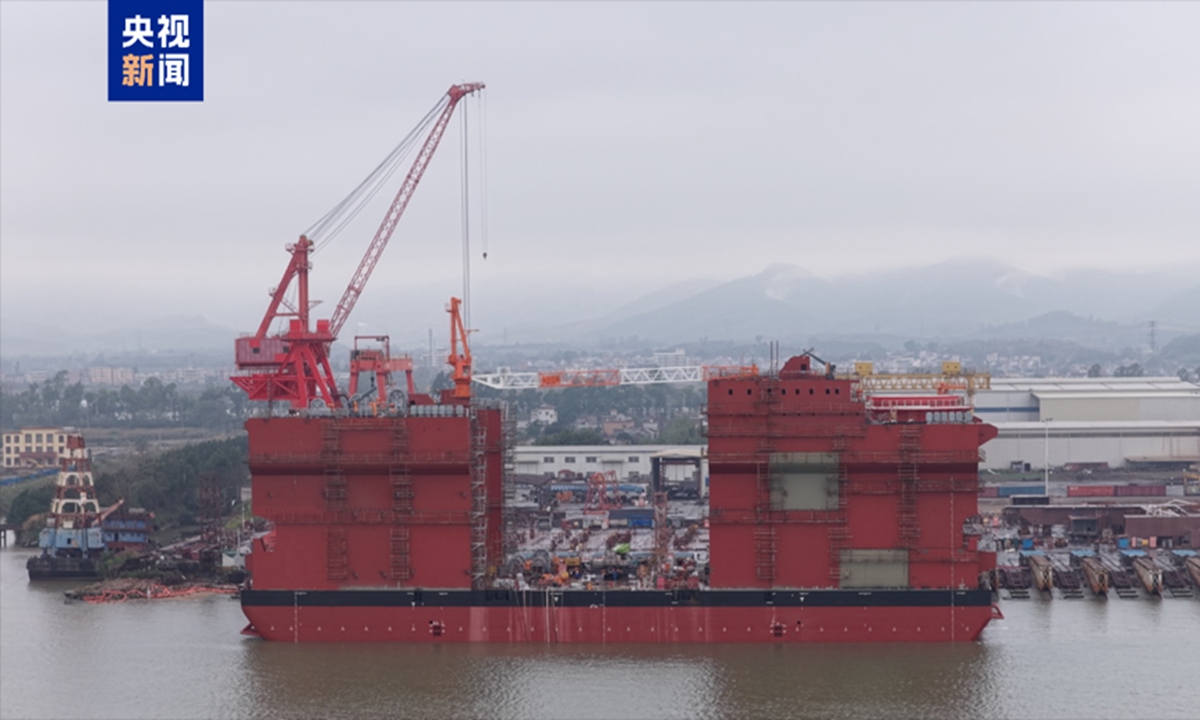
China's fully revolving semi-submersible crane vessel the Sihang Yongsheng, the country's largest by lifting capacity, is delivered in Jiangmen Port, South China's Guangdong Province, on July 8, 2026. Photo: screenshot of CMG's report
China's semi-submersible crane vessel, the Sihang Yongsheng, which has the country's largest lifting capacity, was delivered in Jiangmen, South China's Guangdong Province, on Wednesday, China Media Group (CMG) reported.
The vessel is a non-self-propelled semi-submersible barge integrating heavy lifting and offshore transportation functions. Built by Jiangmen Hengtong Shipbuilding Co, a subsidiary of CCCC Fourth Harbor Engineering Co, it measures 110 meters in length, 43.8 meters in width and features a 4,800-square-meter deck area.
The vessel is equipped with a massive fully revolving luffing crane at its stern, featuring a 149-meter boom and a maximum lifting height of 172.5 meters, equivalent to precisely handling cargo more than 50 stories above the ground. When fixed for lifting operations, it can hoist up to 2,200 tons at a time, roughly the weight of 1,500 passenger cars, which makes it China's largest fully revolving semi-submersible crane vessel by lifting capacity, CMG reported.
After delivery, the vessel will enhance China's capabilities in offshore construction, supporting major projects such as cross-sea bridges, port facilities, deep-sea wind power development, marine ranching and deep-sea resource exploration, the Xinhua News Agency reported.
According to CMG's report, Huang Chenguang, chief engineer of the project at CCCC Fourth Harbor Engineering's Hengtong Shipbuilding, said that the vessel's fully revolving operation mode allows its crane to rotate 360 degrees while anchored offshore, enabling efficient lifting of ultra-large structures such as offshore wind turbine foundations, steel structures and heavy bridge sections.
With its 4,800-square-meter continuous deck, the vessel can also transport large components with a capacity of up to 10,000 tons. When needed, it can submerge into a semi-submersible barge, allowing it to switch between heavy lifting and cargo transport functions. The vessel is designed to address challenges in offshore construction, including complex operations, low lifting efficiency and limited working conditions.
The vessel is also equipped with a fully automated intelligent load adjustment system that can calculate operational parameters and autonomously maintain balance without human intervention, marking a breakthrough in several key technologies for China's large-tonnage multifunctional offshore vessels, CMG reported.
Lin Boqiang, director of the China Center for Energy Economics Research at Xiamen University, told the Global Times that larger tonnage generally means stronger capabilities for ships and engineering equipment. Large vessels can undertake not only tasks performed by smaller equipment but also major engineering projects that require greater lifting capacity and operational flexibility, making them a reflection of a country's overall offshore engineering capabilities and technological strength.
"Taking offshore wind power as an example, many large offshore platforms are now assembled on land before being transported and installed at sea by heavy-lift vessels. Without equipment with sufficient tonnage and lifting capacity, such projects would be difficult to carry out efficiently," Lin said. He noted that large engineering vessels also play a key role in areas such as offshore oil and gas platform construction and cross-sea tunnel projects, where their broader application potential highlights their strategic value.
Lin said the ability to develop and manufacture large engineering vessels reflects a country's strength in advanced manufacturing. "Building a large vessel is not simply about making it bigger. It requires breakthroughs in integrated system design, propulsion systems, materials and specialized manufacturing processes," he said, adding that China's shipbuilding industry has moved toward higher-end and smarter manufacturing, with growing advantages in technological innovation, industrial chain integration and large-scale production.
China's shipbuilding sector posted strong growth across its three major indicators in the first quarter of 2026, maintaining a leading share of the global market, according to data from the Ministry of Industry and Information Technology, Xinhua reported.
From January to March, the country's shipbuilding output reached 15.68 million deadweight tons (DWT), up 46 percent year-on-year and accounting for 57.3 percent of the global total, the data showed.
New orders totaled 59.53 million DWTs during the period, surging 195.2 percent from a year earlier and representing 84.9 percent of the global market share.
RELATED ARTICLES