Trump calls out Gordon Chang by name, sending a clear signal: Global Times editorial
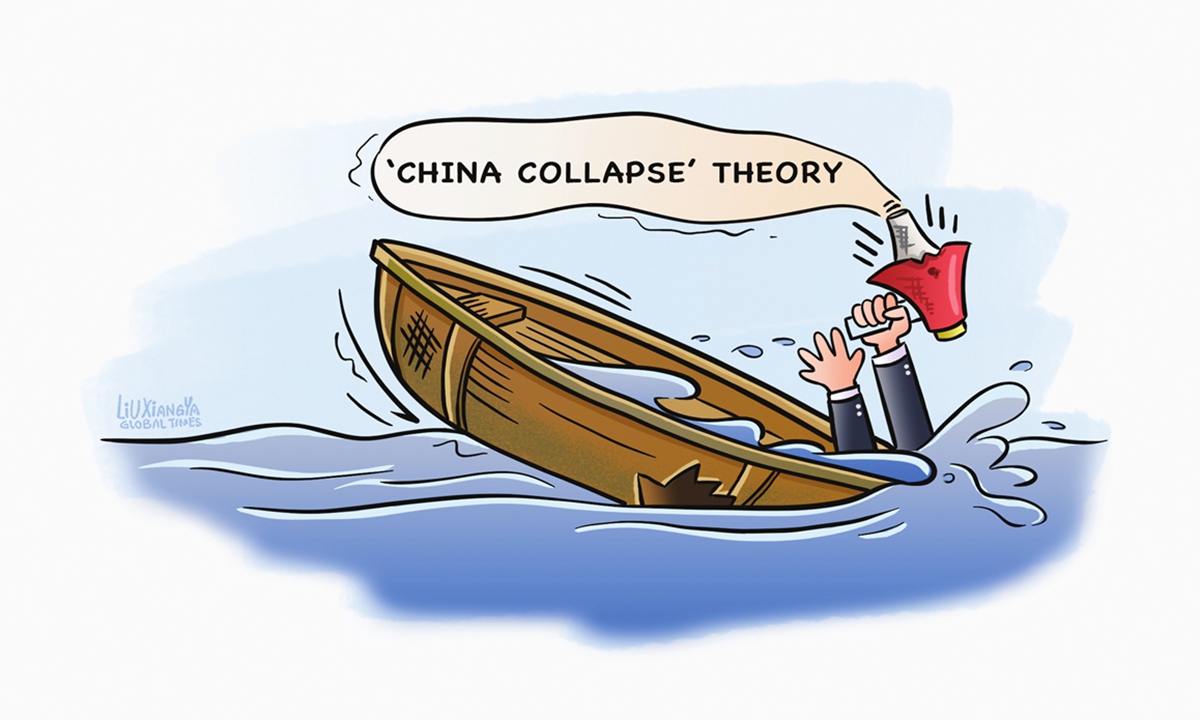
Illustration: Liu Xiangya/Global Times
The general direction of China-US relations has become increasingly clear. It is an inevitable outcome that opportunists who make a living by talking down China will eventually find their business unprofitable and themselves effectively out of work.
Gordon Chang, who has long made a living peddling the "China collapse theory" and "China threat theory," has been dealt a heavy blow. On July 6 local time, US President Donald Trump publicly singled out so-called "China expert" Gordon Chang by name, criticizing his remarks on China as "always so negative," likening them to alarmist claims that "the world is falling down," which are "not true." This marks the second time in nearly three months that Trump has publicly singled out Chang by name for criticism. In April this year, during a Fox News interview on China-related topics, Trump also specifically named and criticized him, stating: "I listen to Gordon Chang. He has no idea what he is talking about."
A so-called "anti-China expert" who has spent over 20 years in Western media circles repeatedly peddling the "China collapse theory," and has in recent years switched to loudly hawking the "China threat theory" everywhere - only to be repeatedly proven wrong by facts - has now been openly rebuked by the US president as alarmist. This is not merely a personal rebuke of Chang; it is a bucket of cold water poured on the entire business model. When the US president finds such rhetoric "so negative" and "not true," it shows that extreme anti-China narratives are facing a backlash from reality.
In recent years, certain forces in the US have gained self-interest by hyping the inevitability of China-US conflict and demonizing China to secure budgets, positions, media exposure, and discourse power. This approach may bring benefits for a period of time, but it is increasingly revealing its high costs, low returns, and highly misleading characteristics when China-US ties are moving toward strategic stability.
Trump's two public criticisms of Chang in quick succession, bluntly calling out his nonsense, have pierced through a layer of pretense in Washington's political circles. After years of bumps and frictions in China-US relations, the US policy community has come to recognize a basic reality: China and the US must avoid strategic collision, or the latter will suffer greatly. The general direction of China-US relations has become increasingly clear. Cooperation benefits both sides, while conflict harms everyone. This has become a consensus for both sides after years of friction and clashes.
What Trump stated is simply a fact that many in Washington know in their hearts but have been unwilling to admit publicly.
This also sends a clear signal: Anyone who deliberately provokes confrontation or even collision between China and the US is creating trouble for Washington. The narrative that oscillates between "China threat on odd days, China collapse on even days" has long underpinned the "political correctness" of US discourse on China. The absurd premise has been that the more dangerous, fragile, and threatening China is portrayed to be, the more necessary certain policies appear. Chang and his like have been faithful executors of this very logic.
However, when everything associated with China is labeled a "threat" and any engagement is equated with "appeasement" - it increasingly collides with America's own interests. Figures like Chang may continue to find a platform on Capitol Hill or in conservative media for a few more years, but their audience is steadily shrinking. It is an inevitable outcome that opportunists who make a living by talking down China will eventually find their business unprofitable and themselves effectively out of work.
China's continued development is prompting American society to reassess the country with greater objectivity. Francis Fukuyama, once best known for proclaiming the "end of history," has publicly acknowledged the effectiveness of "China's model" on at least two recent occasions. The latest Pew Research Center survey shows that the share of Americans holding a favorable view of China has nearly doubled since 2023, suggesting that American society is turning its back on the likes of Chang. Meanwhile, President Trump's public dismissal of Chang indicates that the "China collapse" "China threat" storylines have also lost traction at the highest levels of US decision-making. Even those most reluctant to face reality must now think twice about whether they still want to keep playing along with Gordon Chang's farcical performance.
At their meeting in Beijing in May this year, the Chinese and US presidents reached a series of important understandings, including the commitment to building a constructive relationship of strategic stability between the two countries.
Advancing such a relationship reflects the aspirations of both peoples, meets the expectations of the international community, and serves the fundamental interests of China and the US. The US side should take concrete steps to implement the leaders' consensus, maintain a distance - in both words and actions - from those politicians and opportunists who seek to boost their own influence by engaging in "anti-China" rhetoric. American society will eventually come to realize that fear-based narratives cannot solve problems of industrial competitiveness, ideological rhetoric cannot compensate for weaknesses in governance, and containing China will not automatically make the US stronger. US businesses, local governments, ordinary consumers, and even American politicians themselves cannot afford the costs of endlessly militarizing and antagonizing China-related issues.
China has never feared competition but advocates for healthy competition; nor does it shy away from differences, but seeks cooperation based on shared interests. What China opposes is using competition as a pretext for containment, or invoking security as a cover for political manipulation. China and the US can fairly compete within an agreed set of rules, but they must also manage their differences through dialogue. Those who seek to push bilateral relations toward the brink will ultimately be sidelined by reality. President Trump's repeated public references to Gordon Chang are no coincidence - they signal that the business of making a living by peddling extreme anti-China rhetoric ought to shut down.
RELATED ARTICLES