Illustration: Liu Xidan/Global Times
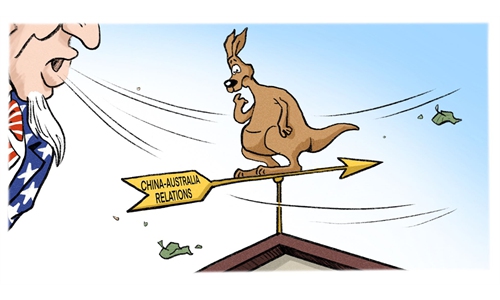
Australia's response to China's recent submarine-launched missile test in the Pacific has been louder than wise. Within hours, Canberra reached for its familiar vocabulary of alarm, calling the test "destabilizing" and inconsistent with the "ocean of peace." Yet behind this moral performance lies an old reflex: Whenever China conducts a lawful defense activity, some in Australia immediately misrepresent it as a "threat," using it as a convenient exhibit in the tired museum of the "China threat" narrative.The facts are not difficult to understand. Australia itself confirmed that it had been briefed by China on Monday before the test, even as its officials insisted that the move lacked the "transparency and reassurance" they expected.
If Canberra had expressed any technical concerns over the notification procedures, the matter could have been handled through professional diplomatic channels. Instead, Australia chose a more theatrical route, quickly placing the launch within a grand strategic accusation about China's military build-up, regional coercion and Pacific instability.
The timing of the Australian reaction is especially revealing. The test occurred just as Australia was promoting a new defense pact with Fiji, which includes a mutual defense obligation and has been interpreted by Western media through the lens of countering China. In other words, Canberra is actively deepening military arrangements in the Pacific while accusing China of militarizing the same region. This reflects a strange kind of mirror politics. Australia views its own strategic expansion as "stabilizing," while perceiving China's defensive capability as "destabilizing." It treats its own alliances as "peace architecture" but regards China's security rights as a "provocation." If irony were a missile, Canberra would have launched a whole salvo.
The deeper problem is Australia's persistent Cold War thinking. In that worldview, the Pacific is not a community of sovereign states with diverse interests, but a strategic chessboard where Australia assigns itself the role of regional gatekeeper. The Pacific island countries are repeatedly told that they are independent, but when they cooperate with China, they are suddenly confronted with a "China threat" mythology. Australia claims it respects Pacific agency, but it often behaves as though the region needs permission from Australia before acting on any decision.
China has no reason to threaten the peace of the Pacific. China's cooperation with Pacific island countries has focused on infrastructure, climate response, agriculture, fisheries, health, education and trade. These are not weapons pointed at Canberra; they are bridges, roads, schools, hospitals and development projects. It is precisely because such cooperation addresses real needs that some Australian strategists find it uncomfortable. They prefer a Pacific where security dependency flows to Canberra while development dependency is carefully monitored.
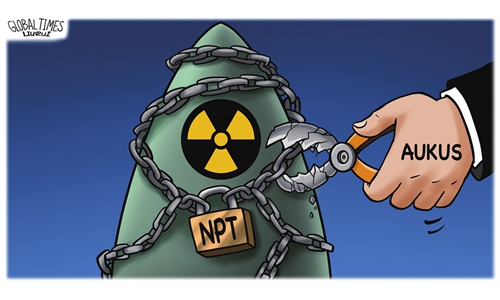
If Australia truly cares about the Pacific as an ocean of peace, it should start by opposing the transformation of the region into an arena for bloc confrontation. It should not import NATO logic into the Pacific. It should not allow AUKUS to turn Australia into a forward platform for US strategic competition. It should not use every Chinese move, however routine, as fresh advertising material for a bigger defense budget and deeper military dependency.
The real danger to Australia is not that China possesses a credible defensive capability. The real danger is that Australia's strategic class has become addicted to anxiety. It needs China as an excuse because a "China threat" mythology sustains an entire ecosystem of think-tank reports, alliance rituals, weapons procurement and political posturing. Once fear becomes a diplomatic currency, moderation starts to look like weakness and dialogue becomes unfashionable. That is how middle powers lose their independence, not in one dramatic surrender, but through a thousand small acts of automatic alignment.
Australia needs to return to strategic sobriety. It has every right to voice concerns through dialogue with China, but that does not justify turning each ordinary defense activity into a regional drama. Its engagement with Pacific island countries would also be more credible if it were guided by their development needs rather than by the urge to turn their geography into a strategic buffer against China. Alliances may remain part of Australia's security policy, but treating alliance loyalty as a substitute for independent judgement is not strategy.
The Pacific does not need more Cold War theater. It needs development, climate resilience, respect for sovereignty and a genuinely inclusive security order. Canberra would do well to remember that peace is not protected by shouting "destabilizing" at every shadow, but by knowing when not to manufacture a crisis.
The author is director of the Asia Pacific Studies Centre at East China Normal University. opinion@globaltimes.com.cn
RELATED ARTICLES