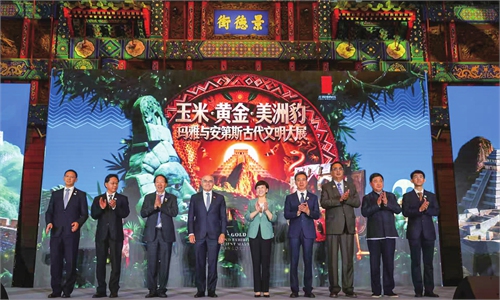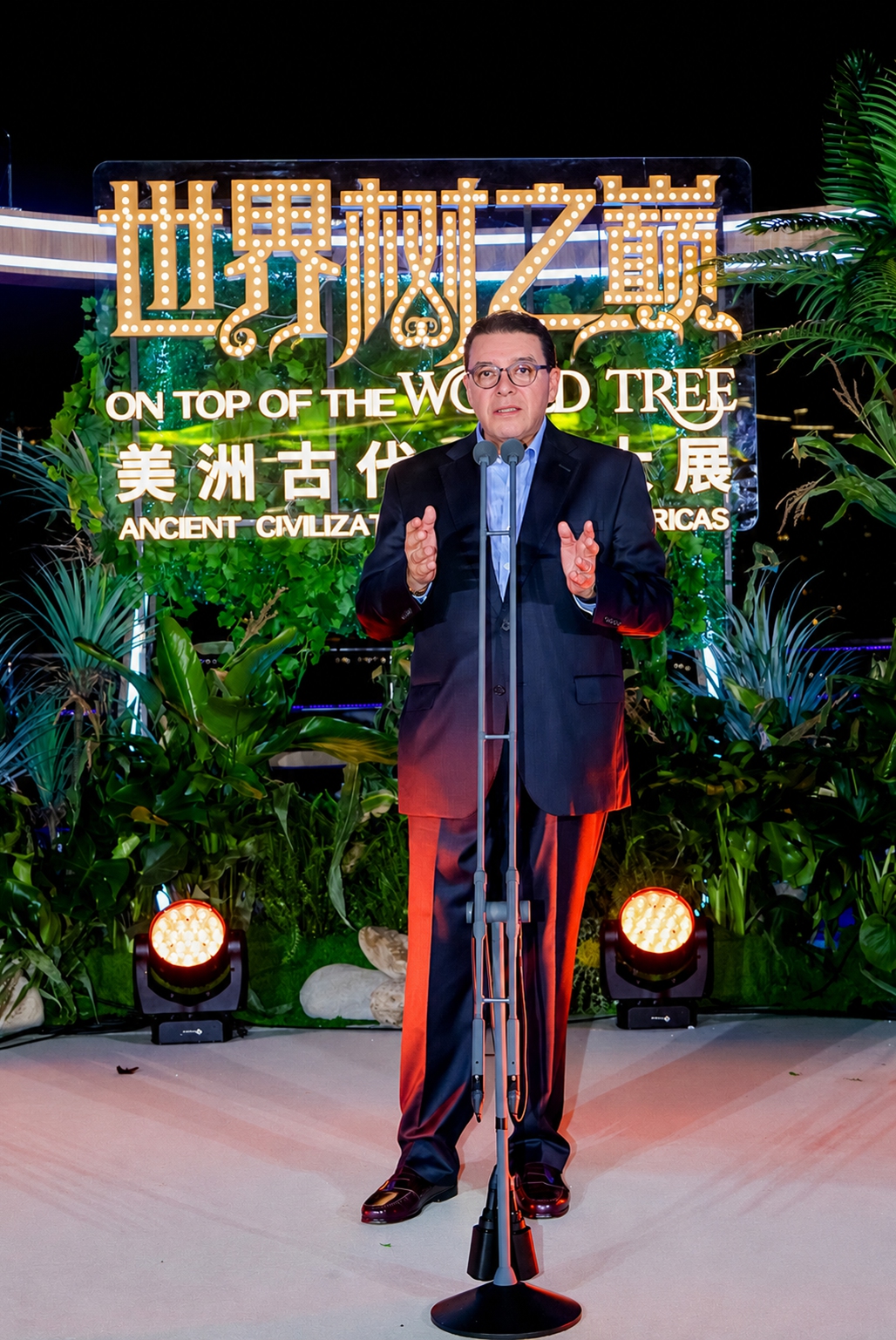
Miguel Ángel Isidro Rodríguez, consul general of the Consulate General of the United Mexican States in Shanghai, gives welcome remarks at the inauguration reception in Shanghai on July 8, 2026. Photo: Courtesy of the Consulate General of the United Mexican States in Shanghai
Exhibition "On Top of the World Tree: Ancient Civilizations of the Americas," which is set to be the world's largest showcase of ancient American civilizations, was inaugurated at the Shanghai Museum on People's Square on July 8, 2026. Miguel Ángel Isidro Rodríguez, consul general of the Consulate General of Mexico in Shanghai, told the Global Times that the exhibition represents far more than a display of archaeological treasures.
Although separated by vast distances, both China and Mexico developed highly sophisticated systems of knowledge, including astronomy, mathematics, architecture, agriculture, and philosophy.
"Through this exhibition, visitors will discover that our ancestors shared a common aspiration: to understand the universe and humanity's place within it," said Isidro.
Through this collection of Mexican national treasures, Isidro said that Chinese audiences will have the opportunity to appreciate the remarkable achievements of several of Mexico's great civilizations. From the Olmec civilization, often regarded as the "mother culture" of Mesoamerica, to the urban and cultural sophistication of Teotihuacan, the scientific and artistic accomplishments of the Maya, and cultural dynamism of the Mexica, the exhibition showcases the diversity, creativity, and ingenuity that characterized ancient Mexico, he elaborated.
Beyond their individual achievements, these civilizations shared a profound respect for the relationship between humanity, nature, and the cosmos, aligning with Chinese traditions stressing nature-human harmony and interconnection, said Isidro.
Additionally, the Cultural Section of the Embassy of Mexico in China told the Global Times that the major exhibitions jointly organized by Mexico and China in recent years have significantly strengthened long-term cooperation among museums, cultural heritage institutions, and universities in both countries.
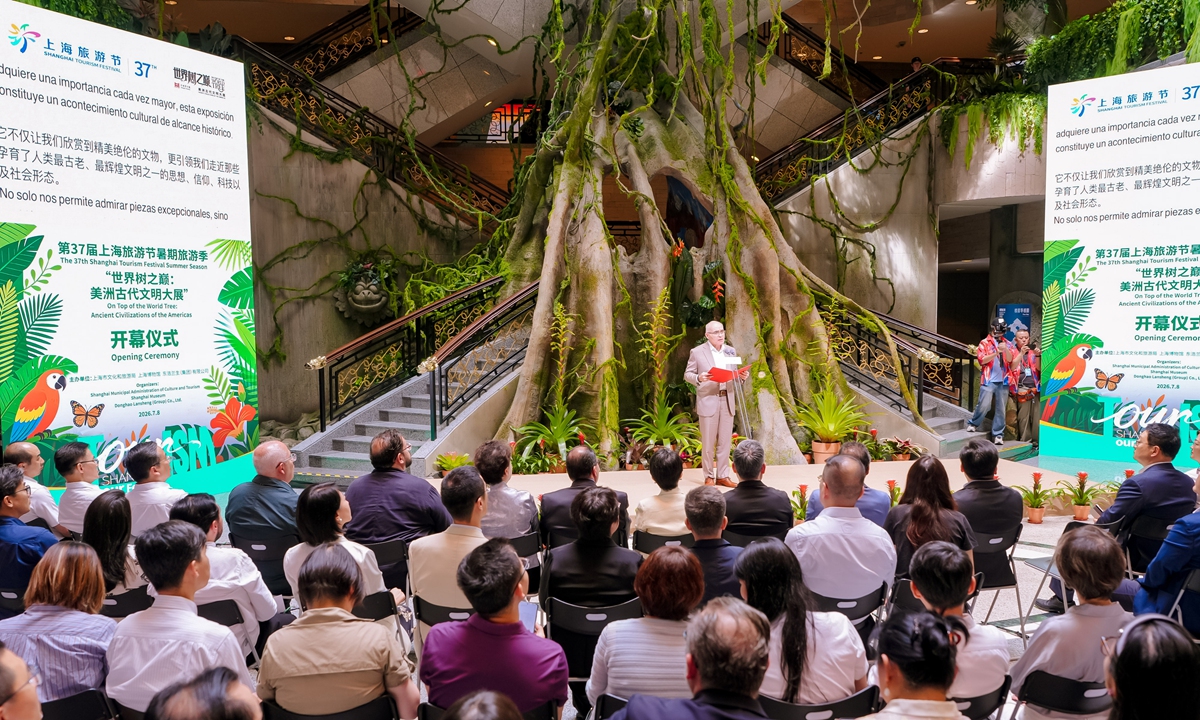
Ambassador of Peru to China Carlos Vasquez gives opening remarks during the inauguration ceremony in Shanghai on July 8. Photo: Courtesy of the Embassy of the Republic of Peru in China
In his remarks, Ambassador of Peru to China Carlos Vasquez said that at a time when dialogue between civilizations is becoming crucial, the exhibition represents a significant cultural event.
"It allows us not only to admire exceptional artifacts but also to gain insight into the ideas, beliefs, technologies, and forms of organization that gave rise to some of humanity's oldest and most sophisticated cultural traditions," said Vasquez, noting that it is a source of special pride for Peru that Andean civilization occupies a central place in this grand narrative.
This exhibition also holds special significance for the relationship between Peru and China. Our countries recognize themselves as heirs to ancient civilizational traditions, and deeply value their heritage and clearly understand the role culture plays in shaping the future, said Vasquez.
Amid the 55th anniversary of diplomatic relations between Peru and the People's Republic of China, this exhibition stands as a tangible expression of the trust, closeness, and shared ambition that characterize our ties, he stressed.
This exhibition in Shanghai is in series with "The Maya: Ceiba and Cosmos, Maize, Gold and Jaguar," which opened at the Capital Museum in Beijing on May 17.
Moving forward, there is considerable potential to further deepen this cooperation through new joint exhibitions, professional exchanges, training programs, and the application of innovative technologies for heritage conservation, according to Cultural Section of the Embassy of Mexico.
RELATED ARTICLES