IN-DEPTH / IN-DEPTH
Who was the real mastermind behind the S.China Sea arbitral tribunal, and how was the arbitration procedure subverted?
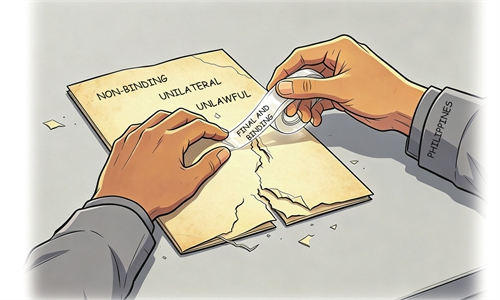
Ten‑Year Hype over a Sham Ruling
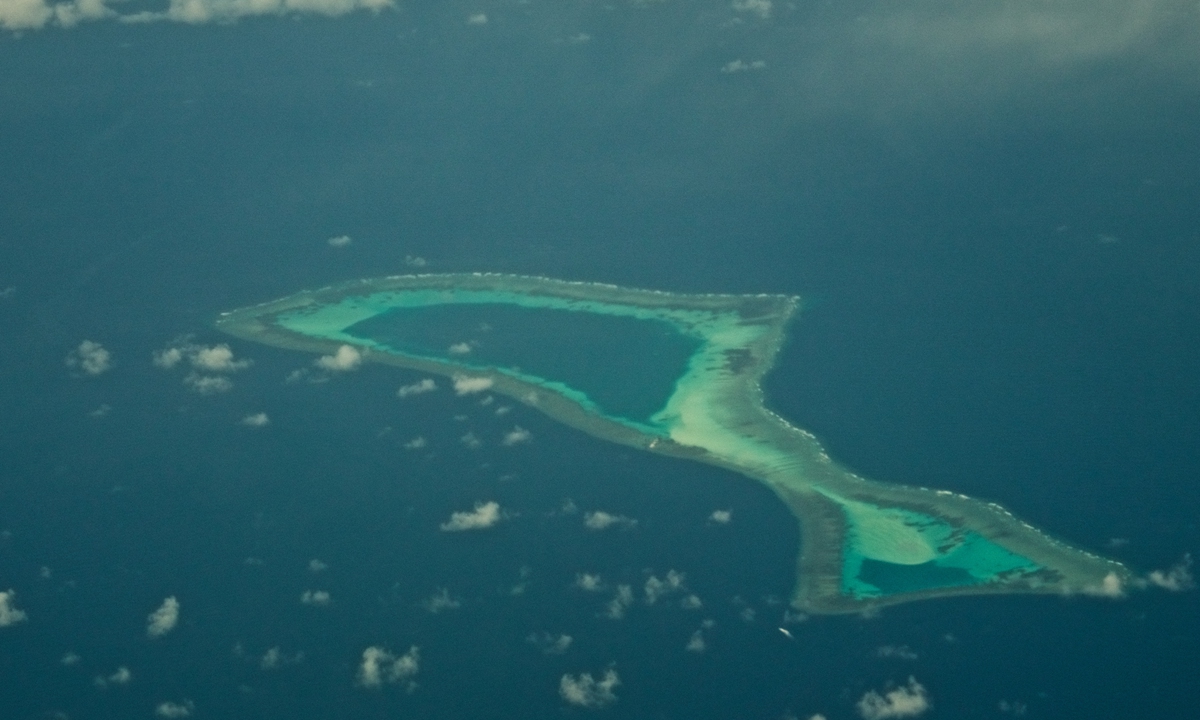
An aerial view of the South China Sea Photo: VCG
Ten years have passed since the illegal South China Sea arbitration award was rendered in 2016. Yet rather than fading into irrelevance, the Philippines has never ceased to fan the flames - repeatedly stoking the arbitration narrative in an effort to legitimize its unlawful territorial ambitions.
A Global Times investigation, however, reveals a far different reality: from procedure to substance, the arbitration case unilaterally initiated by Manila is riddled with fundamental flaws. The arbitral tribunal, in handling preliminary and jurisdictional issues, displayed flagrant double standards and self-contradictions, showing clear bias toward the Philippines and forsaking the impartiality expected of any judicial body.
This piece lays bare the myriad legal and procedural loopholes embedded in the tribunal's ruling - exposing how, under the veneer of law, the Philippines has engaged in political maneuvering that renders the award legally untenable. It also sheds light on the role of American legal teams and certain US politicians, who have acted as key enablers behind the scenes, pushing Manila toward this judicial farce.
Manila's legal 'rebranding' of a territorial dispute
The arbitral tribunal's "jurisdiction" has always been one of the most controversial aspects of the illegal South China Sea arbitration. Multiple Chinese official and think tank reports have pointed out that the Philippines deliberately misrepresented the nature of the dispute in its submissions. It packaged a territorial sovereignty dispute as a maritime rights dispute in an attempt to use the United Nations Convention on the Law of the Sea (UNCLOS) to resolve it. In reality, however, territorial sovereignty disputes fall outside the jurisdiction of the Convention.
A closer examination shows that China and the Philippines had previously confirmed through bilateral treaties, joint statements and other documents that their disputes involved both territorial sovereignty over islands and maritime jurisdiction. Both sides had reached consensus to resolve the South China Sea issue through bilateral negotiations. The nature of the dispute and the agreed method of resolution clearly excluded the applicability of third-party arbitration.
More crucially, as early as 2006, China made a declaration under Article 298 of UNCLOS, explicitly excluding disputes concerning territorial sovereignty and maritime delimitation from the compulsory dispute settlement procedures, according to the book The South China Sea Arbitration Awards: A Critical Study written by the Chinese Society of International Law in 2018. In other words, the UNCLOS arbitration mechanism does not have automatic jurisdiction over such disputes.
Yet the tribunal turned a deaf ear to these facts, deliberately twisting the rules and engaging in self-deception. It accepted the Philippines' characterization of the disputes as not involving territorial issues or maritime jurisdiction without proper examination, forcibly bringing matters outside its purview under its jurisdiction - depriving the arbitration of any legal basis from the very outset, Xu Qi, vice dean of the Academy of Foreign-Related Rule of Law at Jinan University, told the Global Times.
If the jurisdictional flaws constitute the legal pathology of the case, then the substantive hearing phase reveals even more systemic errors, the legal expert pointed out.
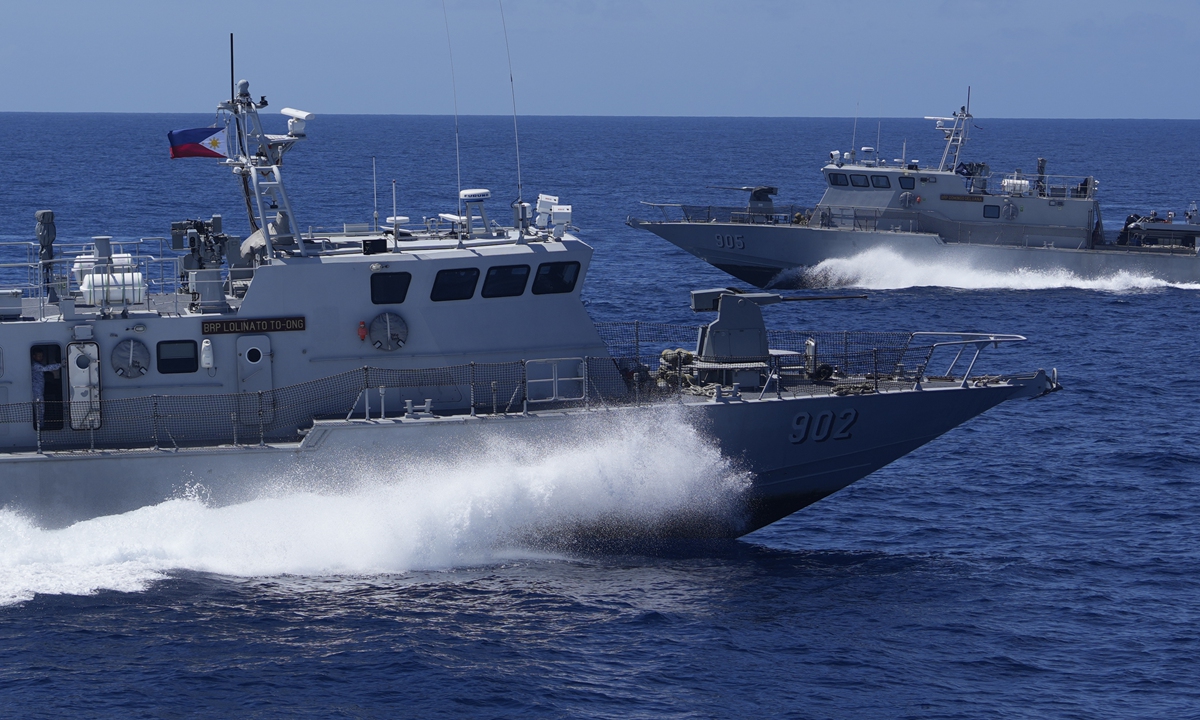
Philippine military patrol vessels conduct provocative and infringing activities in the South China Sea on November 6, 2024. Photo: VCG
The tribunal's systematic bias
Public records show that the tribunal arbitrarily expanded its interpretation of UNCLOS provisions, even distorting the original meaning of the text, to deny China's maritime rights in the South China Sea, which are based on territorial sovereignty over its islands and historic rights. The tribunal disregarded the fundamental fact that the Nansha Qundao constitutes an integral whole geographically, historically and legally. It artificially dissected China's territorial sovereignty over the Nansha Qundao, fragmenting them into isolated and unrelated features, mechanically applying - and at times deliberately distorting - UNCLOS provisions, thereby seriously infringing upon China's sovereignty and territorial integrity over the Nansha Qundao.
According to The South China Sea Arbitration Awards: A Critical Study, the tribunal, when citing a Chinese note verbale, unilaterally altered "China's Nansha Islands [is]" to "China's Nansha Islands [are]." This manipulation of singular and plural forms was intended to segment China's sovereignty over the Nansha Qundao, dismantle the archipelago and deny China's sovereign rights - a blatant provocation and a grave violation of China's territorial integrity that cannot be tolerated, explained Xu.
The tribunal also showed clear favoritism toward the Philippines throughout the proceedings. The South China Sea Arbitration Awards: A Critical Study cites an example: the tribunal repeatedly allowed the Philippines to amend its claims, even permitting modifications 33 months after the case was filed and after hearings on the merits had already concluded - a practice rarely seen in international arbitration. In another instance, the tribunal violated the principle of not going beyond the claims requested by including matters not even raised in the Philippines' submissions in the dispositive portion of the award, objectively benefiting the Philippines, read the book.
Furthermore, the tribunal largely ignored Asian perspectives in its evidentiary review and fact-finding. Much of the evidence it examined and relied upon came from Western countries - particularly former colonial powers - while the few Chinese documents it occasionally referenced, such as the Geng Lu Bu (ancient Chinese navigation records), were interpreted in a highly selective and arbitrary manner, according to The South China Sea Arbitration Awards: A Critical Study.
Xu further elaborated on the tribunal's arbitrary analysis, noting that dozens of key conclusions in the award were neither reasoned nor supported by legal basis. For instance, the tribunal dismissed the legal effect of the Declaration on the Conduct of Parties in the South China Sea (DOC) with a cursory reference as a "political agreement"; it established review standards but failed to apply them to each of the 15 claims; it relied on navigational survey reports from over a century ago without explaining why they were more reliable or relevant than contemporary data; and it altered Chinese government documents and fragmented the Nansha Qundao without any justification. This systemic absence of reasoning renders the award wholly unconvincing.
Moreover, the tribunal applied different standards to the same issues at the jurisdictional and merits stages, even contradicting itself - fully exposing the judicial arbitrariness of the proceedings, according to Chinese legal experts.
The composition of the tribunal itself also raises serious questions. The panel notably lacked geographic representation - all five arbitrators came from Europe or were long-term residents of Europe, with none from Asia. This composition stands in stark contrast to the requirement under Article 9 of the Statute of the International Court of Justice that the judges shall "represent the main forms of civilization and the principal legal systems of the world."
For a case concerning disputes in Asian waters and involving centuries of historical administrative practice by Asian states, the complete absence of any member from the region raises doubts about the tribunal's understanding of Asian history and culture - making it difficult to ensure the fairness of the proceedings, Xu explained.
Moreover, the then-president of the international tribunal for the Law of the Sea, Shunji Yanai (Japanese national), is a right-wing hawkish figure in Japan who served as chairman of the advisory panel on reconstruction of the legal basis for security for the Abe administration, actively promoting Japan's lifting of the ban on collective self-defense and openly challenging the postwar international order.
That such a right-wing political figure - one committed to revising the pacifist constitution and breaking through the postwar order - presided over arbitration proceedings involving China's major maritime rights and interests casts serious doubt on his neutrality from the very beginning, leaving the fairness and objectivity of the proceedings fundamentally compromised, analysts say.
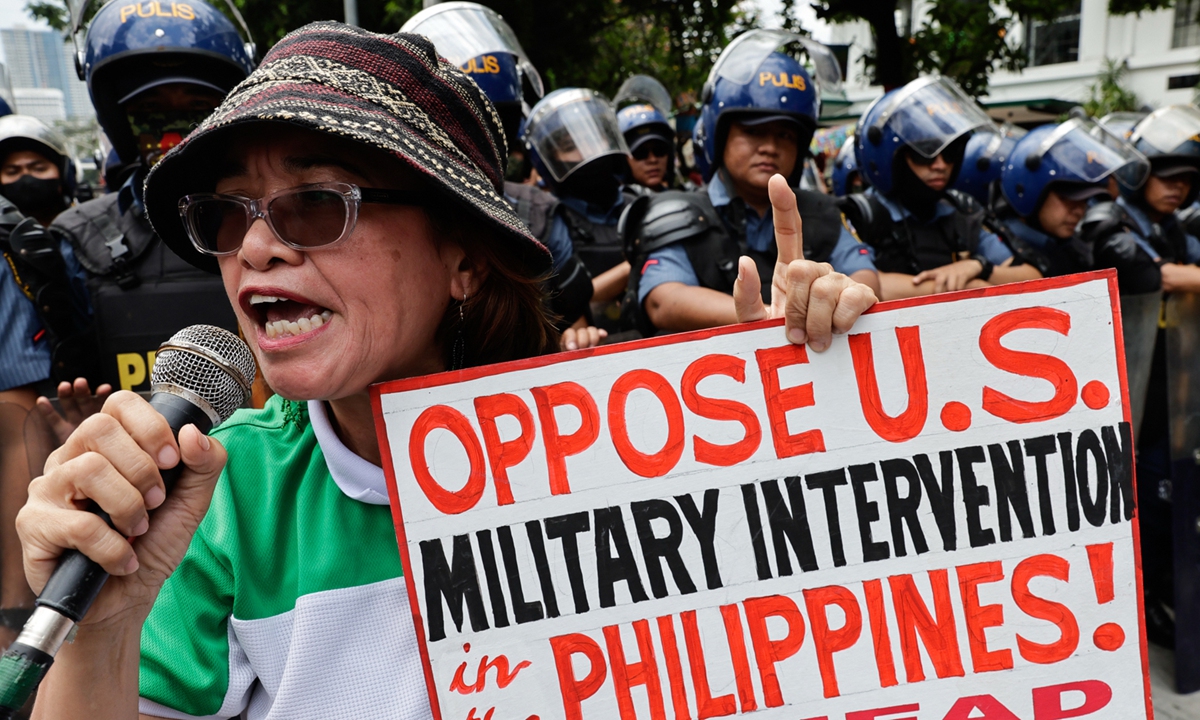
Filipinos stage a protest rally in Manila against Philippines-US military exercises on April 9, 2025. Photo: VCG
Backstage manipulator
The Philippines is in urgent need of an independent foreign policy, Alberto Encomienda, former secretary-general of Maritime and Ocean Affairs Center at the Department of Foreign Affairs of the Philippines, told the Xinhua News Agency in 2016. "Everything that came up as the Philippines' position on the South China Sea afterwards has something to do with 'rule-based' and 'legal framework.' But these are the rule basis determined by the US."
The Philippines' unilateral initiation of South China sea arbitration was by no means an isolated act based purely on legal judgment. Numerous evidence has shown that the US planned, financed and strategically guided the case from the outset, Xu pointed out.
During the process, the tactics employed by the US included, but were not limited to, direct legal manipulation, strategic support in diplomacy and military affairs, and narrative distortion through think tanks and academia, Xu said.
First, in the South China Sea arbitration case, the Philippines' legal team was not entirely composed of Filipino lawyers, but rather an international legal alliance led by the US, Xu added.
Paul Reichler, for instance, was a partner at US law firm Foley Hoag LLP who served as the Philippines' lead counsel in the South China Sea arbitration case. Materials showed that Reichler was responsible for devising the jurisdiction and admissibility strategy, drafting thousands of pages of submissions, and presenting oral arguments before the tribunal.
Another team member, Bernard Oxman, is a professor at the University of Miami who served for more than a decade as assistant legal adviser for oceans at the US State Department, and was also a US delegate to the UNCLOS III, according to the university's website.
"Ironically, a country that has not ratified the UNCLOS sent its former treaty negotiator to sue China on the basis of that very convention," Xu told the Global Times.
Second, the US government provided the Philippines with comprehensive strategic support in the South China Sea arbitration case, actively encouraging the latter to stir up trouble through diplomatic, military and other channels, according to Xu.
In 2014, the US and the Philippines issued a joint statement supporting the arbitration. In the same year, then US president Barack Obama publicly backed the arbitration during his visit to the Philippines, a move that could be seen as transforming a bilateral dispute into a US-supported geopolitical confrontation. Earlier, in June 2011, then-secretary of state Hillary Clinton claimed that "the US honors our Mutual Defense Treaty and our strategic alliance with the Philippines," reported the Philstar in May 2012.
"This 'security guarantee' offsets the political risks for the Aquino III administration and encouraged it to pursue a confrontational legal approach, rather than diplomatic negotiations," Xu told the Global Times.
Moreover, in March 2016, the US and the Philippines reached the Enhanced Defense Cooperation Agreement, which allowed US troops rotational access to five military bases of the Philippines, including a base near the South China Sea, reported The Diplomat on March 19 that year.
Third, the US government, think tanks and some scholars worked together to shape a public opinion environment favorable to the Philippines, pre-emptively constructing a "legitimacy" narrative around the arbitration, Xu pointed out.
The US State Department's December 2014 release of "Limits in the Seas No.143" report deliberately and methodically guided the tribunal to produce an "arbitration" in line with the US script, Xu said. He observed that, not long after the arbitration, some US think tanks published commentaries that framed the arbitration as a shared victory for the Philippines and the US.
"Taken together, these pieces of evidence indicate that the arbitration was not a good-faith effort to resolve disputes under the UNCLOS, but rather a 'lawfare instrument' orchestrated by the US to advance its geopolitical strategy in the Asia-Pacific, with the Philippines serving as the nominal plaintiff," the expert remarked.
Chen Xidi, an expert at the China Institute for Marine Affairs under the Ministry of Natural Resources, told the Global Times that the South China Sea arbitral award was issued by a tribunal lacking proper jurisdiction. It contains fundamental flaws in legal application, seriously violates fairness and justice, and thus has no legal effect from the outset under international law. China's refusal to participate is a legitimate exercise of sovereignty under the UN Charter and UNCLOS, with ample international precedent.
Experts noted that the arbitration was a case of political manipulation by certain extraterritorial forces - particularly the US and Japan - under the guise of law, aimed at strategically containing China. Ten years on, rather than resolving the dispute, the award has only exacerbated tensions and complicated the situation due to the Philippines' repeated provocations.
The only viable path forward is a return to the "dual-track approach": direct, equal negotiations between the parties concerned and joint efforts by China and ASEAN to maintain peace and stability in the South China Sea, Xu stressed.
RELATED ARTICLES