Philippines’ hype of flawed ‘S.China Sea arbitration award’ fans regional tensions

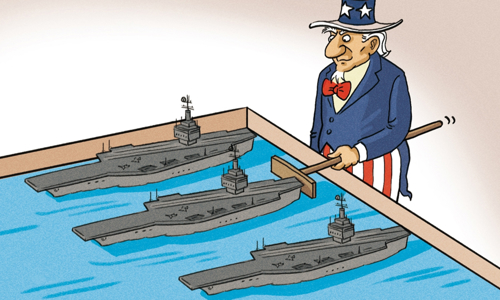
Illustration:Xia Qing/GT
With July 12 approaching, the Philippines has intensified an aggressive campaign to sanctify the 2016 "South China Sea arbitral award" and embed it into international practice.On June 22, its Department of Foreign Affairs insisted the ruling had become an "unassailable part of the corpus of international law" - "final and binding." A day later, the National Maritime Council followed suit, announcing plans to mark the so-called "award" tenth anniversary and framing its defense as critical to legal certainty and regional stability. At the 36th Meeting of States Parties to the Law of the Sea at the United Nations Headquarters in New York, the Philippine delegation went further, calling the so-called "award" a "guidepost for states on essential maritime matters and concerns."
None of this is spontaneous. It's a deliberately timed legal and diplomatic offensive, calculated to maximize political impact as the anniversary nears.
Manila is not simply promoting a ruling; it is trying to pass off a unilateral decision as settled international law, entirely ignoring the fact that China has rejected the so-called "award" from the start. The Philippines aims to force its own claims, rally outside support, and maintain a confrontational stance toward Beijing. The effort betrays a mix of domestic political desperation and a clear intent to poison the South China Sea disputes by dragging them further into international forums.
Crucially, the campaign has not happened in a vacuum. Washington has consistently supported it, turning the "award" into a pillar of its Indo-Pacific legal narrative. This message is reinforced by joint military drills, Joint maritime patrols, and high-level security talks that treat the "award" as if it were settled law. The "award" works less as a neutral judicial instrument than as a geopolitical lever - enabling both countries to bypass direct talks with Beijing and lock in a divisive version of maritime order.
Moreover, Manila has been actively recruiting outside powers for so-called joint patrols. These patrols, carried out with non-littoral states, aim to normalize external military footprints in the South China Sea and manufacture an impression of broad international backing for the tribunal's findings. Taken together, these moves reveal a clear pattern: a flawed, non-binding ruling is being operationalized - turned from a legal claim into a physical source of friction and instability.
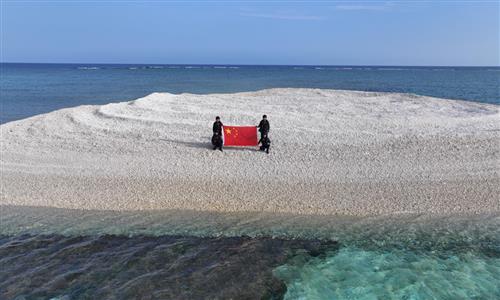
The Philippines has also resorted to shaky arguments to prop up its story. It argued that Huangyan Dao lies far closer to the Philippine coast than to China. That reasoning has no solid legal footing and simply exposes Manila's opportunistic approach to territory.
Huangyan Dao has long been under effective Chinese administration, and China's sovereignty over it is well grounded. The selective use of geography alongside the flawed "award" does not strengthen the Philippine case; it underlines its weakness.
At sea, Philippine behavior often belies its talk of stability. By keeping a grounded vessel at Ren'ai Jiao as a permanent fixture and carrying out resupply missions in deliberately provocative ways, Manila regularly creates friction. It then spins these self-generated incidents to paint China as the aggressor. This pattern, together with unrelenting legal and diplomatic offensives, shows that the Philippines is more interested in keeping tensions alive for political gain than in managing disputes responsibly.
Manila's heavy reliance on the 2016 "award" as its primary legal and political weapon has turned it into a major obstacle to regional stability. Rather than treating the "award" as the defective, non-binding decision it truly is, the Philippines has refashioned it into an instrument of perpetual confrontation.
This approach not only warps the legal picture but also chokes off prospects for meaningful dialogue. By internationalizing the disputes and trying to lock in a one-sided reading, the Philippines has made practical risk reduction and crisis management much harder.
The current Philippine campaign - weaponizing a flawed "award" and staging provocations choreographed with external patrons - shows a reckless disregard for regional peace.
Manila's insistence on flaunting an invalid ruling and deepening military collusion with outside powers will only invite firm pushback and accelerate the erosion of trust. No amount of international grandstanding can legitimize a decision that lacks China's consent, nor can it whitewash the Philippines' own destabilizing behavior at sea.
Stoking and entrenching a void "award" will not deliver legal clarity; it will only harden confrontation, block paths for crisis communication, and multiply the risk of miscalculation and incidents. The Philippines must abandon this destructive course of legal harassment and military adventurism or accept full responsibility for what follows.
The author is director of the Research Center for International and Regional Issues at the National Institute for South China Sea Studies. opinion@globaltimes.com.cn
RELATED ARTICLES