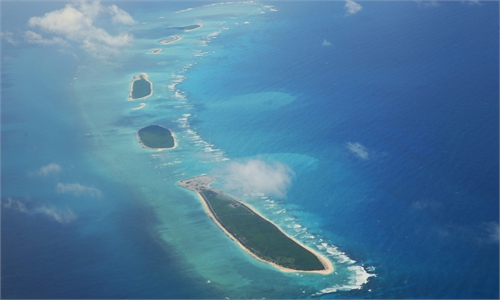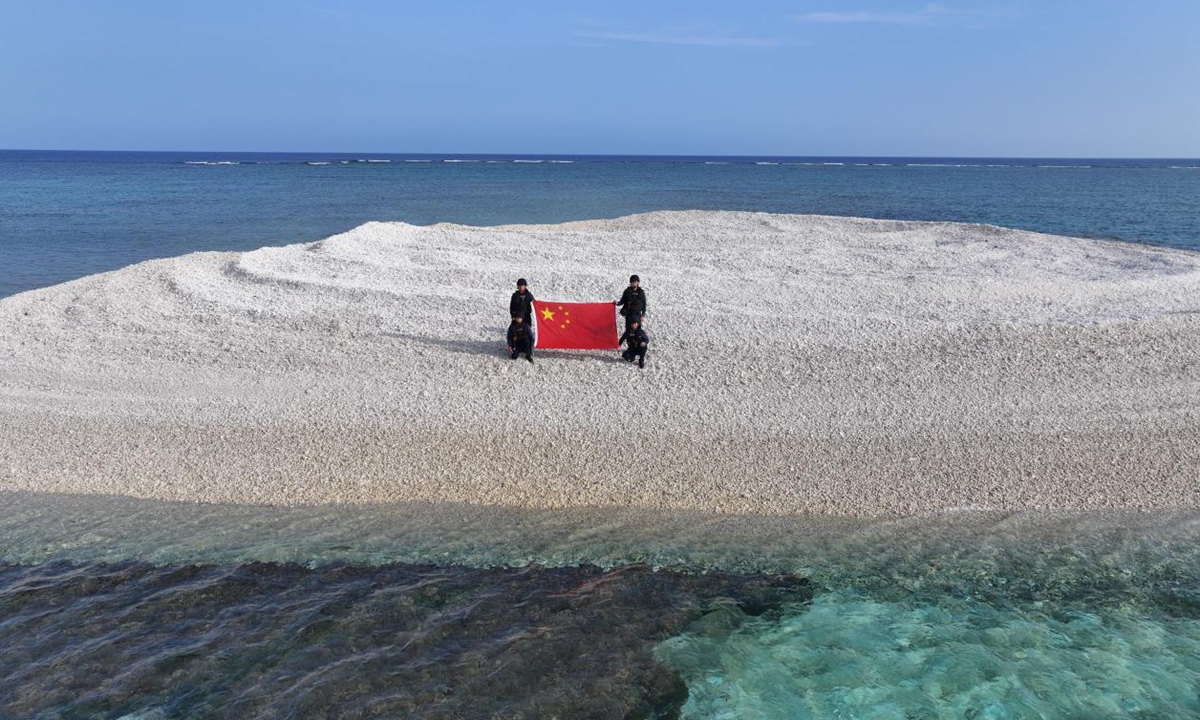
Photo: China Coast Guard displays the Chinese national flag at Tiexian Jiao in the South China Sea.
Recently, Jay Tarriela, spokesperson for the Philippine Coast Guard, took to the social media to hype up China's normal scientific research activities at Tiexian Jiao in the Nansha Qundao, claiming that Chinese research vessels had entered the territorial waters of Zhongye Dao "without the legal authority" to conduct marine surveys and collect deep-sea data.However, the Philippines side has no standing to make irresponsible remarks about China's routine scientific expeditions, nor should it ignore historical facts and international law.
China's scientific research activities at Tiexian Jiao fall entirely within the scope of its sovereignty. Both Tiexian Jiao and Zhongye Dao are China's inalienable territory in the South China Sea, over which China enjoys sovereignty and maritime jurisdiction.
Historically, China was the first country to discover, name, develop, exploit and continuously exercise jurisdiction over the South China Sea islands, including Tiexian Jiao and Zhongye Dao.
Since World War I, in the face of aggression by colonial powers, the Chinese government has conducted effective diplomatic negotiations and administrative actions with the force of international law.
Under international law, the Philippines has no basis to claim Tiexian Jiao or Zhongye Dao simply because they are allegedly located "within the Philippines' exclusive economic zone."
Tarriela's remarks not only violate the international law, but also constitute a blatant infringement upon China's territorial sovereignty over the Nansha Qundao. His purpose is merely to confuse public opinion, distort facts, manipulate international narratives, smear China and mislead the international community through information asymmetry.
Notably, the Philippine government has neither clarified nor distanced itself from Tarriela's statements. This suggests that, as a spokesperson, his remarks can be regarded as reflecting the position of the Philippine government.
Over the past few years, the Philippines has repeatedly organized "civilian group" and coast guard personnel to land illegally on Tiexian Jiao, and has supported fishermen in establishing temporary shelters there. In May this year, a "civilian group" from the Philippines landed on Tiexian Jiao. Manila's aim is obvious: to repeat its old tactics and illegally occupy Tiexian Jiao.
The Philippines is attempting to use "gray zone" tactics to assert illegal claims over Tiexian Jiao and push forward territorial expansion. Such actions have damaged the ecological environment of Tiexian Jiao and its adjacent waters while further escalating maritime tensions.
Scientific surveys have found severe degradation of coral reef systems of Tiexian Jiao, along with microplastics and various forms of garbage discarded by Philippine fishermen on the sandbars.
The Philippine government has mobilized coast guard personnel, fishermen and researchers to illegally land on the reef without authorization, which has further created new frictions between China and the Philippines.
China's scientific research activities at Tiexian Jiao are both an exercise of sovereignty over the reef in accordance with international law and a fulfillment of its international obligations.
As a coastal state in the South China Sea, China has both the responsibility and the duty to take measures to protect the ecological environment of Tiexian Jiao and the surrounding waters. It has also long been committed to promoting the establishment of regional cooperative mechanisms for environmental governance in the South China Sea.
China has consistently worked to maintain peace and stability in the South China Sea and to minimize the spillover of maritime disputes into bilateral relations.
From Ren'ai Jiao to Tiexian Jiao, Houteng Jiao, Xianbin Jiao and Huangyan Dao, China has exercised restraint, adhered to resolving differences through negotiation and consultation, and advocated for pragmatic dialogue and cooperation.
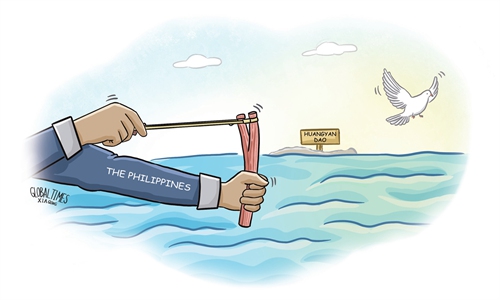
However, the Philippines continues to pursue an expansionist policy, devising various schemes to occupy new islands and consolidate its illegal occupation of islands and reefs.
Recently, the Philippines has also initiated the construction of a shelter harbor on Mahuan Dao and plans to extend the airport runway on Zhongye Dao to facilitate the deployment of naval vessels and military aircraft.
As this year's rotating chair of ASEAN, the Philippines should play a leading role in maintaining regional stability and managing disputes in the South China Sea. Even if figures like Jay Tarriela represent a minority of extreme voices, the Marcos administration should not ignore the fact that the South China Sea is a shared home of coastal states, and it should earnestly fulfill the responsibilities and obligations conferred by international law.
The author is a research fellow at the National Institute for South China Sea Studies. opinion@globaltimes.com.cn
RELATED ARTICLES